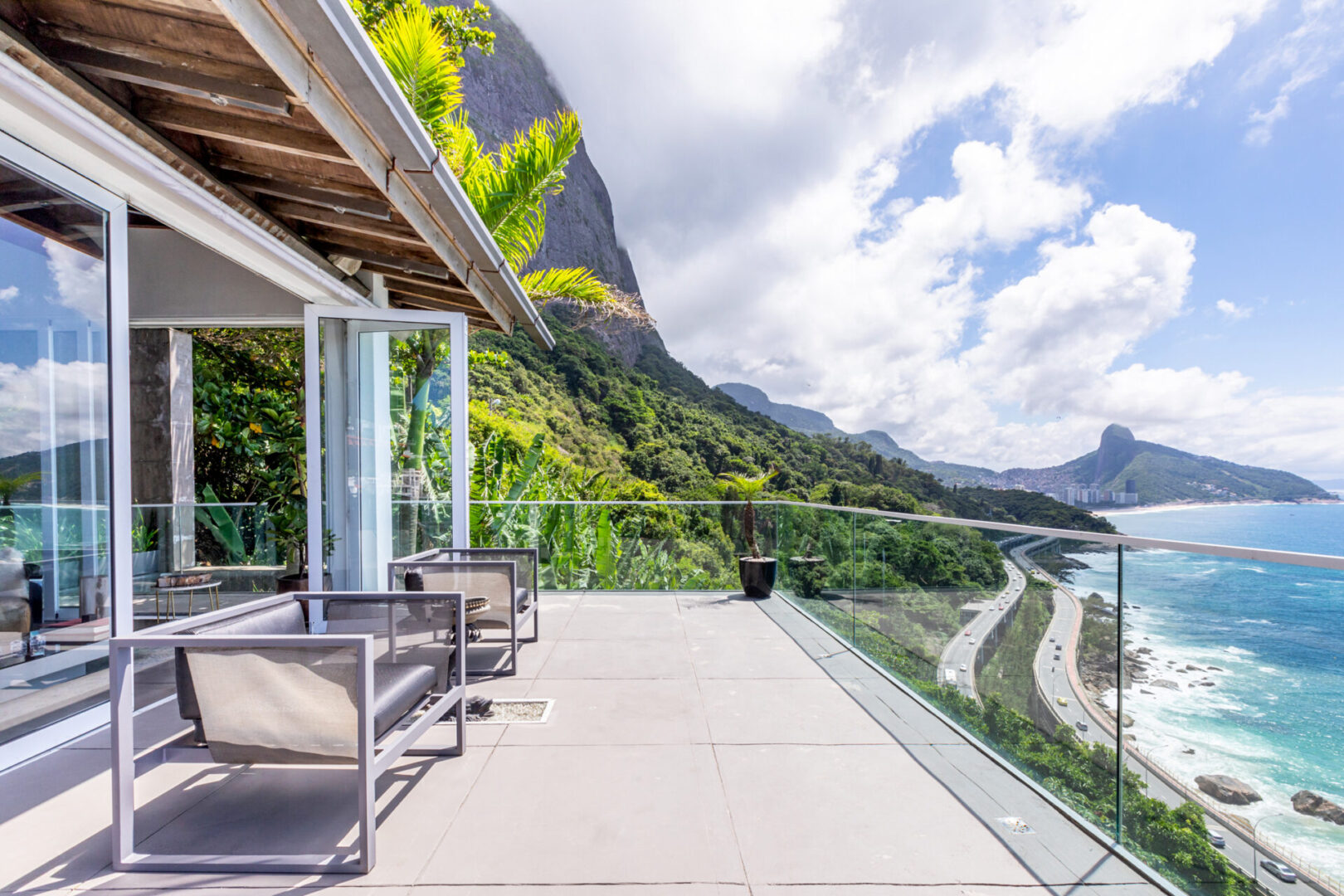
Most of the money in Rio de Janeiro's luxury market changes hands for apartments. The famous addresses, Leblon and Ipanema, are buildings by the sea, and the city's price records are kept per square metre of flat. A buyer who wants a house, with its own ground, its own pool and its own gate, is shopping in a smaller and very different market, spread across a handful of neighborhoods that rarely appear on the same list. This guide walks through them one by one: what kind of homes each one actually has, what the published market figures say about price, how far each sits from the beaches and the international schools, and what you give up to live there.
Joá Rio is published from ADV101, a five-suite villa in Joá offered at R$ 15,000,000, shown privately by appointment through Art de Vivre.
Ask about a viewing on WhatsAppA house or an apartment: the decision that comes first
In most cities the choice between a house and an apartment is a matter of taste. In Rio it largely decides where you will live. The flat, walkable beach neighborhoods of the Zona Sul were built up in apartment buildings, and the market data describe them that way. A Loft survey of about 28,000 active listings in October 2025, reported by Diário do Rio, gave the average listed home in Leblon as 139 square metres with a monthly condominium fee of R$ 2,000, and in Ipanema as 142 square metres with a fee of R$ 2,106. Those are the numbers of buildings with doormen and shared lifts, not of houses on their own plots.
Houses cluster elsewhere: on the slopes and cliffs of the western coast, in the gated condominiums of Barra da Tijuca, and in a few green, hilly neighborhoods where the land, the forest or the zoning rules keep the buildings low. That geography is the real map of this guide. If a house is what you want, your shortlist is shorter than the list of Rio's well-known addresses, and it looks different.
The second thing the choice decides is how prices are measured. Apartment neighborhoods are compared by price per square metre, and on that measure Leblon and Ipanema lead the country. House neighborhoods are better compared by the total price of the home, because a house on a large plot carries land, garden and outdoor space that a per-metre figure does not capture. Keeping those two measures apart avoids most of the confusion in what is written about this market. Our comparison of Joá with Leblon and Ipanema works through that difference in detail.
How to read the price figures in this guide
Every price below comes from a published market study, and most of those studies measure asking prices, not sales. Loft, the property company whose data the Brazilian press quotes most often, builds its neighborhood rankings from listings on the main property portals. Its December 2025 study, published on its Portas site, analysed about 450,000 active listings from August to October 2025 and included only neighborhoods with at least 20 homes listed. Its April 2026 ranking of price per square metre in Rio drew on more than 91,000 sale listings, and Portas states plainly that the figures do not represent prices actually paid.
The FipeZAP index, run by the Fipe foundation with Grupo OLX, is the other figure you will see. It also works from advertised prices and covers residential sales in 56 Brazilian cities. In December 2025 it put Leblon at R$ 25,717 per square metre and Ipanema at R$ 25,302, first and second in Brazil, ahead of every São Paulo neighborhood (Forbes Brasil, January 2026).
Two cautions follow. First, studies taken in different months, from different samples, will disagree, sometimes by a lot, and this guide gives the date with every number so you can see which is which. Second, at the top of the house market, where only a few homes trade each year, an average of asking prices tells you about the shape of the market rather than what a particular house will sell for. A broker who knows the recent sales in a specific condominium is worth more than any index. The full sequence of a purchase, from offer to deed, is in our step-by-step guide to buying property in Rio, and the taxes and fees on top of the price are in what it costs to buy property in Rio.
Joá
Joá is the neighborhood on the headland between São Conrado and Barra da Tijuca, reached by the Estrada do Joá and crossed overhead by the Elevado do Joá. Its homes are houses: set into the cliff and the forest, most of them inside gated condominiums within what is otherwise an open, public bairro. There are no apartment buildings to speak of and no commerce.
On price, the published studies agree that Joá leads Rio for houses. Loft's December 2025 study put the average asking price of homes above 125 square metres in Joá at R$ 9,735,045, against R$ 6,193,263 in Leblon and R$ 5,535,860 in Ipanema, the top three in that Rio ranking. An earlier Loft cut, for August 2025 and reported by Diário do Rio in October 2025, gave Joá an average of R$ 10.6 million at R$ 15,948 per square metre. Divide one figure by the other and the typical Joá home in that sample comes out at roughly 665 square metres, against roughly 205 to 210 square metres for the large homes listed in Leblon and Ipanema the same month. Joá leads on the total price of a house; it does not lead on the price of a metre, and it does not appear in the per-metre rankings at all, because it has too few apartments to rank.
What you get: large houses on large plots, privacy that the terrain provides before any gate does, and wide ocean views over the Atlantic and toward the Pedra da Gávea. What you give up: walking to anything. Shops, restaurants and the open beach are a drive away, in São Conrado to the east or Barra to the west, and the elevated road and its tunnels are the only way in and out. The neighborhood's beach, Praia da Joatinga, is small and is reached on foot through a condominium. Because the market is small, a sale can take time, and asking prices at the top can sit well above what eventually changes hands. Our guides to buying in Joá and to its gated condominiums go further into how this market and its condominiums work.
São Conrado
São Conrado is the valley just east of Joá, between the Pedra da Gávea and the Dois Irmãos, with a long open beach, a golf club and an upscale mall. Its housing is mixed. Portas, describing the city's upscale neighborhoods in November 2025, summed it up as elegant residential buildings and mansions on the slopes: apartments along the beach and the valley floor, houses on the hillsides above.
Its prices sit well below the beach neighborhoods further east. Loft's April 2026 listing data put São Conrado at R$ 11,051 per square metre, twelfth in the city, and Portas gave an average listed home of R$ 3,383,317 from Loft data for July 2025. For a house buyer, those averages blend apartments with the hillside homes, so the price of a house there has to be read listing by listing.
What you get: a real neighborhood beach, the golf club, the mall and hotels a few minutes away, and the same mountain scenery as Joá. What you give up: some of Joá's seclusion, and the valley has a busier, more mixed character than the cliff next door. Our guide to São Conrado covers the neighborhood in full.
Barra da Tijuca: Jardim Oceânico and the gated condominiums
Barra da Tijuca is the large, flat district west of Joá, and it is the one part of Rio where a house buyer has real choice. Portas describes it as offering many options in both apartments and houses. It is also the biggest market of the upscale neighborhoods by volume: the October 2025 Loft survey counted 7,161 homes listed there, against 3,146 in Leblon, with an average listed home of 198 square metres at R$ 2.80 million and an average condominium fee of R$ 1,890. In April 2026 Loft's listing data put Barra at R$ 14,813 per square metre, sixth in the city.
Two parts of Barra matter most for a house buyer. The first is Jardim Oceânico, at the eastern end of the district nearest Joá. Height rules there allow only low-rise buildings with rare exceptions; it has about 30,000 residents in roughly 1,500 buildings and houses, and its leafy grid of streets is often described as the part of Barra most like the Zona Sul. Since July 2016 it has had Barra's first metro station, on Line 4. Avenida Olegário Maciel has become a dining street that draws people from across the city.
The second is the gated condominiums: walled residential communities, many of them made up of houses rather than apartment towers, with their own security, internal roads and shared amenities. They vary enormously in age, size, management and fee, and the only way to compare them is one by one. Our guide to Barra da Tijuca covers how the district grew and how life inside its condominiums works.
What you get: space, newer construction, the widest choice of houses in the city, a long open beach, large malls, and several international schools on the doorstep. What you give up: time in traffic, and the street life of the older neighborhoods. The international schools guide iSchoolAdvisor, in its October 2026 guide for families, notes that the drive from Botafogo to Barra can take about 30 minutes on a quiet Sunday and well over an hour at rush hour, through tunnels and along the Elevado do Joá, and that Barra suits families who want space and are happy to drive.
Itanhangá
Itanhangá lies behind Barra, between the Lagoa da Tijuca and the Tijuca massif, bordering Jacarepaguá to the north and Alto da Boa Vista and São Conrado to the east. Administratively it belongs to the Barra region. It is one of the few neighborhoods in that region where most homes are houses rather than apartments, and the Portuguese Wikipedia entry for the bairro records that municipal law currently prohibits new apartment construction there. The Itanhangá Golf Club and the Marina Barra Clube on the lagoon are its best-known addresses.
None of the market studies used in this guide publishes a price figure for Itanhangá, so we give none. What can be said is what shapes the market. It is a neighborhood of houses close to Barra's schools and services, quieter and greener than the district below it. It is also more varied: within its boundaries are several informal communities, among them Muzema, Tijuquinha and part of Rio das Pedras. Conditions change from one street to the next, and a buyer should look at each house in its immediate surroundings, ideally with a broker who works the area.
Alto da Boa Vista
Alto da Boa Vista sits on top of the Tijuca massif, at an average of about 300 metres above sea level, and much of it lies inside the Parque Nacional da Tijuca. Strictly it belongs to the Zona Norte and the Tijuca administrative region, but it is reached from the south too: by the Estrada das Canoas and the Estrada da Gávea Pequena from São Conrado, and by the Estrada do Horto from Jardim Botânico. Its homes are large houses, country properties known as chácaras, and old mansions. The zoning now allows new construction only on plots of at least 10,000 square metres, which keeps it very low in density.
The altitude changes the climate. Alto da Boa Vista has the lowest temperatures in the city in every season, and it is wet: the Wikipedia entry for the bairro cites a one-day rainfall record of 327.2 millimetres, set in March 1998. The same entry notes that many wealthy residents left in the 1980s and 1990s, and that some large houses stood empty or were turned over to events. We found no published price index for the neighborhood.
What you get: forest, cool air, big plots and real quiet, inside the city limits. What you give up: the sea at your door and quick access to the beaches, damp that a house has to be built and kept for, and a mixed stock in which some older properties need a great deal of work. It suits a buyer who wants a country house in the city more than a beach house.
Gávea, Jardim Botânico and Lagoa
These three neighborhoods surround the Lagoa Rodrigo de Freitas and the Botanical Garden, between the beaches and the forest. They are the green, residential heart of the Zona Sul, close to Leblon and Ipanema but quieter, The market figures for all three are dominated by apartments; a house here is the exception, and a buyer has to look listing by listing.
Lagoa is the most expensive of the three per square metre: R$ 18,035 in Loft's April 2026 listing data, third in the city after Leblon and Ipanema. The October 2025 Loft survey gave it the highest average condominium fee of the upscale neighborhoods, R$ 2,400 a month, on an average listed home of 166 square metres priced at R$ 3.02 million: the figures of large apartments around the lake.
Jardim Botânico was at R$ 13,716 per square metre in April 2026, and Portas gave an average listed home of R$ 2,628,823 for July 2025, describing the neighborhood as green, calm and family-minded. Gávea was at R$ 12,537 per square metre in April 2026; the October 2025 survey gave an average listed home of 197 square metres at R$ 2.66 million, and Portas describes it as very residential, with quiet, tree-lined streets.
For families, Gávea has a particular draw: the Escola Americana do Rio de Janeiro has been on the Estrada da Gávea since 1971. iSchoolAdvisor's caution is worth repeating: the Estrada da Gávea climbs steeply, drop-off traffic is heavy, and families should try the journey at 7am before committing to a home that depends on it.
What you get: the Zona Sul's schools, restaurants and the lagoon within reach, with more green and less noise than the beachfront. What you give up: houses are a small part of a market built mostly of apartments, so choice is limited, and gardens and plots are usually smaller than in Joá, Barra or Itanhangá.
Leblon and Ipanema
Leblon and Ipanema are the most valuable residential addresses in Brazil by price per square metre. Loft's April 2026 listing data put Leblon at R$ 28,232 and Ipanema at R$ 26,315, first and second in Rio, and the FipeZAP index for December 2025 ranked them first and second in the country. Portas describes Ipanema as a neighborhood known for its apartments with fine views, and the condominium fee data from Loft tell the same story for both: in September 2025 Loft reported the highest condominium fees per square metre in its national sample in Leblon, R$ 15.24, and Ipanema, R$ 15.20, as reported by Diário do Rio.
For a buyer set on a house, these two neighborhoods are mostly a reference point rather than a market. The large homes listed there in August 2025 averaged R$ 5.9 million in Leblon and R$ 5.4 million in Ipanema, at more than R$ 26,000 a square metre, for roughly 205 to 210 square metres: the price of a big apartment by the sea, not of a house with land. What they offer is something no house neighborhood can: the beach at the end of the street, a walkable grid of shops and restaurants, the metro, and the deepest, most liquid market in the city when the time comes to sell.
Santa Teresa
Santa Teresa is the outlier on this list, and it is here for buyers who want an old house with character rather than a modern one with a pool on the sea. It sits on a hill between the Zona Sul and the city centre, bordering Lapa, Glória, Catete and Laranjeiras, with views over both. Its stock includes large nineteenth and early twentieth-century houses and mansions, many of them in a French-influenced style, built up to the 1940s. Its tram, running since 1872 and the last in the city still used as transport, was suspended after a fatal accident in 2011 and returned in December 2015 with a new fleet. The neighborhood has a long artistic and bohemian tradition, centred on the Largo dos Guimarães.
We found no published average for houses in Santa Teresa, so we give no price figure. What drives value there is the condition of the building, the view and the street: historic houses can need heavy restoration, and a buyer should budget and survey accordingly. It is a long way, in traffic terms, from the western beaches and from Barra's schools, and close to the centre.
Schools and the daily drive
For a family, the choice of house and the choice of school are one decision. The international schools are split between two zones, and the distance between them is measured in tunnels and traffic.
- Zona Sul: the Escola Americana do Rio de Janeiro in Gávea; the British School's Botafogo and Urca sites; and Our Lady of Mercy in Botafogo, according to iSchoolAdvisor's 2026 guide.
- Barra da Tijuca: the British School's Barra unit, SIS Swiss International School and Rio International School, per the same guide, and the Escola Americana's Barra campus, which the school opened in 2006 and moved to new premises in 2014.
Joá sits between the two, which is part of its practical appeal: Barra's schools are to the west along the Elevado, and Gávea's to the east through São Conrado. Itanhangá and Barra's condominiums are closest to the Barra campuses. Gávea, Jardim Botânico and Lagoa are closest to the Zona Sul schools. iSchoolAdvisor's advice, to keep the daily school run within one zone where possible, is the most useful single rule for a family choosing among these neighborhoods.
Choosing among them
Set side by side, the neighborhoods sort into a few clear trades.
- For a large house on the ocean, with privacy: Joá, and the hillsides of São Conrado. Highest total prices, fewest homes, longest to sell, car for everything.
- For space, choice and newer houses near schools: Barra da Tijuca's gated condominiums and Jardim Oceânico, and Itanhangá behind them. More choice, lower prices per metre, more traffic.
- For forest and a big plot inside the city: Alto da Boa Vista. Cool, quiet and low-density; far from the sea and damp.
- For the Zona Sul with some green: Gávea, Jardim Botânico and Lagoa. Excellent location, but houses are scarce in markets built mostly of apartments.
- For the beach on foot: Leblon and Ipanema, which in practice means a large apartment rather than a house.
- For history and character: Santa Teresa, with the restoration work that comes with it.
Whichever you lean toward, the purchase itself runs the same way. Foreign buyers need a CPF and usually a Brazilian bank account first, covered in our guide to the CPF and bank account; some will want to look at residency through real estate; and every buyer needs the document checks in property due diligence in Brazil. A house also costs more to keep than an apartment, and that should be part of the comparison from the start: the yearly taxes are set out in property taxes for owners in Rio, and the rest, from the condominium fee to the pool, in what it takes to run a house in Rio.
This site presents one house in Joá: ADV101, five suites and about 800 square metres on a 2,000 square-metre plot on the cliff, with an infinity pool, inside a gated condominium with 24-hour security, offered at R$ 15,000,000. It is set out in full on The House. It is marketed by the brokerage Art de Vivre, whose brokers can arrange a viewing and answer questions about it; you can reach them through our contact page or directly at artdevivre.com.br.