People who write about Joá reach, almost without exception, for the same word: private. It appears in the property listings and in the celebrity round-ups, in the drone-shot captions and in the quiet asides of neighbors who have lived here for forty years. But the word is doing more work than it lets on. Privacy in most of Rio is a thing you buy — a wall, a gate, a guard, a floor high enough that no one can see in. Privacy in Joá is a thing the land already had, before the first house was poured. That is the distinction this page is about. The famous do not choose Joá because it is guarded. They choose it because the mountain does most of the guarding for them.
Joá Rio is published from ADV101, a five-suite villa in Joá offered at R$ 15,000,000, shown privately by appointment through Art de Vivre.
Ask about a viewing on WhatsAppWhat follows is an honest accounting of why that is so — the geography, the access, the gated-condominium model, the discretion culture that keeps addresses out of the press — and a plainspoken note, at the end, on security in Rio generally and why the enclave answer appeals to the kind of buyer who ends up here. There are no addresses on this page and no private details, for the obvious reason and for a subtler one: the very thing that makes Joá worth writing about is that its residents are not on display. We can explain the neighborhood without exposing the people. That is, in a sense, the whole point of the place.
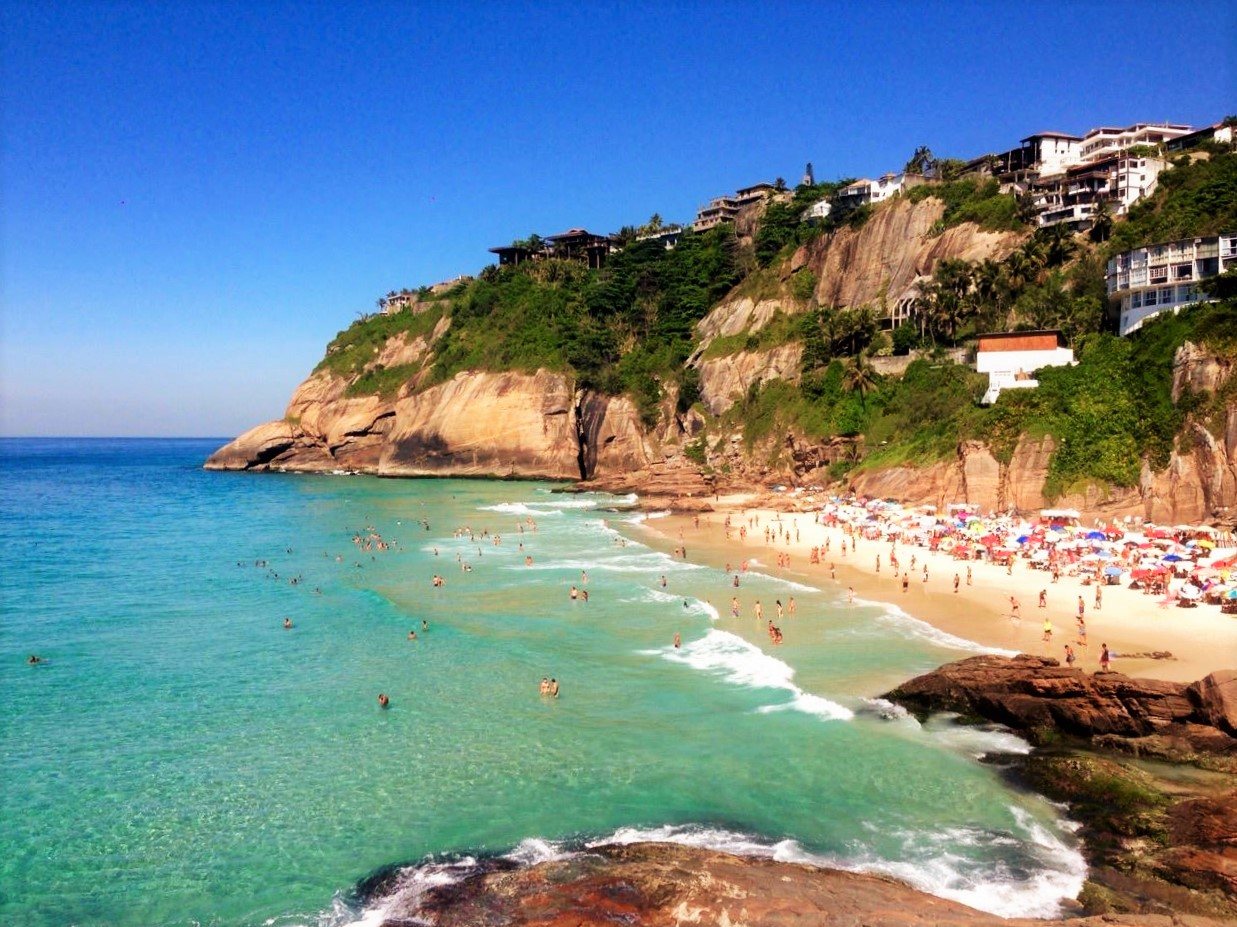
The privacy is geological before it is anything else
Start with the shape of the ground, because everything else follows from it. Joá is draped over the flank of the Morro da Joatinga, at the southern edge of the Tijuca massif, where the coast of Rio finally gives out against the Pedra da Gávea and turns to sheer rock. On three of its four sides the neighborhood is closed by things that cannot be developed, sold, or walked through. Behind the houses rises the protected Atlantic Forest of the Tijuca National Park and its buffer of mata — a wall of green that will not be built on because the law forbids it. Below the houses, in most of the neighborhood, the land does not slope so much as fall: cliffs drop to the ocean, and the ocean is the last neighbor. There is no plot on the far side of it.
This is worth dwelling on, because it inverts the usual logic of a rich address. In Leblon or Ipanema, privacy is subtracted from a dense grid — you carve out a private volume from a place that is otherwise entirely public, and the carving is expensive and never quite complete. In Joá the default is the opposite. The land arrives already sealed on the sides that matter, and the only thing a house has to manage is the one edge that faces the road. A property here does not have to manufacture seclusion against the grain of the city. It inherits seclusion and then, at most, tidies the last gap. The forest closes the plots from behind; the cliffs and the sea close them from below. What is left to guard is a fraction of what a beachfront apartment must guard, and it is guarded more easily.
There is a second consequence, less obvious. Because the boundaries are made of national park and open ocean, they are permanent in a way that fences are not. A wall can be overlooked by a taller building next door; a hedge can be cut; a view can be lost when the empty lot across the street is finally sold. In Joá the empty lot across the street is a granite mountain inside a conservation unit. It is never going to be sold, and nothing is ever going to be built on it. The privacy is not just structural — it is durable. A buyer is paying, in part, for a guarantee that no one can renege on, because the guarantor is the topography.
A single way in, and no reason to pass through
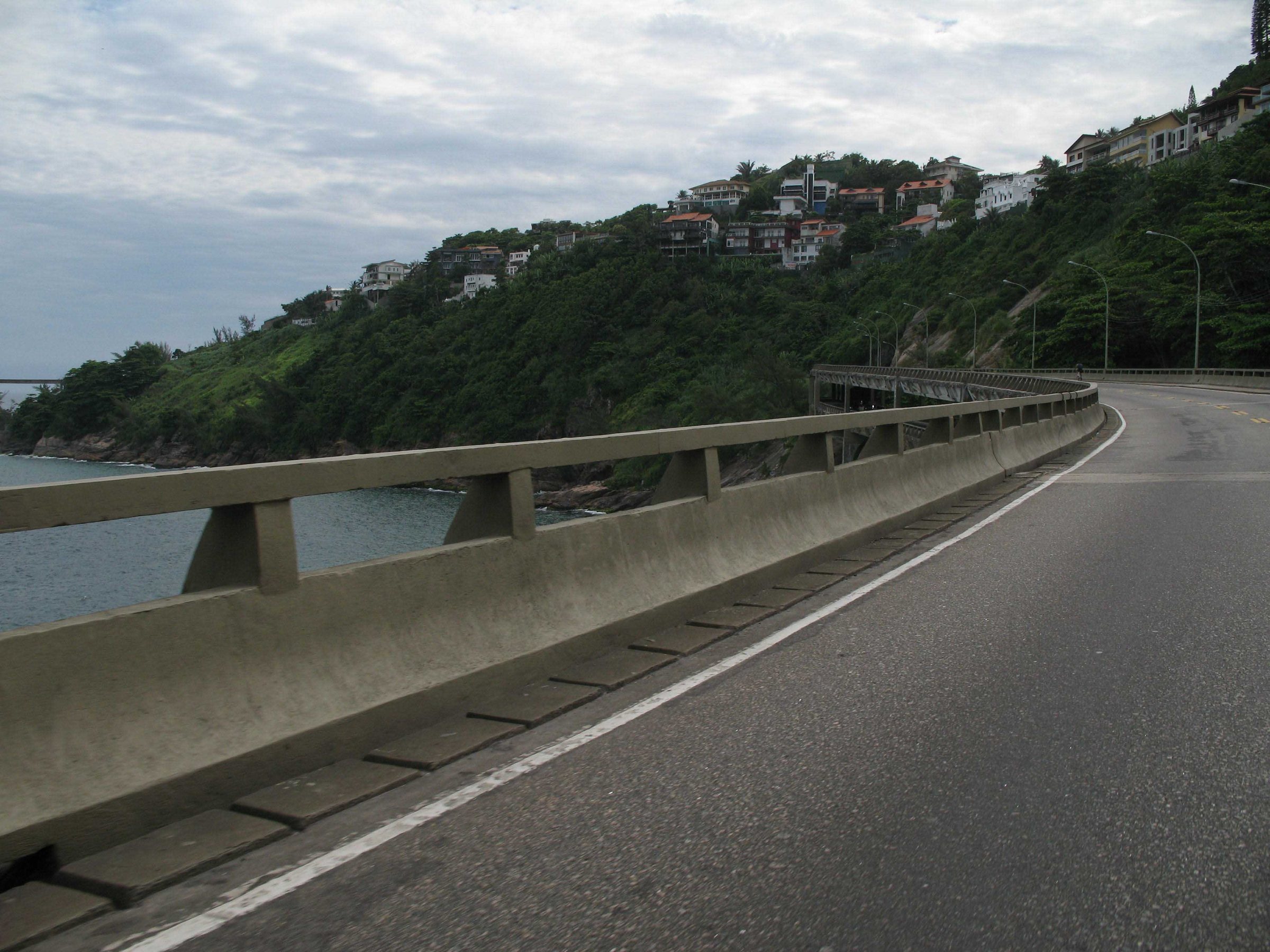
The fourth side — the one that faces the city — is where privacy becomes a matter of design rather than geology, and here Joá is almost aggressively simple. There is essentially one way in and out by land: the Estrada do Joá, the sinuous road that peels off the coast highway and climbs the hill, branching as it goes into the private lanes that serve the condominiums. There is no grid to get lost in and no alternate route to discover. If you are on the hill, you came up the one road, and you can be accounted for.
What makes this powerful is not the single road by itself but the fact that the road leads nowhere except to the houses. Joá has no commerce — no shops, no restaurants strung along a strip, no market, no bank branch, no reason for a stranger to run an errand here. It has no through-traffic, because it is not on the way to anywhere; the coast highway carries the traffic bound for Barra or São Conrado out over the rock on the elevated road, above and past the neighborhood, so the cars that would otherwise thread through simply never enter. And it has no internal bus line. A city bus does not run up the Estrada do Joá, which means the informal foot traffic that a bus stop generates — the people waiting, passing, lingering — does not exist here either.
Add those absences together and you arrive at the quiet secret of the place: in Joá, an outsider has no errand. There is nothing to buy, nowhere to eat, no bus to catch, no shortcut to take. A person on the hill who does not live on the hill is, almost by definition, there on purpose — and a place where every visitor is there on purpose is a place that is very easy to keep an eye on. The neighborhood does not have to filter a crowd. There is no crowd to filter. This is the opposite of a beach neighborhood, where the entire economy depends on drawing as many anonymous strangers as possible to the sand, and where a resident's front door opens onto that flow whether they like it or not.
It is worth naming the trade this arrangement asks of a resident, because it is real. A life in Joá is not a life you walk out into. There is no corner café to drift down to, no bakery at the end of the block, no evening promenade among neighbors; the daily texture of a dense neighborhood — the small, spontaneous public life of running into people — is simply not available on the hill. The car is not a convenience here but a precondition, and the neighborhood's emptiness, which is the whole of its privacy, is also the whole of its quietness. The people who choose Joá have looked at that trade squarely and decided in favor of the silence. For a public figure whose days are already saturated with other people, the absence that a first-time visitor might find disconcerting is exactly the thing being purchased. The hill is not sociable, and that is the point of it.
Fewer than a thousand neighbors
The numbers make the point better than adjectives can. Joá is the smallest neighborhood in the city, and by the 2022 census it was home to just 983 residents across its square kilometre and a half of hillside. That is not a figure of speech about exclusivity; it is a literal population smaller than a single apartment tower in Copacabana. The whole neighborhood — every house, every family, every long-term resident — would not fill a mid-sized school.
Low numbers do a specific kind of security work that is easy to underrate. In a place of fewer than a thousand people, unfamiliarity is legible. The gate staff and the private patrols are not scanning a river of faces for the one that doesn't belong; they are watching a village where the cars, the domestic staff, the delivery routines and the regular faces are known, and where a vehicle that has never been seen before is conspicuous precisely because everything else is familiar. Criminologists call this natural surveillance, and it is usually something planners try, and mostly fail, to engineer into new developments. Joá has it by accident of scale. There are simply not enough people, or enough movement, for a stranger to hide in the flow.
The same scarcity shows up in the economics, which is another way of measuring how tightly held the ground is. On the income component of the human development index, the census tract encompassing Joá and its immediate neighbors has registered the highest per-capita income in the entire city, scoring at the very top of the scale. A neighborhood does not reach that position by being large and average; it reaches it by being small and uniform — a short list of substantial households and almost nothing else. The absence of a mixed street life, of the shops and stops and crowds that make other rich neighborhoods porous, is the same absence that keeps the population tiny and the ground expensive. Privacy, scale, and price are not three features of Joá. They are one feature described three ways.
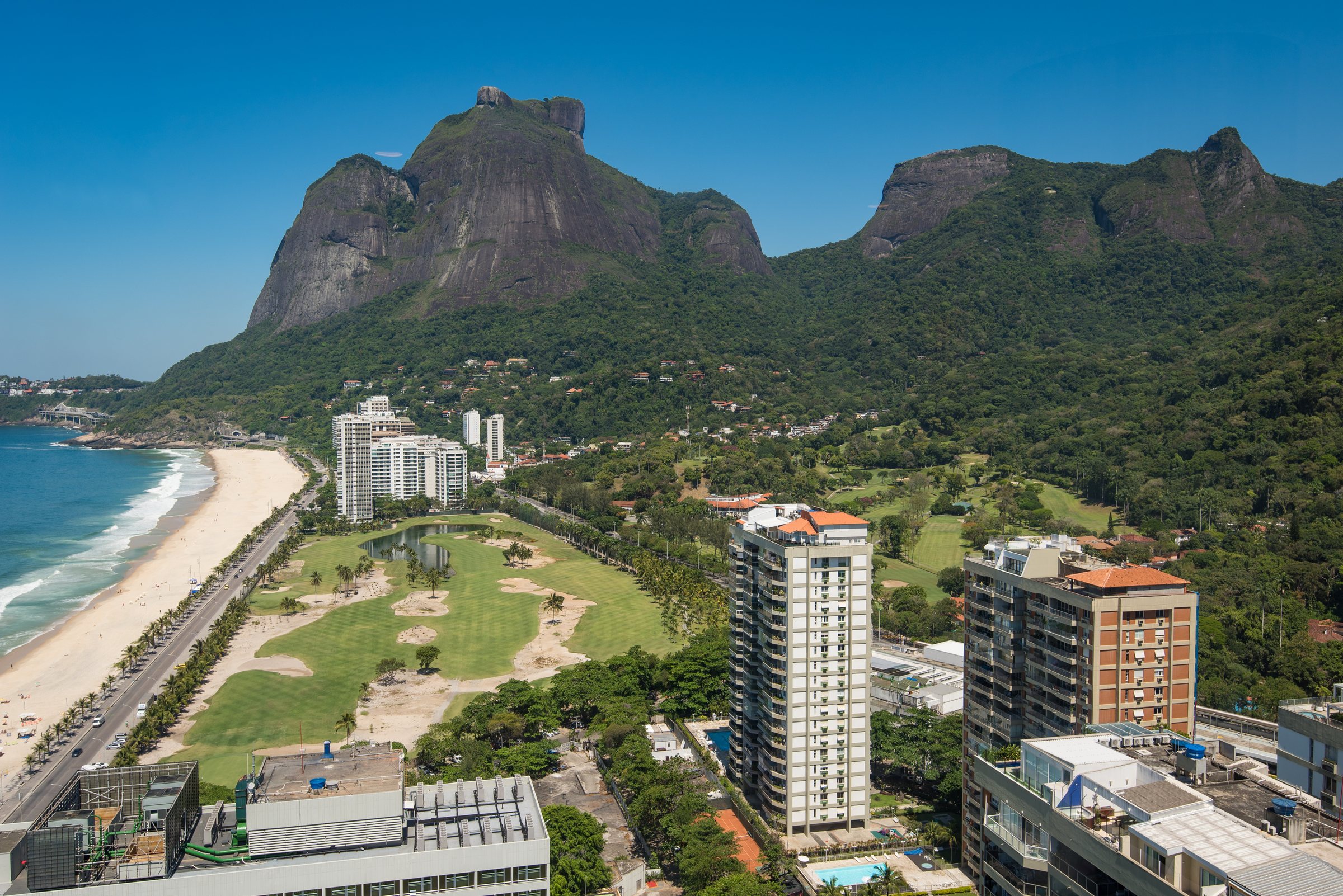
A wall that will never be sold.
Above the houses stands the Pedra da Gávea and the protected forest of the Tijuca massif — a boundary made of national park. It cannot be built on, overlooked, or developed away. For a resident it is the rarest thing a rich address can offer: a neighbor that is permanent, silent, and green.
Inside the condominiums →The gated-condominium model
Joá is often described, loosely, as a gated community, and it is worth being precise about what that does and doesn't mean, because the reality is the more interesting version. Joá is an open bairro — a legal neighborhood of the city of Rio de Janeiro, with public roads and public status like any other. The Estrada do Joá is a public street; you may drive it. What is closed is almost everything that branches off it. With the exception of the main Estrada do Joá and a short public stretch, the lanes that lead to the houses are private ways, gated at their mouths, each condominium sealed behind its own portaria — a manned gatehouse — with a barrier, a register of who comes and goes, and its own private security.
This is the model that actually delivers the privacy, and it is a layered one. The outer layer is the geography and the single approach already described. The middle layer is the condominium gate: to reach a house you must be admitted at a portaria, announced, expected, logged. The inner layer is the house itself, set back inside walls and planting on its own plot. A visitor who has no business on the hill is stopped at the first layer by the simple absence of anywhere to go; a visitor who makes it onto the Estrada do Joá is stopped at the second by the gatehouse; and a resident's front door sits behind a third. It is not one wall but a sequence of them, and each is doing a different job — the first filters intent, the second filters admission, the third filters arrival.
The staffing is correspondingly quiet and constant rather than dramatic. The portaria is the visible edge of it — a gate, a guard, a barrier arm, cameras trained on the approach and the lane. Behind that sit the ordinary instruments of a residential condominium anywhere: closed-circuit monitoring, controlled access for staff and deliveries, a private patrol that knows the regulars, and a public-police presence on the main road that residents describe as routine. None of it is theatrical. There are no visible fortifications, no spectacle of security — the effect is meant to be an absence, a hill that feels empty and calm, with the machinery kept at the edges. That understatement is itself part of the appeal. The point of the enclave is not to look defended. It is to feel like nothing is happening at all.
Houses you cannot see
There is a further layer that no gate provides, and it is perhaps the most effective of all: you cannot see the houses. The topography that seals the neighborhood from the outside also hides its interiors from one another and from the road. Joá is built on a slope, in a scatter of terraces at different heights, folded around ridges and gullies and screened by the same Atlantic Forest that closes the plots from behind. Drive the Estrada do Joá and, for long stretches, you would not know a great house was there at all. The gates give onto lanes that vanish into greenery; the houses sit below the road, or above it, or around a shoulder of rock, angled at the sea and away from the eye of the passer-by.
This matters more than it may seem, because so much of the exposure that wealthy people fear is casual rather than criminal — the photograph taken from the pavement, the drone hovering over the pool, the sightline from the balcony next door, the simple fact of being looked at in the course of an ordinary day. In a dense neighborhood those sightlines are unavoidable; a tall building somewhere always overlooks a garden somewhere. In Joá the sightlines mostly do not exist. Houses do not stack. There are no towers with windows angled down into the terraces, because there are no towers — the neighborhood has none. Neighbors are separated not by a party wall but by a fold of forested hillside, so that even the people who live closest to one another rarely have a clear line of sight between their homes.
The result is a kind of visual quiet that is hard to buy anywhere else in Rio. A resident can sit by the pool without being visible from a road, a building, or the house next door. That is the texture of privacy that the word usually fails to convey — not a locked gate, which anyone can picture, but the plain daily fact of not being seen. It is the reason a certain kind of very public person, whose face is on television every week, can live an unwatched life fifteen minutes from the studios. The cameras of their working life stop, quite literally, where the forest begins.
“The forest hides the houses from each other, and the road never sees them at all.”
The exposure of the beachfront, by comparison
To understand what Joá offers, it helps to hold it against the alternative that most of Rio's wealth has traditionally chosen: the beachfront apartment in the Zona Sul. The great addresses of Ipanema and Leblon are magnificent, and they are the opposite of private. A beachfront building faces, by definition, the most public space in the city — a strip of sand walked by tens of thousands of strangers a day, overlooked from a promenade, photographed from every angle, alive at all hours. The apartment's entire value is bound up in that exposure: you pay a fortune precisely to be on the beach, in the flow, at the center of things. Privacy is the tax you pay for the location, and no amount of money fully buys it back. The doorman controls the lobby, but the moment you step out, you step into Rio at its most crowded.
Joá is the same money spent on the reverse proposition. Instead of buying your way into the most public place in the city and then defending a private volume inside it, you buy your way onto a forested hill where the public simply is not — and the defending is largely done for you by the shape of the ground. The two are not better or worse; they are answers to different desires. The beachfront is for a life lived outward, in the swim of the city. Joá is for a life lived inward, behind the trees. It is telling that many Joá residents keep a foot in both worlds — an apartment in the Zona Sul for the public life, a house on the hill for the private one — and that when they want to disappear, it is the hill they go to. The beach is where you are seen; the hill is where you are not.
This is also why the price gap between the two runs the way it does. Joá regularly tops the city's tables for the most expensive large homes, above even Leblon on a per-property basis, according to market surveys of the most valued neighborhoods. The premium is not for square metres alone — plenty of neighborhoods offer space. It is for the one thing the beachfront cannot supply at any price: seclusion built into the site. You can always buy a bigger apartment. You cannot buy a bigger silence.
The discretion culture, and why the addresses stay hidden
There is a cultural layer on top of the physical one, and it is the reason a page like this exists at all. Brazilian outlets write about Joá constantly — the Beverly Hills carioca is one of the most durable clichés in the country's lifestyle press, and pieces on which celebrities live where appear several times a year. And yet almost none of that coverage carries an address. You will read that a famous host, a singer, an actor lives in Joá; you will very rarely read on which lane, behind which gate, in which house. The press names the neighborhood and stops at the portaria, and it does so by a kind of unwritten agreement that is worth understanding, because it is not an accident.
Part of it is structural, again. Even a journalist who wanted to print an address would struggle to confirm one, because the houses are behind gates, the ownership often sits inside companies rather than personal names, and the neighborhood offers no public vantage from which to verify who lives where. When there is no shop the person frequents, no doorway they are photographed entering from a public street, the ordinary machinery of celebrity address- hunting has nothing to grip. The same features that keep out an intruder keep out a reporter. The geography is a discretion policy that no one had to write down.
But part of it is genuinely cultural — a norm the neighborhood and the press both observe. Joá's whole proposition is that the people who live there are not watched, and a publication that violated that by printing a gate number would be biting the hand that feeds the entire Beverly Hills carioca genre. So the coverage settles into a stable compromise: the fame is reported, the glamour is described, the extraordinary houses are photographed when an owner chooses to open the doors — and the precise location stays vague. It is a rare instance of a press culture policing itself, and it works because everyone benefits: the outlets get their story, the residents keep their privacy, and the myth of the hidden hill is renewed rather than punctured. This site follows the same line, and for the same reasons. We can tell you who is reported to live in Joá; we will never tell you where.
An honest word about security in Rio
It would be dishonest to write about privacy and security in a Rio neighborhood without acknowledging the obvious: security is a real consideration in this city, as it is in most large cities, and it is one of the reasons the enclave model exists. But it is worth being careful and unsensational here, because the subject invites both exaggeration and fear-mongering, and neither serves a reader well. Rio is a vast and varied place; the lived experience of safety differs enormously from one neighborhood to the next, and blanket statements about the city are almost always wrong in one direction or the other. We are not going to quote crime figures for Joá, because reliable neighborhood-level statistics for a place of fewer than a thousand people are not meaningful, and inventing a sense of danger — or of perfect safety — would be a disservice.
What can be said honestly is this. Wealthy buyers in Rio, as in São Paulo and much of Latin America, have for decades gravitated toward the gated model — the condomínio fechado, the controlled-access enclave — not out of panic but out of a straightforward preference for controlled environments where access is managed and daily life is calm. It is the same instinct that produces gated communities the world over, from the United States to the Gulf: people with a great deal to lose tend to value predictability, and a managed perimeter delivers it. Joá is the purest expression of that preference that Rio has, because in Joá the perimeter is not a fence bolted onto a subdivision but the natural edge of a mountain, reinforced by gatehouses at the few points where the land is soft.
The value, framed honestly, is less about any single threat than about the quality of everyday life. A resident of Joá is buying a place where the routine frictions of a big, dense, unequal city are held at arm's length — where the street outside the gate is quiet, the faces are known, the traffic goes by overhead, and the machinery of access management runs in the background so that the foreground can be forest and sea. That is a genuine good, and it is worth paying for, and it does not require anyone to catastrophize about Rio to understand it. The enclave is not a bunker. It is a way of buying calm in a city that does not otherwise sell it cheaply.
It is also fair to note what the model does not claim. No perimeter makes a place immune to anything, and a serious buyer should evaluate Joá the way they would evaluate any address — on its own terms, with their own advisers, rather than on a slogan. What the neighborhood offers is not a promise but a structure: a set of layered filters, most of them natural, that make casual intrusion and casual observation far less likely than they are almost anywhere else in the city. That is a difference of degree, honestly stated, and it is enough. The families who have kept houses on this hill for generations did not come for a guarantee. They came for a hill that was hard to reach, hard to see into, and quiet at the end of the day — and they have found, decade after decade, that the geography keeps its side of the bargain better than any wall they could have built.
Why the buyer chooses the hill
Put all of it together and the appeal of Joá resolves into something coherent. A buyer here is not assembling privacy piece by piece the way one must in the Zona Sul — a wall here, a high floor there, a guard at the lobby. They are buying a site that arrives sealed: forest behind, cliff and ocean below, a single road in front, a gatehouse on the lane, and a house folded into the hillside where no road and no neighbor can see it. Each layer would be valuable on its own. Stacked, they produce a place that is genuinely difficult to observe, reach, or intrude upon by accident — and that difficulty is the product being sold.
It is also, not incidentally, a beautiful place to live, and the two are connected. The forest that hides the houses is the same forest that fills the windows; the cliffs that seal the plots are the same cliffs that hand every terrace a view of the open Atlantic. In Joá, the machinery of privacy and the source of the beauty are the same geography. You are not trading a view for seclusion or seclusion for a view. The mountain gives you both at once, and asks, in return, only that you accept a life a little removed from the crowd — which, for the people who choose this hill, was the entire idea. If you would like to understand how that life is lived day to day, our guide to Living in Joá takes up the practical side, and the neighborhood hub gathers the rest of the story. The house at the center of this collection — Art de Vivre's villa on the hill — was chosen for exactly the qualities described here, and the wider Art de Vivre collection is built around the same conviction: that the rarest luxury Rio has to offer is not a better view or a grander room, but the simple, durable privacy of a place the city cannot see into. For those weighing a stay or a purchase, the collection's own pages carry the properties in full.
The people this privacy is built for — the roster the press reports on the hill, and never quite locates — are the subject of the next page: Who Lives in Joá.