The first thing to understand about privacy in Joá is that the neighborhood itself is not private. It is a public bairro of the city of Rio de Janeiro, like Ipanema or Botafogo, with a name on the maps, a postal district, and a public road — the Estrada do Joá — running through the middle of it. Anyone may drive it. What is closed are the things built inside the open bairro: the gated condominiums, the condomínios fechados, each behind its own wall and its own gatehouse, that hold nearly every house on the hill. The gate you cannot pass is never the gate to Joá. It is the gate to a particular condominium within Joá. Getting that distinction right is the whole of understanding how the place actually works — and it is the difference between a buyer who knows what they are purchasing and one who finds out afterward.
Joá Rio is published from ADV101, a five-suite villa in Joá offered at R$ 15,000,000, shown privately by appointment through Art de Vivre.
Ask about a viewing on WhatsAppThis confusion is understandable, because in practice the two blur. So many of Joá's streets are gated that a visitor can drive its length and feel that the entire neighborhood is sealed. It is not. According to the local guides to the area, everything but the Estrada do Joá and a small number of access streets is closed off by heavy gates and controlled by private security, which is exactly why the whole hill reads as one great fortress from a car window. But legally, and in every way that matters to an owner, Joá is a patchwork: a public bairro whose land has been divided, over sixty years, into private closed communities that each govern themselves.

The open bairro and the closed condominiums
Start with the public part, because it is small and quickly described. The Estrada do Joá is the spine of the neighborhood, the coast road that runs from São Conrado to Barra da Tijuca across the headland. It is public. The Mirante do Joá, the free lookout on that road, is public. The beaches below the cliff are public — every one of them, by law, without exception, a point we will come back to because it is the most misunderstood fact about the place. And the handful of streets that carry through-traffic or lead to a beach access are public. That is roughly the extent of it.
Everything else — the branching lanes that climb the hillside to the houses, the internal roads with their planted verges and their speed humps, the cul-de-sacs that end at a wall of forest — belongs to a condominium. When you read that Joá has "fewer than a thousand residents in houses set into gated condominiums," as the history of the neighborhood puts it, this is what is meant. The population lives not on public streets but inside private ones, and to reach a friend's house you first satisfy that friend's condominium that you are expected. The bairro is the container. The condomínios are what fill it. If you want the longer version of how this arrangement came to be — a cliff nobody could reach, made reachable by a single road, and then defended house by house — it is the subject of the Joá field notes, and worth reading first.
This structure is not unique to Joá; it is the dominant form of upper-income Brazilian housing, from the condomínios of Alphaville outside São Paulo to the walled beach communities of the Northeast. What is unusual in Joá is the density of it on such a small and dramatic piece of land — a square kilometre and a half of cliff, cut into private enclaves, with the Atlantic on one side and the protected forest of the Tijuca massif on the other. The geography does half the work of the walls. The condominium does the rest.
The condominiums by name — and a caution about names
It is tempting to hand a buyer a tidy roster of Joá's condominiums, the way one might list the buildings on a block. The honest answer is that the map is messier than that, and getting the names wrong is easy, so we will be careful here and name only what can be verified. The best-documented gated community on the hill is the Condomínio da Joatinga — the one whose internal streets carry the sole foot route down to Praia da Joatinga, and which therefore appears in every account of how that beach is reached. Beyond it, the real-estate listings for the area attach the label "Condomínio Joatinga" and similar names to houses on a scatter of different streets — Rua Jackson de Figueiredo, Rua Professor Júlio Lohman and others — which may or may not be the same registered condominium, because listing sites are not a land registry and a marketing name is not a legal one.
So a word of caution that applies to the whole neighborhood: do not trust a condominium's identity to a property advertisement. The name a broker uses, the name on the gate, and the name on the registered convention are not always the same string of words, and in a place where a single hillside holds several adjacent enclaves the distinctions matter. The only authoritative source for which condominium a given house belongs to, what its common area includes, and what its convention says is the property's registration at the cartório de registro de imóveis — the land registry — read against the convention itself. Everything upstream of that document, including this article, is orientation, not proof. We would rather tell a buyer plainly that the names are slippery than hand them a confident list that turns out to be half right.
What can be said with confidence is the pattern, and the pattern is what matters for understanding the place. Joá is not one gated community but several, side by side on the same cliff, each a self-contained condominium with its own wall, its own gatehouse, its own convention, its own fee and its own culture. Two houses a two-minute walk apart may belong to entirely different condominiums, governed by different rules, paying different fees, answering to different síndicos. That is why a buyer's diligence has to be done on the specific condominium a house sits in, not on Joá in the abstract — and why a general guide, however careful, can only tell you what questions to ask.
What a Brazilian gated condominium actually is
A condomínio in Brazilian law is not a homeowners' association bolted onto ordinary private streets, the way an American subdivision often is. It is a specific legal object, and buying into one means buying a defined share of a defined thing. In the residential-house version that dominates Joá, every owner holds two things at once: exclusive title to their own lot and house, the unidade autônoma, and an undivided fractional share of everything held in common — the internal roads, the perimeter wall, the gatehouse, the water and drainage infrastructure, any shared green space or amenity. That common share is called the fração ideal, and it is inseparable from the house. You cannot sell one without the other, and your share of the fraction usually determines your share of the bills.
The arrangement is governed by a written constitution called the convenção de condomínio — the condominium convention — which is registered against the property at the land registry and binds every owner, present and future, whether they have read it or not. Beneath the convention sits the regimento interno, the internal rulebook, which handles the day-to-day: guest procedures, works and renovations, noise, pets, the use of any shared space. Between them, these two documents are the real law of the place a buyer is entering. They are more consequential to daily life than the municipal code, and a serious purchaser reads them the way they would read the deed itself. We say more about that in the practical section below, and in the dedicated guide to buying in Joá.
A distinction that matters, and that trips up foreign buyers in particular: the older, apartment-style law of Brazilian condominiums — Law 4.591 of 1964, and later the condominium chapters of the 2002 Civil Code — was written for vertical buildings, floors stacked in a tower. The horizontal, house-on-a-lot communities that fill Joá were for decades a slightly awkward fit for that framework, and were organised through a mix of that law and land-subdivision rules. In 2017 Brazil finally gave them their own express legal form, the condomínio de lotes — a condominium of lots — which recognised exactly this pattern of private houses on private plots around commonly held streets and infrastructure. The upshot for a buyer is prosaic but important: you should know which legal form your particular condominium takes, because it shapes what the common area includes, how decisions are made, and what you are on the hook for.
You buy a house and a fraction.
The road you drive in on, the wall along the ridge, the pumps and pipes and the gatehouse at the entrance — none of it is anyone's private property and all of it is everyone's. Each owner holds an undivided share, pays a share of the upkeep, and gets a share of the vote. It is the least glamorous half of a Joá address and, financially, often the more important one.
The gatehouse, and the culture around it
The visible face of all this is the portaria — the gatehouse — and its guarita, the security post, staffed around the clock. In Joá the gatehouse is not a decorative flourish; it is the working boundary of the private world, and the culture around it is precise. A resident's car is known and waved through, often via a windscreen tag or a plate reader. A visitor is not. The procedure for a guest is the small ceremony that anyone who has spent time on the hill will recognise: you arrive, you give your name at the guarita, the guard confirms with the house you are visiting, and only then does the gate open. It is polite, it is quick, and it is not optional.
Many of the larger condominiums run this with visibly professional, sometimes armed, private security, controlled access for both people and vehicles, and cameras along the perimeter. The reporting on the neighborhood consistently describes the streets beyond the Estrada do Joá as gated and guarded, and that is not marketing gloss — it is the daily texture of the place. For the people who choose Joá, this is much of the appeal: a level of managed discretion that a normal city street cannot offer. It is also, quietly, part of what a buyer is paying for every month, because guards and gates and cameras are not free, and their cost lands squarely in the condominium bill.
There is an etiquette to the portaria that is worth naming, because it is easy to get wrong and easy to get right. The guards are the memory of the condominium — they know the residents, the regular staff, the delivery patterns, the cars that belong. Treating the gatehouse as a checkpoint to be argued with marks a newcomer immediately; treating it as the front desk of a shared home, which is closer to how residents regard it, is both more accurate and more effective. The broader logic of how this security actually protects a house — layered, low-key, more about knowing who belongs than about looking like a fortress — is its own subject, covered in Joá privacy and security.
The taxa de condomínio — what the monthly fee buys
Every owner in a Brazilian condominium pays a monthly charge, the taxa de condomínio — the condominium fee, the Brazilian equivalent of an HOA due. It is not a tax and it does not go to the city; it is the condominium spending its own members' money on its own shared obligations. What it covers in a Joá community is, roughly: the security operation — usually the single largest line — the maintenance of the internal roads and lighting, the upkeep of shared landscaping and any amenity, water and pumping where the supply is communal, insurance on the common parts, and the wages and charges of whatever staff the condominium employs. In a place whose entire value proposition is privacy, security, and a well-kept private environment, these costs are real, and the fee reflects them.
The fee is set not by a landlord or a management company acting alone but by the owners themselves, in a general meeting called the assembleia. The assembleia approves the annual budget, elects the síndico — the elected manager, part chairman and part building superintendent, who runs the condominium between meetings — and votes on anything material: major works, a special assessment, a change to the rules. Decisions are typically weighted by each owner's fraction and require the quorums the convention specifies. This is genuine self-government, with all the virtues and frustrations that implies: a well-run condominium under a competent síndico is a quietly excellent thing to live in, and a badly run one can be a slow-burning headache regardless of how beautiful the house is.
Two mechanisms inside the fee deserve a buyer's attention. The first is the fundo de reserva, the reserve fund — a portion of the monthly charge set aside for large or unexpected costs, so that a failing pump or a storm-damaged retaining wall does not trigger an emergency levy on every owner at once. A healthy reserve is a sign of a well-managed condominium; a depleted one is a warning. The second is inadimplência, delinquency — owners who fall behind on the fee. Because the common costs are fixed and must be met, unpaid fees by some owners raise the effective burden on the rest, and persistent delinquency is one of the clearest indicators that a condominium is under strain. Both figures live in the condominium's accounts and the minutes of its assemblies, and both are entirely knowable before you buy.
“You are not buying a house on a street. You are joining a small, self-governing republic that happens to own the street.”
The rules you agree to when you buy
Because a condominium is a form of shared ownership, membership comes with obligations that a stand-alone house on a public street simply does not carry. The convention and the internal rulebook can, and in Joá often do, regulate matters an owner elsewhere would consider entirely their own business. Common provisions govern the height and footprint of what you may build, so that no one's construction ruins a neighbour's view or overloads the shared infrastructure; the hours and conduct of building works, which in a community of large renovation projects is a live and recurring issue; the use of the internal roads; guest and staff access; and, frequently, the appearance of the property from the common areas. None of this is unusual by Brazilian standards. All of it is binding.
These rules are the machinery that keeps a condominium feeling like itself over decades, and they are also, inevitably, a source of friction. Disputes between owners and the síndico, or between neighbours, are a normal feature of condominium life anywhere, and they surface in the assembly minutes as clearly as the budget does. For a buyer, the point is not to be alarmed by the existence of rules — a place as deliberately controlled as Joá would not be what it is without them — but to read them, and to read the recent minutes, so that you know the culture of the particular community you are joining before you are inside it. A quiet, well-administered condominium and a fractious one can sit on the same ridge with the same view, and only the paperwork tells them apart.
There is one further rule that no convention can override, and it is worth stating plainly because it collides directly with the instinct that a gated community can wall off whatever it encloses. A Joá condominium can control its own streets. It cannot privatise the coast. And the clearest illustration of that limit is the single most famous thing below the hill — the beach that you reach by walking through a gate.
Why the beaches stay public — even through a gate
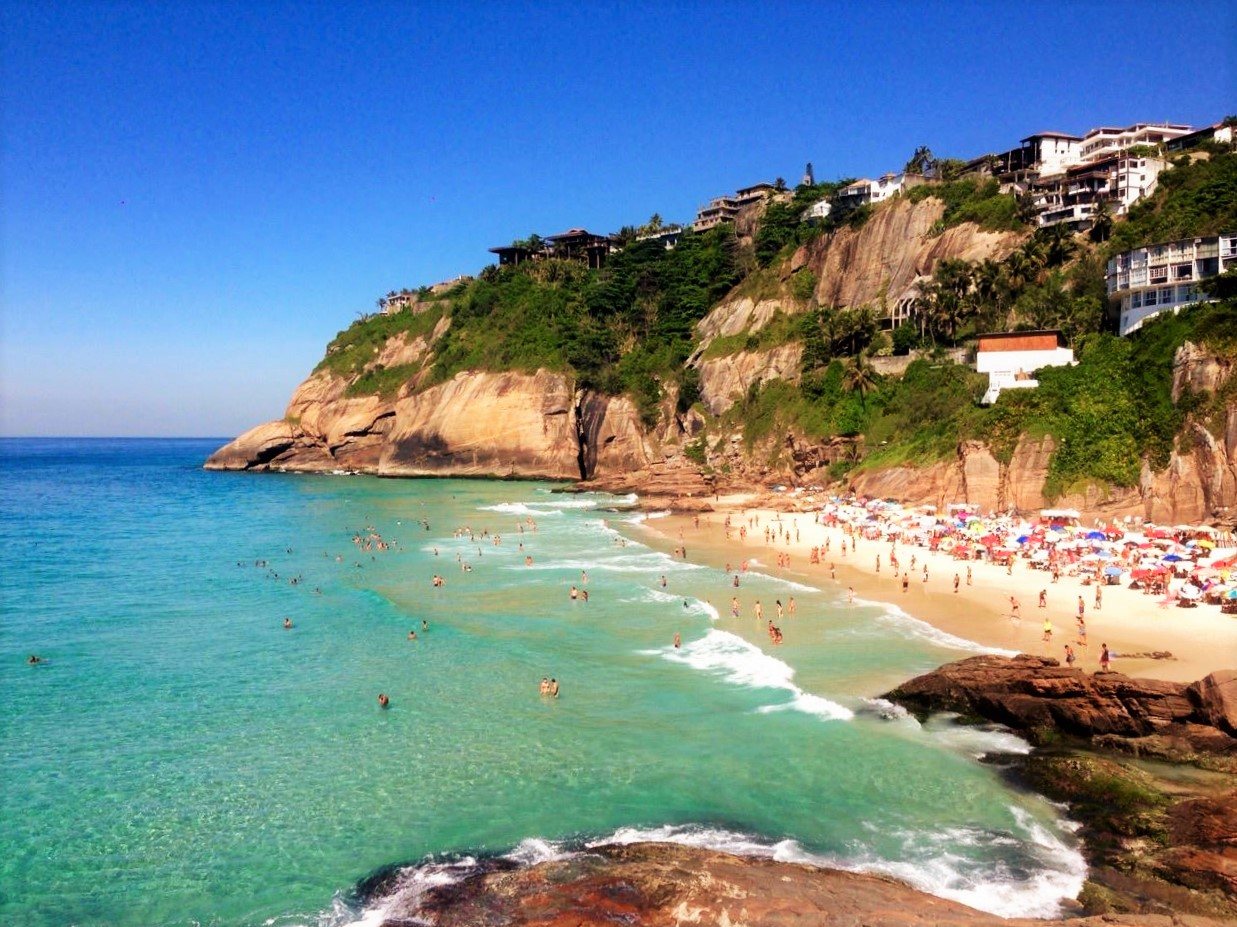
The most seductive misreading of Joá is that its most hidden beach, Praia da Joatinga, is private — a residents-only cove behind a wall. It is not, and it legally cannot be. Under Brazilian law, beaches are bens de uso comum do povo: public goods for the common use of the people, held by the Union, with free and open access guaranteed. The Coastal Management Law of 1988, Law 7.661, states the principle directly, and the Federal Constitution places beaches and the coastal zone among the property of the Union that exists for collective use. A private party may own land next to a beach; no one owns the beach.
The Joatinga case is exactly the situation this law was written for. The beach sits at the foot of the cliff, and the only practical way down to it runs through a gated condominium — you enter from the Estrada do Joá, pass the condominium's access control on Rua Pascoal Segreto, and descend a staircase from Rua Sargento José da Silva to the sand. According to the encyclopedia entry for the beach, and to every reliable local account, the condominium does control access — it will hold visitors back when the small parking area is full — but the beach may be used by non-residents, because the law leaves it no choice. The gate manages the flow of people; it does not own the shore they are walking to.
This is not merely a theory that has never been tested. Brazilian courts have repeatedly drawn the line where a gated condominium tried to cross it. In a much-cited 2019 decision, a federal appellate court, the TRF-4, ordered a closed condominium in Santa Catarina to remove the gates and fences blocking the only public route to a beach, holding flatly that "the law rejects any attempt at privatising beaches, which are public assets" available to everyone. The reasoning applies wherever the facts repeat: a condominium may sit between the road and the sand, but it must let the public reach the sand. The rule in Joatinga is the national rule, not a local courtesy.

There is a natural check on all of this that no lawyer or síndico designed: the tide. Praia da Joatinga is a narrow strip of sand at the base of the cliff, and at high water the sea covers it completely — for part of every day there is simply no beach to stand on. That, more than any gate, is what keeps the cove quiet. The condominium's access control and the small parking lot cap the numbers; the tide caps the hours. The result is a public beach that behaves like a private one without ever legally being one — open to all, but only to those who know to check a tide table and arrive on foot at the right moment. The full mechanics of that descent, the timing, and the walk over the rocks are laid out in the guide to Praia da Joatinga.
The same principle governs the rest of the coast below the hill, not only Joatinga. Wherever a Joá condominium's land runs down toward the water, the water and the sand at the bottom of it remain public, and the private holding stops at the beach's edge. This is the quiet reconciliation the law performs all along the Brazilian coast: it lets the wealthy build walls, gate streets and guard gates as much as they like on their own land, and it draws an immovable line at the shore, where private ownership simply ends and the common property of the people begins. In Joá that line happens to fall at the foot of some of the most expensive real estate in Rio — but the line is drawn in exactly the same place, and for exactly the same reason, as it is on the most ordinary beach in the country.
It is worth holding both halves of this in mind at once, because together they are the truest picture of Joá's privacy. The neighborhood's discretion is real, layered, and largely lawful — walls, gatehouses, guarded lanes, a geography that hides the houses in the forest. And there is a firm line the whole apparatus stops at: the water. A buyer drawn to Joá for its seclusion should understand exactly where that seclusion ends, because the same law that protects a public beach from privatisation is the law that will not let any condominium promise you a private one.
What a buyer should actually check
If you are buying a house in Joá, you are buying into a condominium, and the diligence on the condominium matters as much as the diligence on the house. The good news is that almost everything a careful buyer needs to know is written down and obtainable. Ask for, and actually read, the convenção de condomínio and the regimento interno — the two documents that will govern how you may live, build, and host. Ask for the last year or two of assembly minutes, which reveal the temperature of the community, the disputes in progress, and the works being argued over. And ask for the condominium's accounts: the level of the reserve fund, the rate of delinquency, and any special assessments recently levied or looming.
Confirm, plainly, what the monthly fee is and what it covers, and treat that number as part of the cost of the house rather than an afterthought — in a security-heavy community it is not a small line. Confirm which legal form the condominium takes and that it is properly constituted and registered, because the enforceability of everything else depends on it. And do the one piece of diligence that Joá makes uniquely necessary: satisfy yourself that the house itself was built legally, with proper permits, and not over the line into the protected forest. This is not a hypothetical caution. In 2024 the city demolished four luxury mansions in Joá that had been built illegally on protected land — a vivid reminder that the scarcity which makes the hill valuable also tempts owners across boundaries the authorities still enforce. A gorgeous house on the wrong side of that line is not an asset; it is a liability with a view.
Done properly, none of this is a deterrent — it is simply the shape of the purchase. Joá rewards the buyer who understands that they are acquiring a membership as well as a property: a share in a small, self-governing community that owns the road, guards the gate, sets the rules, and keeps the whole improbable arrangement standing on the side of a cliff. The house is the part you fall in love with. The condominium is the part that makes it possible. The Art de Vivre collection exists precisely to sit on the buyer's side of that table — to read the convention before the contract, to translate the paperwork, and to make sure the address you are being sold is the address you actually get.
That is the version of Joá worth buying into: not a wall you hide behind, but a well-run private world inside a public one, with a beach at the bottom that belongs to everybody and a house at the top that can properly, quietly, be yours. If you would like to see what one such house looks like from the inside, the house at the centre of this collection is the clearest answer we can give, and the collection's advisers are reachable through Art de Vivre when the paperwork gets real.
What all this discretion actually costs, and what the figures mean when you get close to them, is the next thing to read: Buying in Joá.