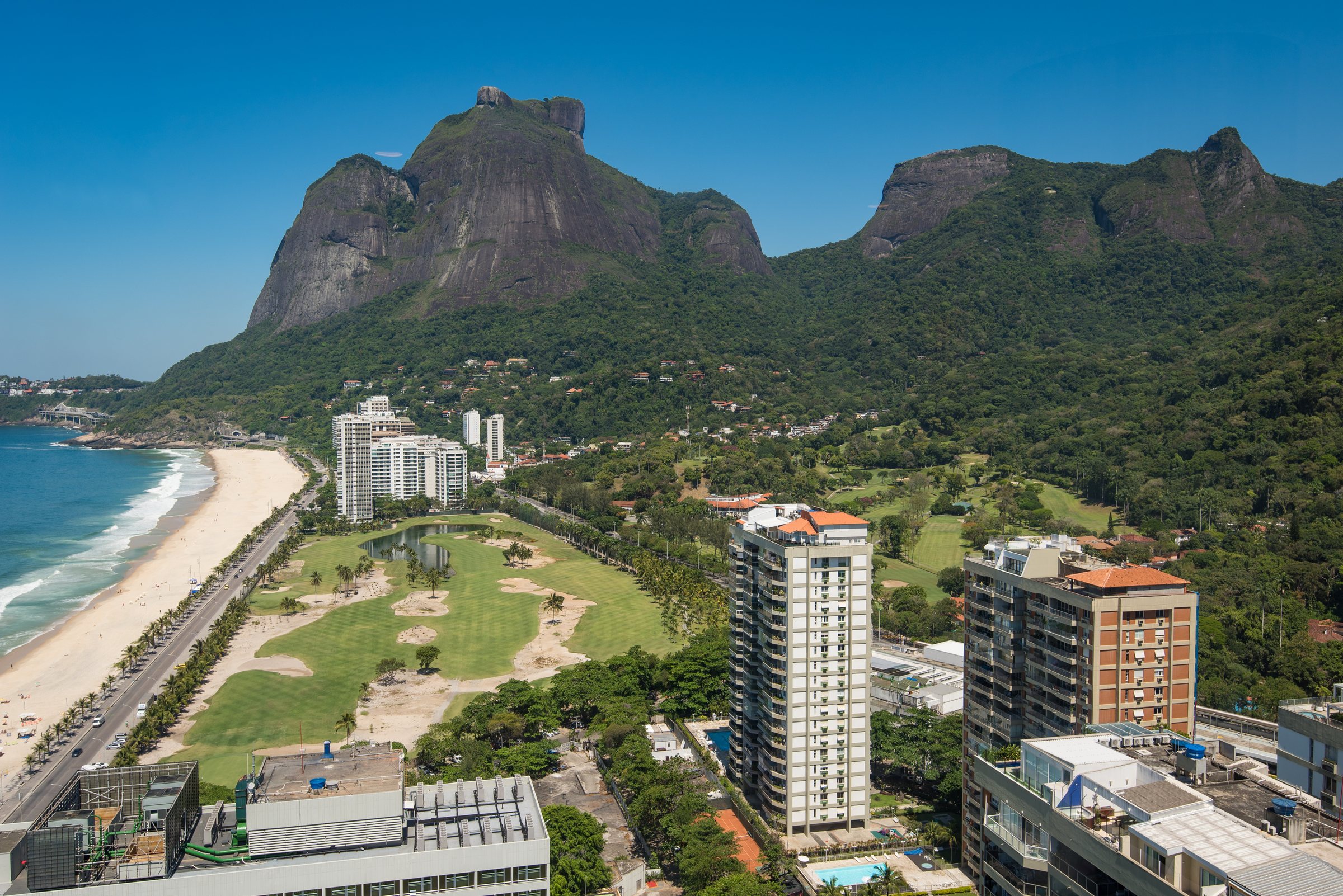
Stand on any terrace in Joá and turn your back to the sea. What faces you is not another house, or a road, or a ridgeline of rooftops climbing the hill. It is forest — dense, dark, unbroken, rising green off the granite until it disappears into whatever cloud the afternoon has brought in. That wall of trees is not landscaping and it is not luck. It is the Tijuca massif, the mountain forest that the Tijuca National Park protects, and it is the single most valuable thing about living here that no amount of money could buy into existence. The sea in front of Joá is the view everyone photographs. The forest behind it is the reason the view will still be there in a hundred years.
Joá Rio is published from ADV101, a five-suite villa in Joá offered at R$ 15,000,000, shown privately by appointment through Art de Vivre.
Ask about a viewing on WhatsAppA forest that had to be planted
The first thing to understand about the forest behind Joá is that it is not, strictly speaking, wild. It is a comeback. Two centuries ago the slopes above Rio were not rainforest at all but farmland — terrace after terrace of coffee, cut into the mountainside by planters who had felled the native Mata Atlântica to make room for the crop that was making the young empire rich. The trees came down; the soil thinned and slid; and the springs that fed the city began to fail. By the middle of the nineteenth century Rio de Janeiro, capital of the Empire of Brazil, was facing a water crisis of its own making, and the cause was plainly visible on the bare brown hills above it.
The response was one of the earliest large-scale reforestation efforts anywhere in the world. In 1861 the Emperor Dom Pedro II ordered the degraded coffee land bought back and put under trees again, and handed the job to an army officer named Major Manuel Gomes Archer. Over the following decades — the planting ran, in fits and starts, from 1861 into the 1880s — Archer's small crews put something on the order of a hundred thousand seedlings into the ground, coaxing native forest back onto slopes that coffee had stripped. It is a founding story Rio likes to tell, and it deserves telling honestly: the trees were planted, for the most part, by enslaved men and women. The historical record preserves a handful of their names — Eleutério, Constantino, Manuel, Mateus, Leopoldo, and a woman called Maria — the people who actually carried the water and set the seedlings that became the green wall behind Joá. The forest is a monument, but it is not only a monument to an emperor's foresight.
What grew back is not a perfect copy of what was lost. Archer and his successors planted what they had and what would take — a mix of native species and a fair number of exotics, some of which are still being weeded out by the park's managers today. But it worked. The springs recovered. The slopes held. And over a century and a half the replanted forest matured into something that functions, convincingly, as rainforest again: multi-storeyed, dripping, loud with insects, closing over the trails within a few metres of the road. You would never guess, walking under it, that almost every tree above you has an ancestor that someone carried up the hill by hand.
It helps to understand why the empire cared enough to plant a forest, because the reason is the same reason the forest is protected now, and it is not scenery. It is water. The old town of Rio drank from streams that ran off these slopes — the Rio Carioca chief among them, carried into the city on the stone arches that still stand in the Lapa district — and when the coffee planters stripped the hills, those streams turned unreliable and foul. A city cannot run on a view. Reforesting the massif was, first and last, an infrastructure project: rebuild the forest, and the forest rebuilds the watershed. That utilitarian bargain is why the trees went in, and it is quietly why they can never come out. The green wall behind Joá is still, in legal and hydrological fact, part of the machinery that keeps water running in the taps of Rio de Janeiro. You are living against a public utility that happens to look like paradise.
The largest urban forest — a claim worth qualifying
You will read, in almost every guidebook and on a good many websites, that Tijuca is "the largest urban forest in the world." It is worth being careful with that line, because it is repeated far more confidently than the facts support. The claim is genuinely contested — most often with Johannesburg, in South Africa, whose vast planted canopy is sometimes called the largest urban forest on earth instead. The two are not really the same kind of thing: Johannesburg's is a human-planted urban tree cover spread through a city, while Tijuca is a continuous protected rainforest, replanted but self-sustaining, wrapped inside the city limits of Rio. Which one is "largest" depends entirely on what you decide to count.
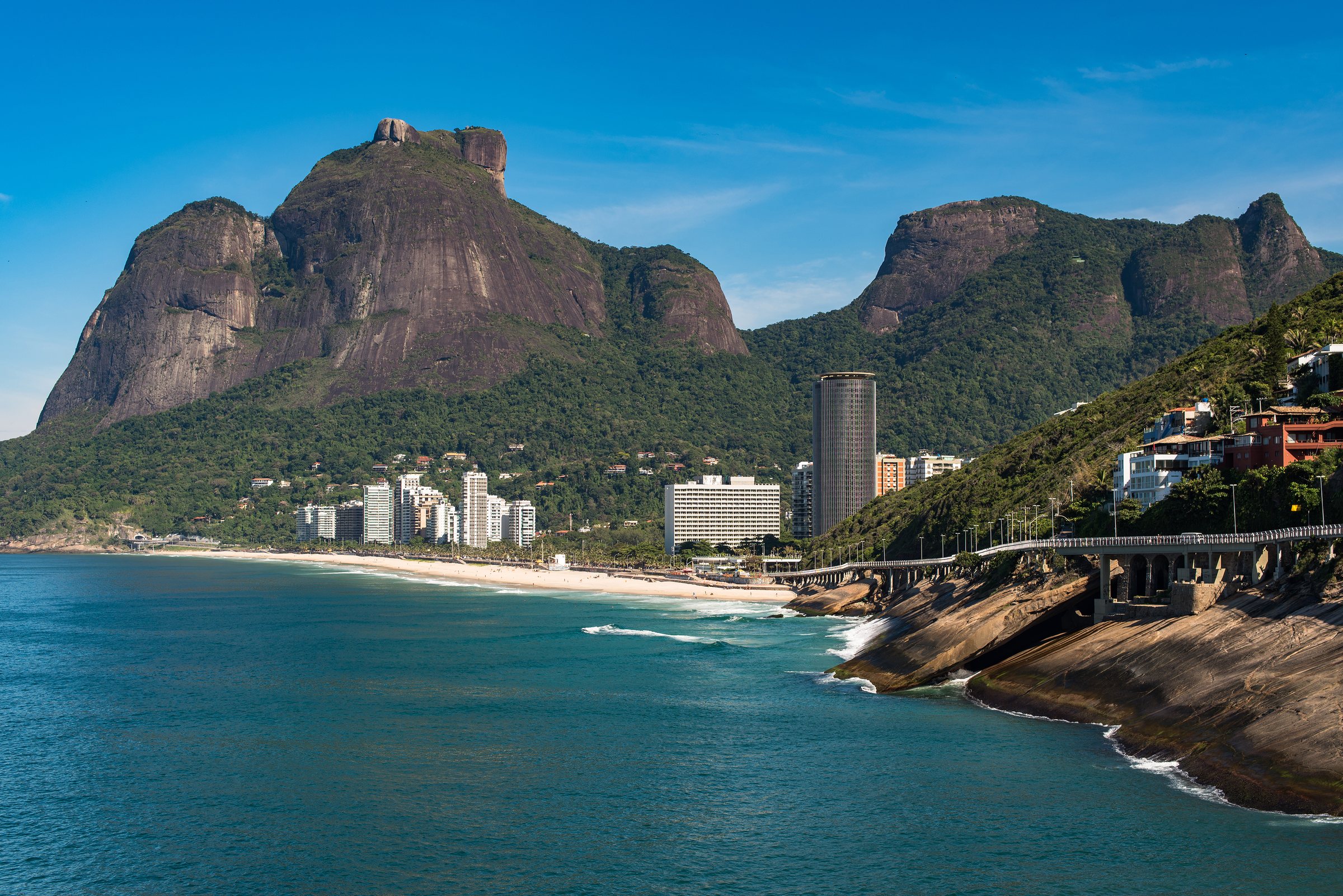
What is not in dispute is the shape of the thing. The Tijuca National Park covers a little under four thousand hectares — roughly forty square kilometres of mountain forest — and it sits not on the edge of Rio but inside it, with the city wrapped around its base on every side. Its highest point, the Pico da Tijuca, rises to 1,021 metres, the tallest summit in the city. It was made a national park in 1961, one of the first in Brazil, and it takes in a roster of landmarks that between them define the Rio skyline: the Corcovado with the Christ on top of it, the Pedra Bonita, and — the one that matters most to this neighborhood — the Pedra da Gávea, eight hundred and forty-two metres of granite standing directly over Joá. So the safest and truest version of the boast is this: whether or not it is strictly the biggest, Tijuca is one of the largest urban forests on earth, and there is nowhere else where a rainforest of this scale presses so hard against a city of this size. Joá is built into the seam where the two meet.
Three forests, and the one behind Joá
It is tempting to think of the Tijuca park as a single green mass, but it is really three, managed as separate sectors that between them ring the whole southern city. There is the Floresta da Tijuca proper — the deep interior forest of waterfalls and trails, with the little cascade of the Cascatinha and the belvederes the empire built to admire its own reforestation. There is the Serra da Carioca, the sector that carries the Corcovado and the Christ on its summit, the part of the park most of the world has seen without knowing it was looking at a national park at all. And there is the third sector, the massif of the Pedra Bonita and the Pedra da Gávea — and that is the one that stands over Joá.
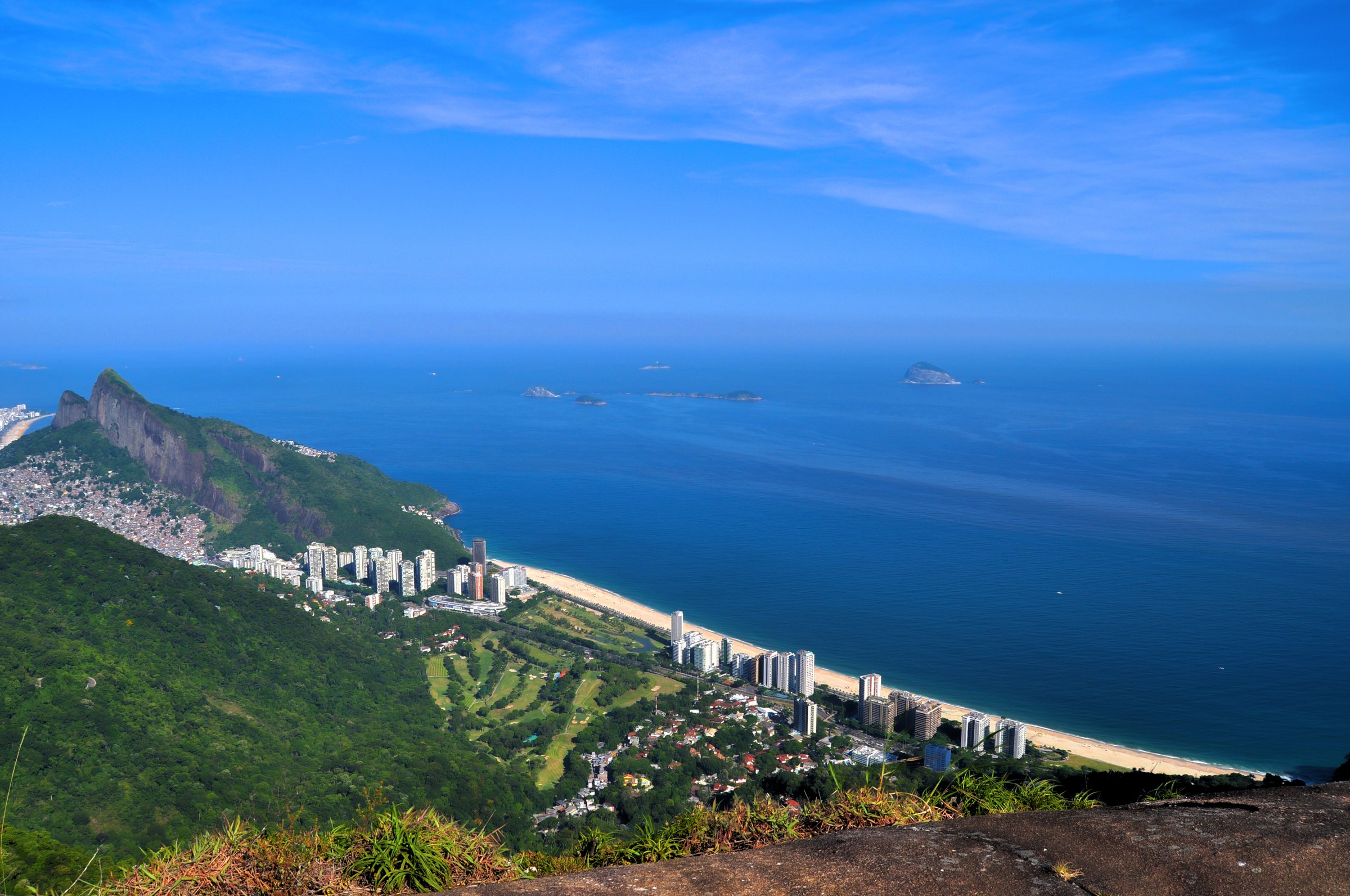
This matters because it fixes the neighborhood's exact place in the geography. Joá is not near the park; it is tucked into the coastal foot of the park's westernmost sector, directly beneath the great granite blocks that terminate the Tijuca massif at the sea. The Pedra da Gávea is the wall at the neighborhood's back; the Pedra Bonita, a little to the north, is the launch point where hang-gliders step off into the air over São Conrado. Between and below them, on the narrow band of buildable cliff the forest leaves free, sits Joá. Understand the three sectors and the neighborhood stops looking like an anomaly clinging to a hillside and starts looking like what it is: the seam where the last and steepest sector of a national park runs out of mountain and hits the Atlantic.
What "Atlantic Forest" actually means
The forest behind Joá is a fragment of something once enormous and now almost gone. The Mata Atlântica — the Atlantic Forest — is the biome that used to run in an unbroken green band down the whole eastern coast of South America, from the northeast of Brazil into Paraguay and northern Argentina. It is a different forest from the Amazon: separated from it by drier country, evolved on its own, and as a result staggeringly rich in species found nowhere else. Ecologists class it as one of the world's biodiversity hotspots, which is a technical term and not a compliment — it means a place of exceptional endemism that is also under exceptional threat. Something like half of its tree species and a large share of its mammals exist only here.
The threat is not hypothetical. Of the original Atlantic Forest, by most estimates, only somewhere between a tenth and an eighth still stands — the rest cleared over five centuries for sugar, coffee, cattle, timber and cities. What survives survives in pieces, and many of those pieces are small, isolated and hemmed in by the most heavily populated part of the country. That is what makes the Tijuca block unusual and important: it is a large, continuous, legally protected remnant of a biome that mostly exists now as scraps. UNESCO recognised the wider ecosystem as a Biosphere Reserve — its first in Brazil — precisely because holding on to the surviving fragments matters out of all proportion to their size. When you look at the green wall behind Joá, you are not looking at generic jungle. You are looking at one of the better-preserved pieces of one of the most endangered forests on the planet.
That reframes the neighborhood a little. Joá is often described in terms of what it costs — the listings, the gates, the discretion. But its setting is a matter of conservation as much as real estate. The houses here are guests in a protected biome, tucked into the last band of buildable land between the Atlantic and a national park. It is a privilege that comes with a boundary, and the boundary is the whole point.
The animals that came back — and the ones that didn't
A forest this size, this close to a city of millions, does something surprising: it holds real wildlife. Walk the trails above Joá at the right hour and you can meet a good part of the Atlantic Forest's cast. Bands of capuchin monkeys work the canopy, bold and quick-handed, near enough to the trailheads that hikers are warned not to feed them. Ring-tailed coatis patrol the ground in loose troops, noses down. Sloths hang, near-motionless, in the crowns of the tallest trees, and are far easier to walk past than to spot. There are marmosets, agoutis, tegu lizards, and — for the patient and the lucky — the occasional ocelot, the small spotted cat that still hunts these slopes at the edge of the city's lights. Overhead the birdlife runs to a couple of hundred recorded species, among them the big black-and-yellow channel-billed toucan and the little saffron toucanet, tanagers, and the tinamous whose flute-like calls carry a long way through wet forest.
But the honest picture is not simply abundance. For all its size, the Tijuca forest spent much of the twentieth century as what biologists bluntly call an empty forest: the trees stood, but the larger animals that once lived among them had been hunted out or squeezed out, and their absence quietly broke the machinery of the place. Of the roughly three dozen larger vertebrate species that the forest historically held, only about a third were still present by the time anyone thought to count. A forest can look perfectly healthy and still be, in this sense, hollow — big fruit falling and rotting on the ground because the animals that used to carry the seeds away are gone.
What is happening now is one of the more hopeful stories in Brazilian conservation. Since 2010 a rewilding programme run out of the federal university — Refauna — has been deliberately putting the missing pieces back. It began with agoutis, the large forest rodents that bury seeds the way squirrels bury acorns and, in doing so, plant the next generation of big-seeded trees; a few dozen were released, and the population now living in the forest is entirely wild-born. It went on to howler monkeys, reintroduced from 2015, whose dawn roar is one of the defining sounds of intact Atlantic Forest, and to yellow-footed tortoises, released from 2020. The point is not sentiment. It is function: return the seed-dispersers and the forest starts reproducing itself properly again. Slowly, the forest behind Joá is being made whole rather than merely green.
It is worth sitting with how strange this is. A few minutes' drive from Ipanema, in a metropolitan region of some twelve million people, a howler monkey is raising young that were born wild; agoutis are burying seeds that will be trees when the current owners of Joá are long gone; an ocelot is crossing a trail at dusk within earshot of the traffic on the Elevado. Cities do not usually contain functioning wilderness. This one does, and it does so directly behind a row of some of the most expensive houses in Brazil. The animals do not know or care about the property values below them, and that indifference is precisely the luxury: a wild thing living its own life, on its own schedule, a hundred metres from your kitchen and entirely uninterested in you.
There is one animal you cannot reintroduce and cannot avoid, and honesty about the forest means naming it: the marmosets and capuchins that raid the trailheads are half wild and half opportunist, quick to learn that people carry food, and a nuisance the moment anyone teaches them so. It is the small, unromantic tax of living against a real forest with real animals in it — the same porousness that brings a toucan across the terrace at breakfast brings a marmoset onto the railing after your fruit. Residents learn to keep the kitchen doors shut and to never, ever feed them. It is a fair price. A landscape that could not do this — that had no monkeys to misbehave — would not be worth living against in the first place. The mischief is proof the machine is running.
A rainforest with an address.
Pedra Bonita rises to just under seven hundred metres a short way north of Joá, its ramp the only place in Rio where hang-gliders step off the mountain and drift down over the forest to the beach at São Conrado. It is a reminder of the scale at the neighborhood's back: not a park you drive to, but a mountain range you live against.
“You cannot buy the forest. You can only be allowed to live beside it.”
The light the mountain makes
Living against a mountain forest changes the days themselves, in ways a photograph rarely captures. The Tijuca massif is a physical presence over Joá, and it edits the weather. Cloud gathers on the high forest and slides down its flanks in the late afternoon; mist pools in the folds of the hills and burns off by mid-morning; rain that would pass over flat coast hangs up on the granite and falls harder and greener here. The forest breathes moisture into the air, and the neighborhood is a few degrees cooler and a shade more humid than the open beachfront a couple of kilometres away. The trade is a good one: you give up the full blast of the coastal sun and get, in return, a softer, wetter, more temperate pocket of city, held between the rock and the sea.
And then there is the light. Because Joá sits low on the seaward side of a tall mass of forest and granite, the mountain governs the end of the day. The Pedra da Gávea and the ridgeline behind it stand between the neighborhood and the falling sun, so the light does not simply switch off at the horizon the way it does over open water — it lingers, climbs the rock, turns the granite gold and then rose, and holds there while the houses below are already in shadow. It is the specific quality of light that people who have lived in Joá talk about more than any other: long, warm, theatrical, arriving already framed by the mountain. The forest and the rock do the composition for you. It is worth saying plainly that no house can manufacture that; it comes with the ground.
The mountain shapes the mornings as much as the evenings. Because the massif rises to the west and north, the sun clears the sea before it clears the ridge, and the first hours in Joá arrive soft and sidelong, the forest exhaling the night's moisture back into the air as the day warms it. On the wettest mornings the cloud sits on the Pedra da Gávea and comes apart slowly, and the summit appears and disappears like something being decided. It rains more here than on the open beach a short drive away, and it rains greener; the forest is a machine for making its own weather, and the neighborhood lives inside the machine. Some people find the constant nearness of that much wet green oppressive. Most, in time, find they cannot do without it — that a view of open water alone, after Joá, feels strangely unfurnished.
What the forest guarantees
Here is the part that matters most to anyone who actually lives in Joá, or is thinking about it. In a city where the view from a good house is always one planning decision away from being blocked by a better-financed one, the forest behind Joá is a guarantee that almost nothing else in Rio can offer: permanence. The land immediately behind the houses is not merely undeveloped. It is a federal national park. It cannot be subdivided, sold, rezoned, or built on, no matter how the market moves or who wants it. The green wall behind your terrace this year is the green wall that will be there in fifty. Nothing will rise behind the houses, because nothing is permitted to.
That single fact does more for the neighborhood than any gate or wall. It is the source of the privacy that Joá is really selling — a subject worth a page of its own, and one we give here. A house whose back is a protected mountain has no neighbor behind it and never will; the forest closes the plots from above the way the cliffs close them from below. It is also the source of the quiet, and of the sense — rare anywhere, almost unheard of in a city of six million — that you are living in a landscape rather than merely looking at one. When we describe the setting of the house, the forest is not scenery in the background of the pitch. It is the reason the pitch holds.
It is also the through-line that connects everything else about the place. The same mountain that had to be replanted by hand is the mountain that now cannot be touched; the same protection that saved a fragment of the Atlantic Forest is the protection that keeps a builder off the slope behind your bedroom. The making of Joá is, in large part, the story of a neighborhood learning to sell exactly this — not the beach, which Rio has in abundance, but the guaranteed emptiness of the mountain at its back. The forest is the asset. The houses are the tenants.
The line at the forest's edge
None of this means the boundary polices itself. The same scarcity that makes the forest edge so valuable makes every extra metre of it a temptation, and Joá sits on one of the sharpest such edges in Rio: an open, unwalled bairro — anyone can drive its roads — pressed directly against protected land and the surroundings of federally listed landmarks. The pressure to push a wall, a pool, a spare wing a little further up the slope than the paperwork allows is constant, and it is not always resisted.
In July 2024 the city made the point in the bluntest possible terms. Municipal crews moved into Joá and demolished four luxury houses — mansions valued in the millions of reais — that had been built without proper authorisation on a single plot licensed for just one home. Where one legal residence had been permitted, four had gone up. The owners had been notified, fined, and told to stop, and had carried on building anyway; a last-minute court order briefly halted the bulldozers before it was overturned and the demolitions completed. The images — excavators tearing through finished-looking villas with sea views — travelled around the country. They are a reminder that the line between the neighborhood and the forest is a legal line that someone still has to enforce, sometimes with heavy machinery.
Nor is the risk only municipal. Because so much of Joá lies within the surroundings of nationally protected sites — the Tijuca park and the Pedra da Gávea among them — some high-end projects here have also run into the federal heritage authority, which has moved to suspend construction and annul building licences on plots it judged too sensitive or too close to protected ground to carry the homes proposed for them. The lesson for anyone building at this edge is unglamorous but essential: in Joá the forest is not a soft green backdrop you can quietly encroach on. It is a hard legal frontier, watched by more than one authority, and the honest way to live against it is to respect exactly where it falls.
There is a further irony worth naming, because it sharpens the point. The forest edge is contested from both sides. For decades the public argument about encroachment on the Tijuca massif focused almost entirely on the informal communities that grew up its lower slopes, and far less on the high-end houses and condominiums pushing into the same protected fringe from the wealthy side — a double standard that critics of the city's enforcement have pointed out for years. The 2024 demolitions in Joá were, among other things, a rare instance of the enforcement machinery turning toward the money rather than away from it. For a buyer, the reading is simple and practical: the boundary is real, it is watched, and the fact that a house is expensive buys no exemption from it. In Joá the surest way to hold value is to build well within the line, not to test it. The house that respects the forest is the house that gets to keep its view.
That, in the end, is the tension that gives the place its character. Joá is a neighborhood of very expensive private houses built at the exact seam where a protected rainforest meets the sea — a setting whose entire value depends on the forest staying wild, and whose worst instincts are always tempted to take one more bite of it. The good version of Joá understands the bargain. It builds discreetly, keeps its footprint below the tree line, and treats the mountain at its back not as land in waiting but as the permanent, unbuyable thing that makes everything in front of it worth having.
Living inside the massif
To live in Joá is to accept a particular relationship with a forest. It is there when you wake — the howler monkeys at dawn, the cloud coming off the ridge, the smell of wet green that never quite leaves the air. It is there in the afternoon, when the Pedra da Gávea catches the last of the sun and holds it. And it is there in the deeper, structural sense that matters most: as a promise, written into federal law, that the wild green wall behind the houses is not going anywhere, that no tower will rise on it, that the privacy and the quiet and the framed light are not amenities that can be taken away but conditions of the ground itself.
That is the setting the Art de Vivre collection went looking for when it took on a house here. Not the loudest view or the flashiest address, but the rarest thing a city house can have: a back that faces a rainforest and always will. Everything else about the house — the terraces, the light, the sense of being hidden in plain sight in the middle of Rio — follows from that one fact. You can read the full Art de Vivre account of the property, and of the Joá that surrounds it, but stand on the terrace once and the argument makes itself. The forest is behind you, enormous and permanent, and it is not going to move.
The rock that presides over all of it — the mountain that frames the light and guards the forest's seaward edge — has its own page: Pedra da Gávea.