Go out onto any terrace in Joá at the end of the day and you will find you are not looking at the sea first. The eye goes up. It goes to the great flat-topped block of rock that stands over the neighborhood from behind, dark against the last of the light, so plainly the largest thing in view that it takes a moment to remember it is a mountain and not a wall. This is the Pedra da Gávea — eight hundred and forty-two metres of granite and gneiss at the southern edge of the Tijuca massif — and to understand Joá at all you have to start with it. The houses are the foreground. The mountain is the subject. Everything about how this stretch of coast looks, and how the light falls on it, is decided by the rock that came long before any of it.
Joá Rio is published from ADV101, a five-suite villa in Joá offered at R$ 15,000,000, shown privately by appointment through Art de Vivre.
Ask about a viewing on WhatsApp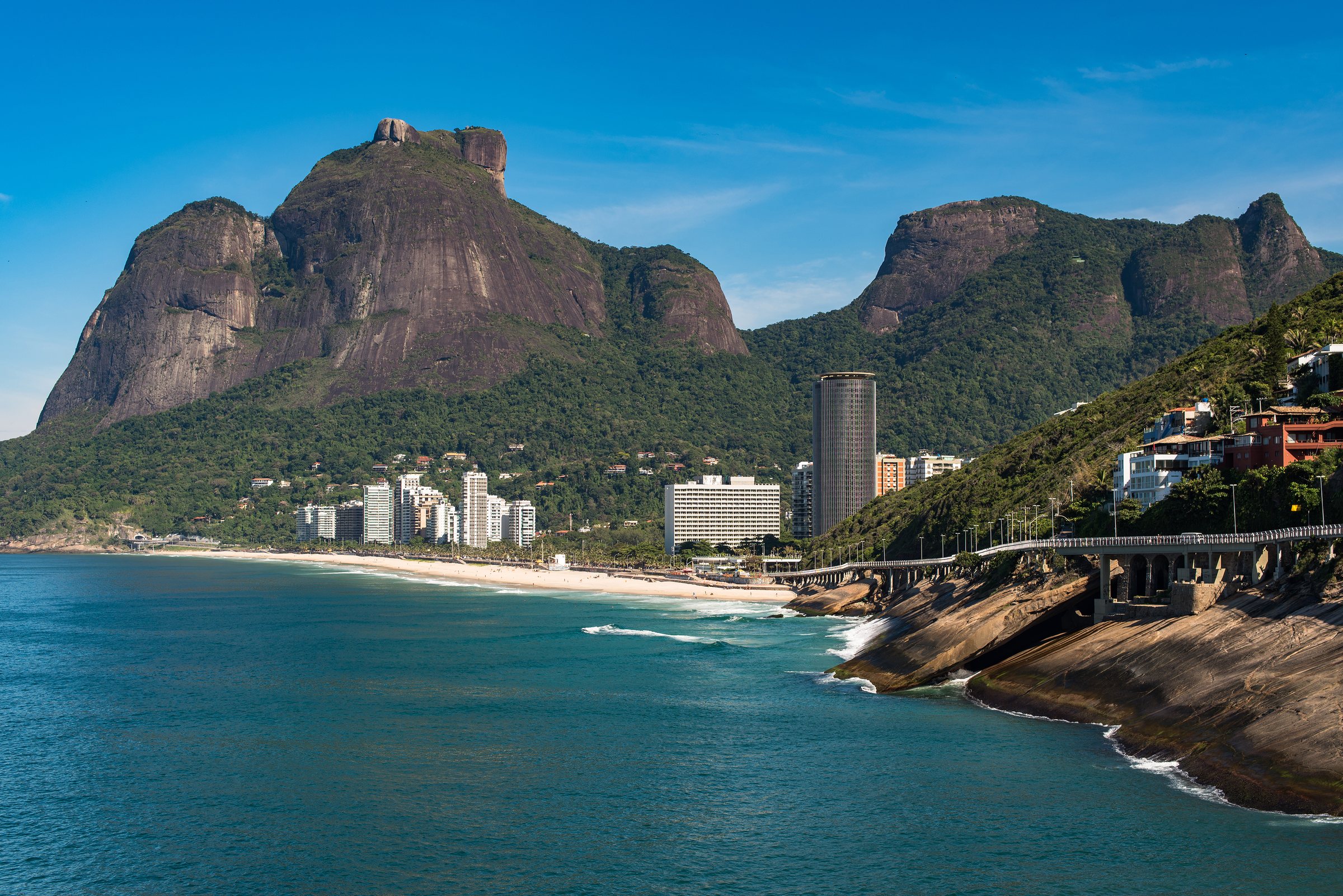
The measure of the thing
Start with the numbers, because they are the part that is not in dispute. The Gávea rises to eight hundred and forty-two metres above the sea it stands beside, which makes it one of the tallest features of the Tijuca range and, from most of the western coast, the dominant one. It is not a single kind of stone. Underneath sits gneiss — the old, banded, high-grade metamorphic rock that forms much of the Rio massif, on the order of six hundred million years old. Capping it, giving the summit its clean horizontal line, is a layer of granite something like a hundred and fifty metres thick and appreciably younger, in the region of four hundred and fifty million years. Geologists reading the exposure have argued that what you are looking at is essentially the floor of an old granitic magma chamber, and that the body of granite was once far larger than the slab that survives. The mountain you see, in other words, is the durable remainder of something much bigger that the weather has spent eons taking apart.
That two-part construction — hard cap over softer base — is not a geological footnote. It is the whole reason the Gávea looks the way it does, and it will matter later, when we get to the face and the marks that people have read into it. Rock does not weather evenly. Where the granite is more resistant it holds its edge; where the gneiss beneath is softer it wears back and grooves and fractures along its grain. The result is a summit block with sheer walls, sharp corners and long vertical scoring down its faces — a shape that reads, to the eye, as built. It was not built. It was left. The distinction is easy to lose when you are standing under it, which is exactly how the legends started.
The deeper history of the stone is a story of intrusion and exposure. The old metamorphic base was already ancient when younger molten granite pushed up into it and cooled; later still, thin sheets of diabase from the age of the dinosaurs cut through the whole assembly as dikes. Then the Atlantic opened, South America and Africa pulled apart, and the coast that resulted was left to erode for tens of millions of years. Everything softer came off. What remained standing — the Gávea, the Corcovado, the Pão de Açúcar, the whole file of bald grey domes that give Rio its skyline — is the hard core of a landscape whose gentler material is long gone, carried down to the sea grain by grain. The mountains of Rio are not what was built up here; they are what refused to wash away. The Gávea is the biggest and bluntest of the survivors, and its flat cap of resistant granite is the reason it kept its height while the land around it lowered.
The geological record is unusually well documented for a single peak, in part because the Gávea has drawn so many people trying to prove it was more than a peak. We will come to them. First, the name.
Rock of the topsail
The name is one of the oldest European place-names on this coast, and one of the most literal. When Gaspar de Lemos's expedition worked its way down the Brazilian shore at the turn of 1502, the sailors looked up at the flat-topped block and saw in it the shape of a gávea — the topsail of a carrack, the square sail set high on the mast. The mountain became the Pedra da Gávea, the rock of the topsail, and it has kept the name for more than five centuries. There is something apt in the fact that the first Europeans to name it named it after a part of a ship: they were reading a human object into a natural one before they had so much as landed. The Gávea has been inviting that mistake ever since.
There is a small irony worth noting in the naming. The expedition that supplied the name was among the very first European voyages to work this coast at all, begun in 1501, and the sighting is traditionally dated to the first days of 1502. The men who looked up and saw a topsail were sailors, and they named the mountain out of the only vocabulary they had — the rigging of their own ship. Centuries of cartography then fixed the name in place, and the neighborhoods that eventually grew beneath it took their own names from the mountain: the Gávea district, and the little inlet of Gávea Pequena, and by extension the whole run of coast the rock presides over. A place-name that began as a passing shipboard resemblance ended up organizing the map.
It sits inside — or at the edge of — the Tijuca National Park, the vast urban remnant of Atlantic Forest that wraps the mountains of Rio's Zona Sul and Zona Oeste. The park is often called the largest urban forest in the world; that title is contested with Johannesburg, and honesty requires the hedge, but the scale is real enough — some forty square kilometres of protected mata threaded through a city of millions. The Gávea, along with its neighbor the Pedra Bonita, forms one of the park's named sectors. What this means for Joá is concrete: the wall of forest that rises behind the neighborhood's houses is not merely undeveloped, it is legally protected, and it is not going to be built on. We wrote about how that protection shaped the neighborhood in the Tijuca forest and Joá, and about how the whole cliff came to be inhabited in the making of Joá. The short version is that the mountain is the reason the neighborhood is both possible and permanently hemmed in.
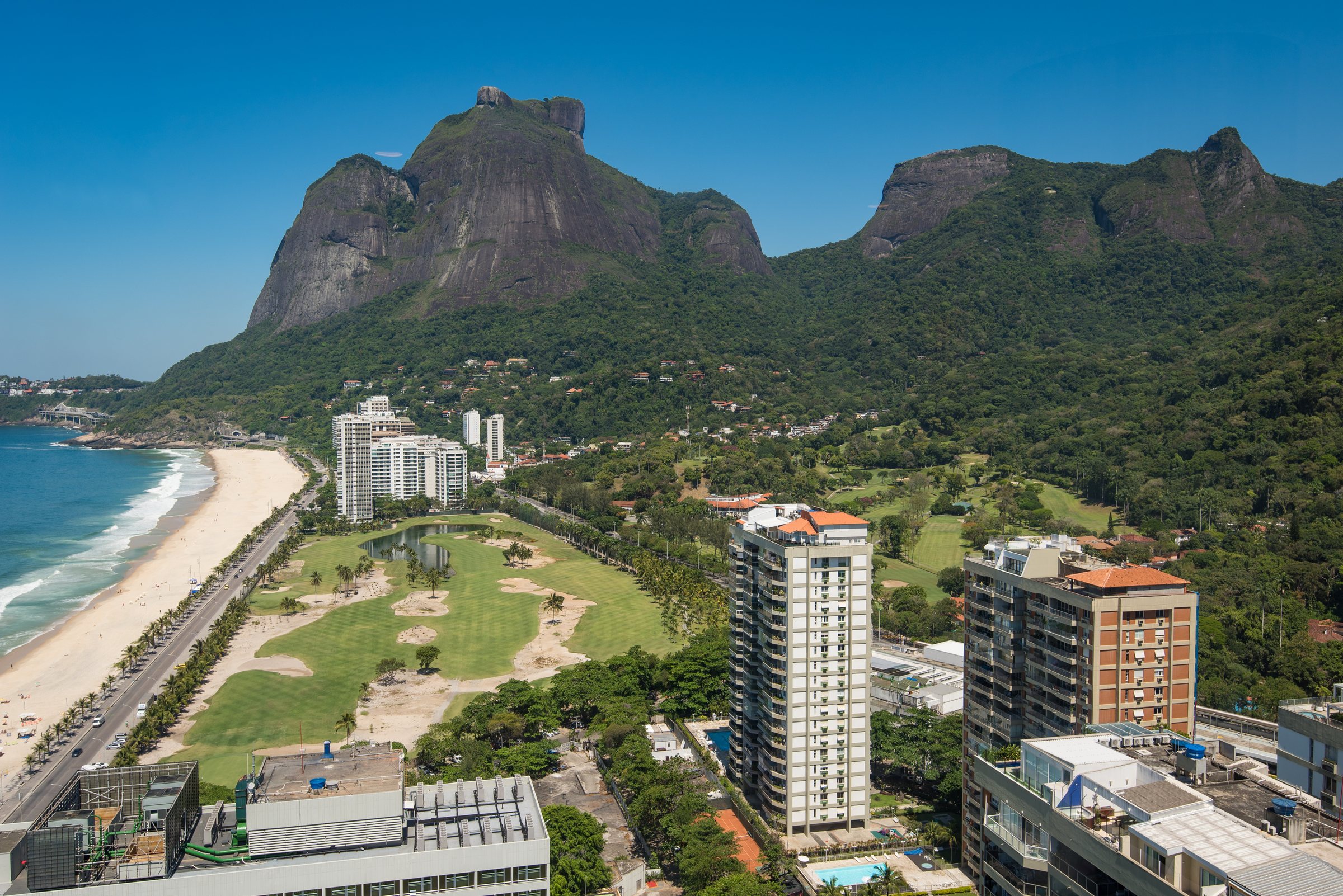
A summit that reads as built.
Hard granite over softer gneiss, worn back along its grain: the sheer walls and vertical scoring that make the Gávea look carved are the work of the weather, not of hands. It is the single most misread mountain in Rio — and the one the whole of Joá is arranged around.
The superlative, handled with care
You will read, in almost every guidebook and on nearly every tour page, that the Pedra da Gávea is the largest monolith on the seashore in the world, or the largest block of rock rising straight from the sea anywhere on earth. It is worth slowing down here, because the claim is repeated so confidently and so often that it has taken on the appearance of a fact, and it is not quite one. "Monolith" is a slippery word — a single mass of stone, more or less, but the definition bends depending on who is counting, and there is no agreed register of the world's coastal monoliths against which the Gávea's rank could actually be checked. There are larger rock masses that meet the sea elsewhere, depending entirely on how you choose to measure and what you agree to call a single stone.
Part of why the claim sticks is that it is nearly impossible to disprove and very easy to feel. Superlatives about the Gávea travel well because the mountain earns them experientially, standing over the water the way it does, even where they fail as measurements. And the neighborhoods around it have every incentive to repeat the grandest version; a "largest in the world" reads better on a tour page than "very large by any reasonable standard." None of which makes the mountain smaller. It simply means the honest writer passes the superlative along in quotation marks and lets the reader keep the wonder without the false precision.
So here is the careful version. The Pedra da Gávea is commonly described as one of the largest coastal monoliths in the world. That description is not invented and it is not absurd — this really is an enormous block of rock standing more or less at the water's edge, and standing over eight hundred metres. But it is a repeated claim, not a measured championship, and the honest thing is to pass it on as exactly that. Joá does not need the superlative. The mountain is overwhelming on its own terms, from every terrace on the hill, whether or not it holds a record no one can quite adjudicate. We will take the same care with the next claim, which is harder to let go of, because it is a genuinely good story.
The face on the summit
Look at the seaward end of the summit block, especially in a low, raking light, and you may see a face. A great many people have. Brazilians have a name for it — the Cabeça do Imperador, the Emperor's Head — and once you have been shown it, it is hard to unsee: a forehead, a heavy brow, the sockets of eyes, a nose, and below them what read as a moustache and a beard, the whole profile turned out toward the Atlantic. It is genuinely striking. It is also, according to the people who have studied the rock most closely, an accident of weathering and of the way the human brain is built.
The technical word is pareidolia — the tendency to find familiar patterns, and faces above all, in random visual information. The clouds do it, the fire does it, the stain on the ceiling does it, and the differential weathering of granite over gneiss does it on a scale of hundreds of metres. Wind, rain and the slow work of thermal cracking have cut back the softer stone and left the harder, and the pattern that survives happens to fall, at the seaward corner, into the arrangement the eye reads as a human head. There is no carving. There are no tool marks. What there is is a mountain, weathering the way its two rock types dictate, and a species that cannot look at a shape like that without seeing a person in it. The face is real in the sense that you can see it. It is not real in the sense that anyone made it.
“The face is real in the sense that you can see it. It is not real in the sense that anyone made it.”
The inscription that wasn't
The face is the gentle version of the legend. The hard version — the one that has drawn treasure-hunters, mystics and at least one serious eccentric up the mountain over the last two centuries — concerns the marks. On one of the faces of the Gávea there are long grooves in the stone, and at some point someone decided they were not grooves but writing. From there the story built itself. The marks were said to be an inscription; the inscription was said to be Phoenician; and if it was Phoenician, then Phoenician sailors had reached Brazil more than two thousand years before anyone was supposed to have crossed the Atlantic, and the Emperor's Head above the writing was a monument they had left behind.
The most committed advocate was a Brazilian named Bernardo de Azevedo da Silva Ramos, who in the early twentieth century devoted two volumes to alleged Phoenician inscriptions across Brazil and, with the help of a rabbi in Manaus, claimed to have deciphered the Gávea's marks. Read right to left, he said, they spelled out a dedication — "Tyre, Phoenicia, Badezir, firstborn of Jethbaal" — naming a Phoenician king of the ninth century BC. It is a wonderful piece of reading. It is also, by the near-unanimous judgment of everyone qualified to check it, wrong. The definitive account of the whole saga is Wikipedia's own article on the archaeological interest of the Pedra da Gávea, which lays out the claims and the demolition of them side by side.
Ramos was not the first to be captivated, and that is part of what kept the story alive: the marks had been reported and copied by earlier travellers and antiquarians through the nineteenth century, each transcription a little different from the last, which is precisely what you would expect from people copying weathered grooves rather than a fixed text. Where there is no real writing, every reader is free to see a slightly different one, and over the decades they duly did. The inscription grew more legible, and more Phoenician, the further it travelled from the rock. By the time it reached its most confident decipherment it had acquired a king, a dynasty and a date — a remarkable amount of specific history to extract from stone that, examined directly, turns out to carry no letters at all.
The demolition is thorough. Geologists who examined the "inscription" found vertical grooves worn into the less resistant bands of the stone — the same differential weathering that produced the face, working on the same rock. There are no tool marks. What look like letters are cracks and mineral veins. By the middle of the last century Brazil's own education authorities had assessed the site and called it nothing more than weather erosion, and a later expedition confirmed the obvious corollary: the mountain is solid stone, with no tunnels, no chambers and no tomb inside it. The larger problem is the one no amount of deciphering can solve. There is no Phoenician settlement anywhere in Brazil to go with the inscription — no pottery, no metalwork, no graves, no second site, no corroboration of any kind. A civilization does not cross an ocean, carve a mountain, and leave behind exactly one ambiguous rock face and nothing else. The inscription is erosion. The face is pareidolia. The story is folklore, and it is worth telling as folklore, which is a different thing from telling it as history.
The hardest trail in Rio
For all the myth, the Gávea is also a real mountain that real people climb, and the climb has a hard-won reputation as the most demanding of the great Rio trails. The standard route runs something like seven kilometres round trip and gains most of the mountain's height, which is a serious day's effort before you reach the part everyone talks about. Much of the lower trail is a steep haul through the forest — hot, close, rooty, unrelenting — and it climbs to a place that has become the mountain's signature: the Garganta do Céu, the "throat of the sky," a slot in the rock on the south face that frames a view back over São Conrado and the twin peaks of the Dois Irmãos. Reaching the Garganta alone is a moderate-to-hard hike of a couple of hours, and for many people it is far enough.
There is more than one way up, and the choice is really a choice of how much rock you want to climb. The common line goes by the Carrasqueira. A second, taken by the Pico dos 4 — the "P4" of the trail notes — keeps more to the forest, spends most of its length in shade, and passes the Garganta before the top; it is kinder on a hot morning but, without equipment, harder in its steep upper pitches. Either way the mountain asks for an early start, a great deal of water, and dry weather: wet rock on the exposed sections turns a demanding day into a dangerous one, and the guides simply will not run it in the rain. Expect the better part of a morning up and a slower, more careful afternoon down. The descent of the technical section is the part that catches people out, because gravity that helped on the way up is working the wrong way on the way down.
Beyond it, the trail confronts the Carrasqueira — the obstacle that gives the Gávea its edge over every other peak in the city. It is a rock wall of around thirty metres, close to vertical, that has to be climbed directly. Climbers grade it as an easy technical pitch, first-degree, with plenty of holds and cracks; the guidebooks call it a chimney and the visible cracks make it look friendlier than it is. But it is exposed, the drop below it is real, and the descent is worse than the ascent. The consistent advice from everyone who runs the mountain — you can read the trail notes on AllTrails' Garganta do Céu route — is to do it with a licensed guide who carries a rope and a harness, and, if the Carrasqueira frightens you, to pay to be belayed up and down it rather than commit to it unroped. People die on this mountain when they treat it casually. It is not a walk with a view at the end; it is a climb, and the summit is earned.
The reward, for those who make it, is the flat top and the full sweep of the coast — Barra da Tijuca stretching west in one direction, São Conrado and the beaches of the Zona Sul in the other, and, far below and almost hidden, the wooded folds of Joá itself. It is the one vantage from which you can see the whole arrangement at once: the mountain, the forest, the cliff, the houses tucked into the mata, and the sea holding all of it. Most residents of Joá never climb it. They do not have to. They live inside the view.
The gliders off Pedra Bonita
Just to the north of the Gávea stands its lower, gentler neighbor, the Pedra Bonita, and off the shoulder of that mountain — inside the same national park, at around five hundred and twenty metres above the sea — is one of the most famous launch ramps in the sport of free flight. The wooden ramp at Pedra Bonita has been used for decades, and on a good day the sky above São Conrado fills with hang-gliders and paragliders that have run off the edge of it, turned out over the forest, and set themselves down, minutes later, on the sand of São Conrado beach. The tandem flights that carry visitors are, by the reckoning of the operators who run them — the long-established local outfits such as Rio Hang Gliding — among the safest such ramps in South America, precisely because the site is so well understood and so heavily flown.
The mechanics of the thing are simple and slightly terrifying. The passenger is strapped alongside the pilot, the two of them run down the sloping ramp together, and within a few strides the ground falls away and they are airborne five hundred metres above the forest. A flight lasts somewhere between eight and fifteen minutes depending on the wind, tracing a long descending arc over the mata and the coast at speeds that can pass sixty kilometres an hour, before the pilot brings the glider down onto São Conrado beach. The whole apparatus sits a short drive from the beaches of the Zona Sul, which is part of why it has become one of the defining images of adventure in Rio — a city where you can, on the same afternoon, be on a beach and then be five hundred metres above it.
From Joá, the gliders are a small, constant piece of the scenery: bright triangles and crescents drifting off the flank of the mountains in the middle distance, banking down toward the neighboring beach. They are worth mentioning here because they belong to the same geography that defines the neighborhood. The ramp, the beach, the whole run of the coast below the twin rocks is São Conrado, Joá's immediate neighbor to the east — a relationship we take up in São Conrado, the neighbor. The Gávea and the Pedra Bonita stand over both places at once. What is a launch ramp from one side is a wall of afternoon shade from the other. It is the same rock, doing different work depending on where you are standing under it.
The mountain that makes the light
Which brings the whole thing back to where it began — to the terraces, and the eye going up. The most important thing the Gávea does for Joá is not the legend or the climb or the record it may or may not hold. It is the light. The mountain stands to the west and north of the neighborhood, between the houses and the lowering sun, and it governs the end of every day here. In the late afternoon it holds the direct light off the hillside, so the harsh part of the day softens early; and then, as the sun drops behind the summit, it hands the neighborhood a long, gold, sideways light that rakes across the water and up the faces of the houses and turns the whole cliff warm before the dark. Anyone who has spent an evening on the hill knows the effect without knowing its cause. The cause is the rock.
The mountain changes the weather of a day as much as the light of it. On mornings when cloud sits low on the range, the summit vanishes entirely and the neighborhood feels closed in, private, almost secretive — the cliff and the mist and nothing above. By afternoon the cloud burns off, the flat top reappears, and the whole scale of the place resets: suddenly there is eight hundred metres of rock over the houses again, and the sea beneath it, and the neighborhood remembers how small it is against its own backdrop. Residents come to know these moods the way people elsewhere know a coastline's tides. The Gávea is not scenery you glance at once. It is a presence you live alongside, and it is different every hour.
This is why the mountain is in the frame of essentially every photograph ever taken from a Joá house, and why the good houses are designed around it rather than merely near it. The architecture on this cliff points itself deliberately: living rooms open west and north toward the Gávea, terraces are cut to catch the moment the light goes gold, and the great expanses of glass exist to hold the mountain inside the room. We wrote about that framing at length in the views from Joá — about how a view here is never just the sea, but the sea with the mountain over it, arriving already composed. The house we look after on this hill, Art de Vivre's villa in Joá, was oriented for exactly this: the terrace and the main rooms are turned to take the Gávea and the coast together, so that the end of the day does the work no decorator can.
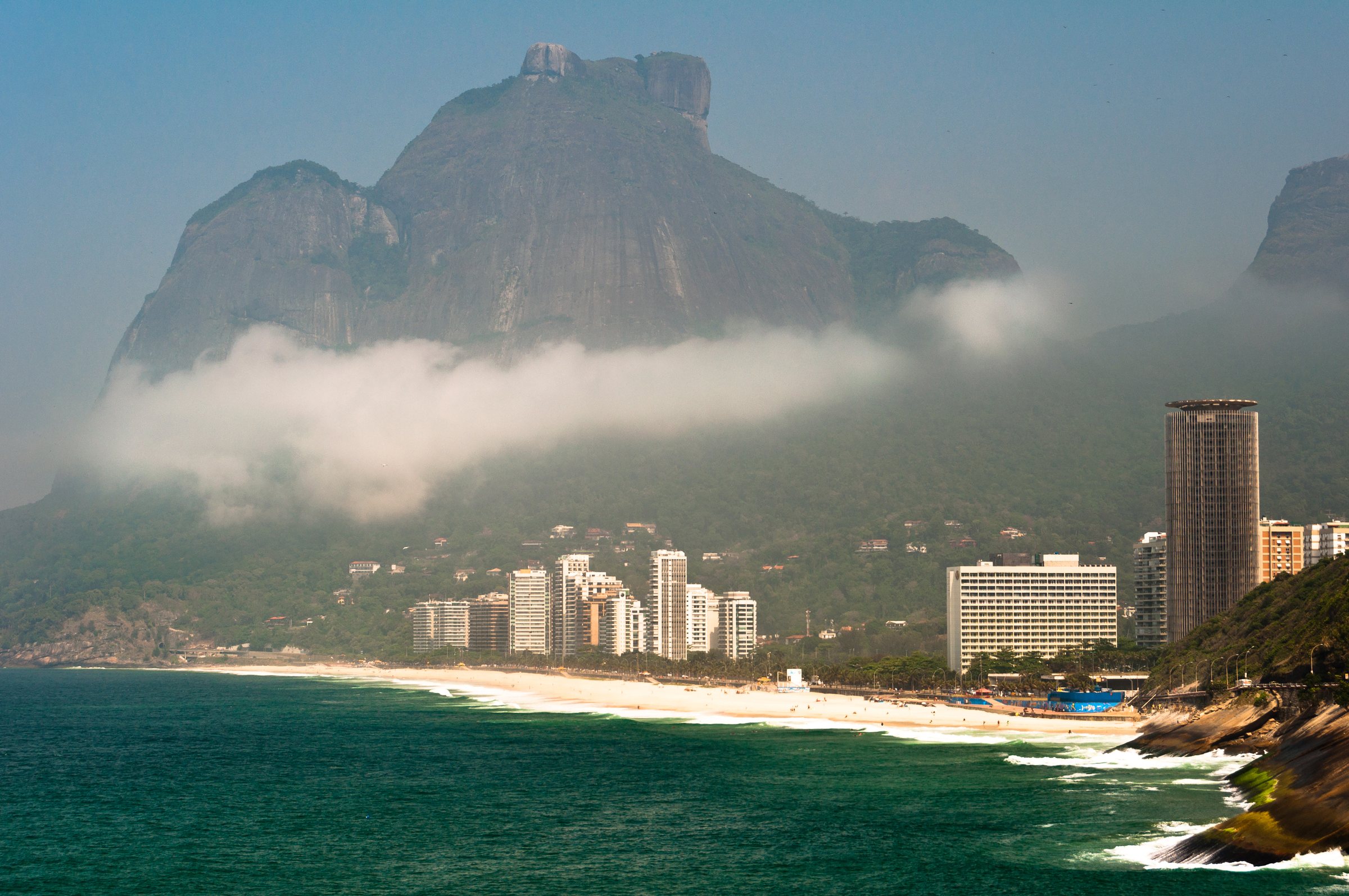
The rock hands the hill its gold hour.
Standing between Joá and the setting sun, the Gávea softens the afternoon and then, as the light drops behind its summit, rakes the coast in warm sideways light. The best houses on the hill are turned to catch precisely that moment.
There is a lesson in the mountain that suits the neighborhood underneath it. The Gávea has spent five centuries being read as something other than what it is — a topsail, a monument, an emperor's face, a Phoenician tablet, a record-holder — and it has been, all along, simply an enormous and very old block of granite and gneiss, weathering the way its stone dictates, standing where it has always stood. Joá is a little like that too: a place that generates more legend than it confirms, and is, underneath the stories, quieter and more physical than any of them. The people who live on the hill did not choose it for the myth. They chose it for the light the mountain makes, and the forest it holds back, and the way the whole coast arrives already framed the moment you step outside. On that, at least, the guidebooks and the geologists and the residents all agree.
If you want to see how the collection reads the rest of this coast — the villa on the hill, and the way Art de Vivre thinks about a house as a frame for a landscape rather than an object in it — the wider Art de Vivre collection is the place to start, and the Joá villa itself is where the mountain does its best work. The rock has been here for four hundred and fifty million years. The house is arranged to make the most of the last hour of any given one of its days.
What the mountain frames — the sea, the coast and the light it hands the hill every evening — is its own page: The Views from Joá.