Leave Joá heading east, out along the coast road, through the tunnels in the headland, and within a few minutes the mountain opens and the road spills you onto a wide crescent of sand with a green valley behind it and a favela climbing the hill above. This is São Conrado — the neighborhood next door, sharing Joá's mountain and Joá's coast road, and in almost every other respect its opposite. Where Joá is quiet, São Conrado is busy. Where Joá hides its houses in the forest, São Conrado puts a thirty-four-storey cylinder on the beach and a shopping mall behind it. It is the place Joá goes for the things Joá does not have — a supermarket, a cinema, a pharmacy, a beach with people on it — and it is worth understanding on its own terms, because to know one is to know why the other is the way it is.
Joá Rio is published from ADV101, a five-suite villa in Joá offered at R$ 15,000,000, shown privately by appointment through Art de Vivre.
Ask about a viewing on WhatsApp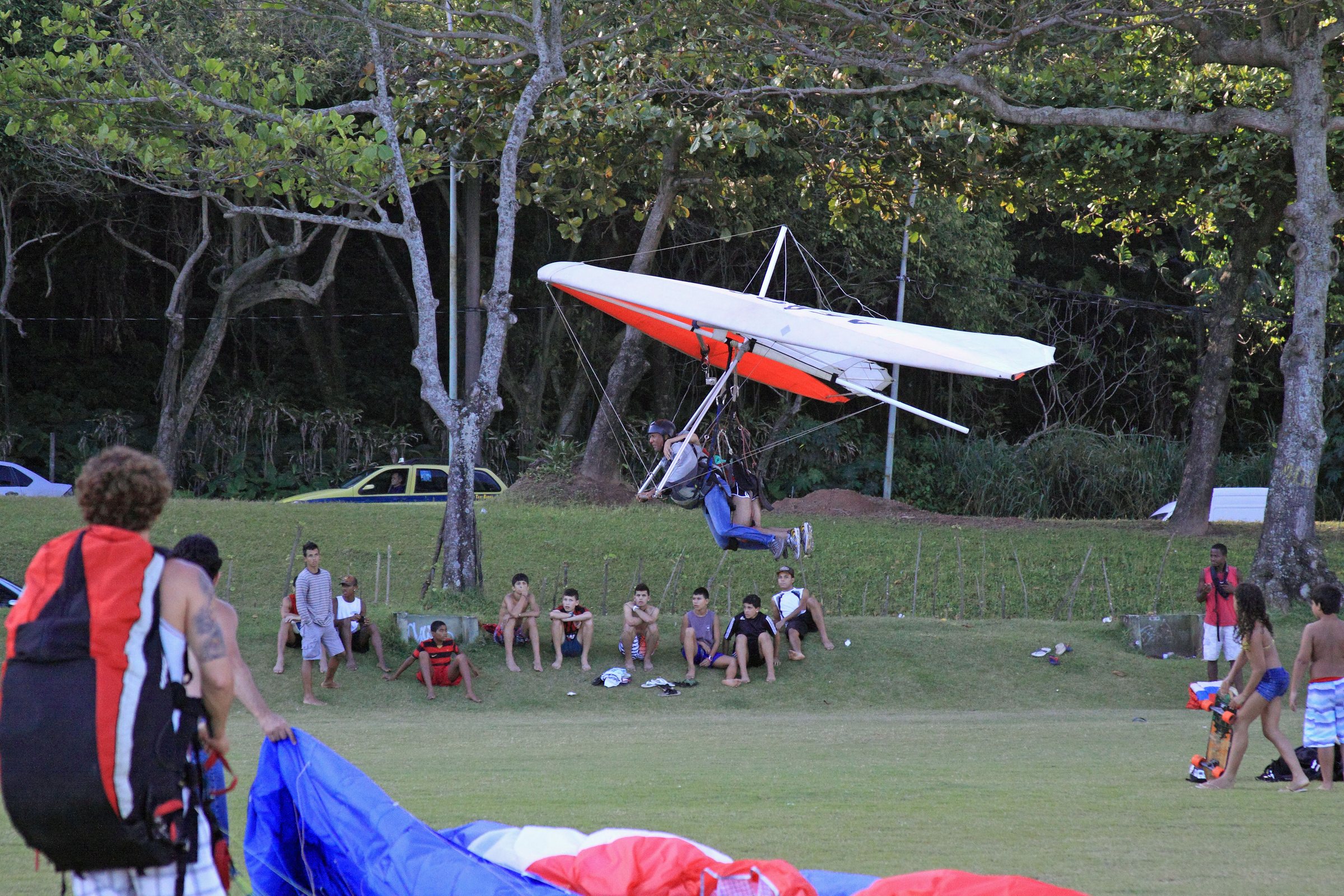
The neighbor over the hill
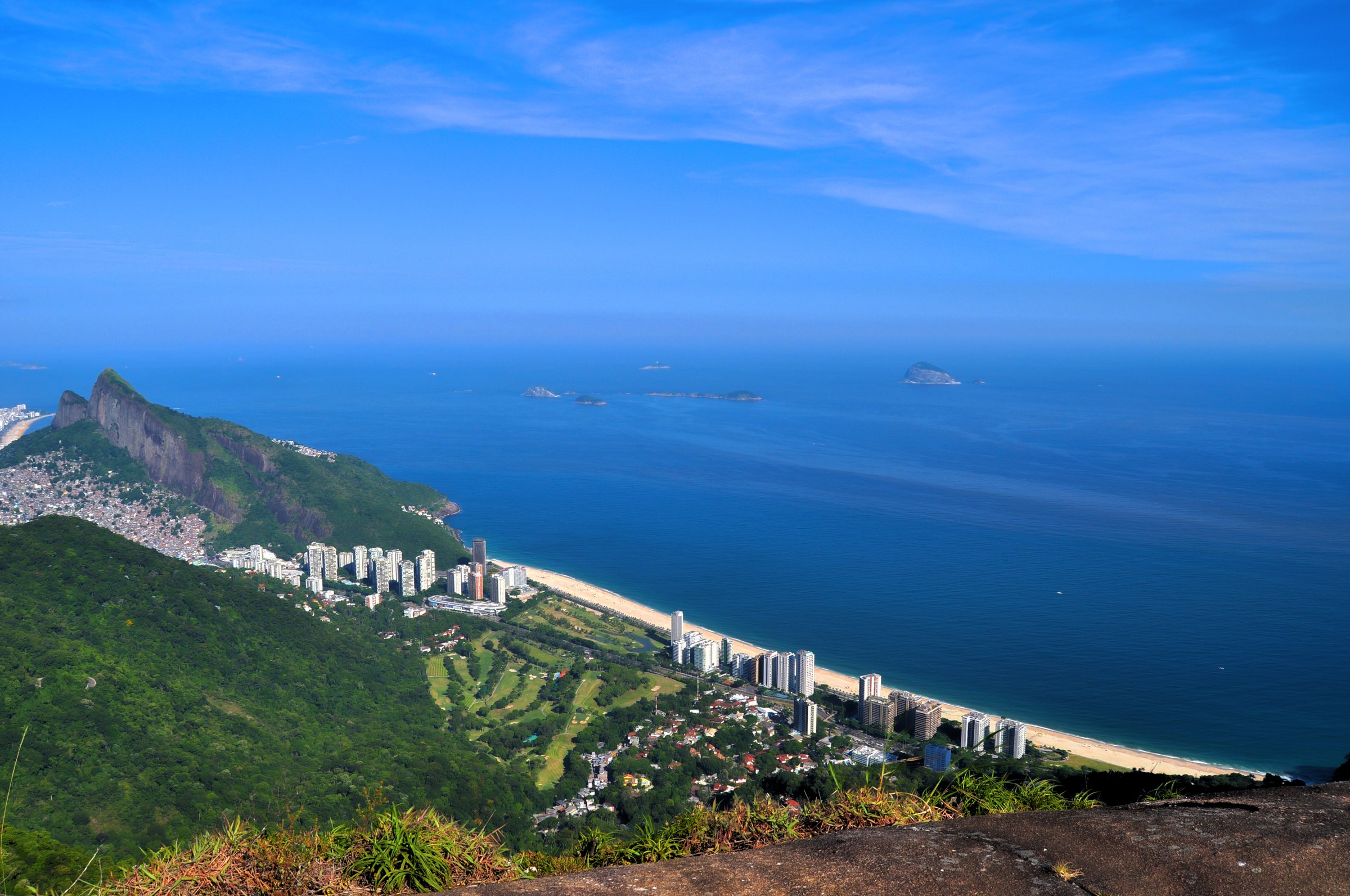
Geography is the first thing to get straight, because it explains the rest. Joá and São Conrado are back-to-back neighbors on the same stretch of the western Zona Sul, divided by the shoulder of the Pedra da Gávea and the Joatinga headland and joined by a single road that threads between them. That road is the Elevado do Joá — the elevated coast highway, opened in 1971, that first made this whole edge of the city reachable. Drive it from São Conrado and you climb out over the rock, run through the tunnels beneath the headland, and come down the far side into Joá and, beyond it, Barra da Tijuca. It is the only land connection between the two, and it is the reason São Conrado functions, for a Joá resident, as the nearest mainland.
São Conrado sits in a kind of amphitheatre. The Atlantic is in front; the Tijuca massif and the Gávea are behind; and the whole neighborhood fills the bowl between them — a flat valley of apartment blocks and a golf course, a single wide beach, and the long green wall of the national park closing it off at the top. The same forest that hangs above Joá's houses hangs above São Conrado's, and the same rock watches both. What differs is what was built underneath. Joá kept to houses and refused commerce; São Conrado let the city in. The result is that the two neighborhoods share a mountain, a coastline and a highway, and almost nothing else. If you want the fuller story of how Joá drew its own line, that is a separate account of the bairro itself; here the subject is the busier world just over the ridge.
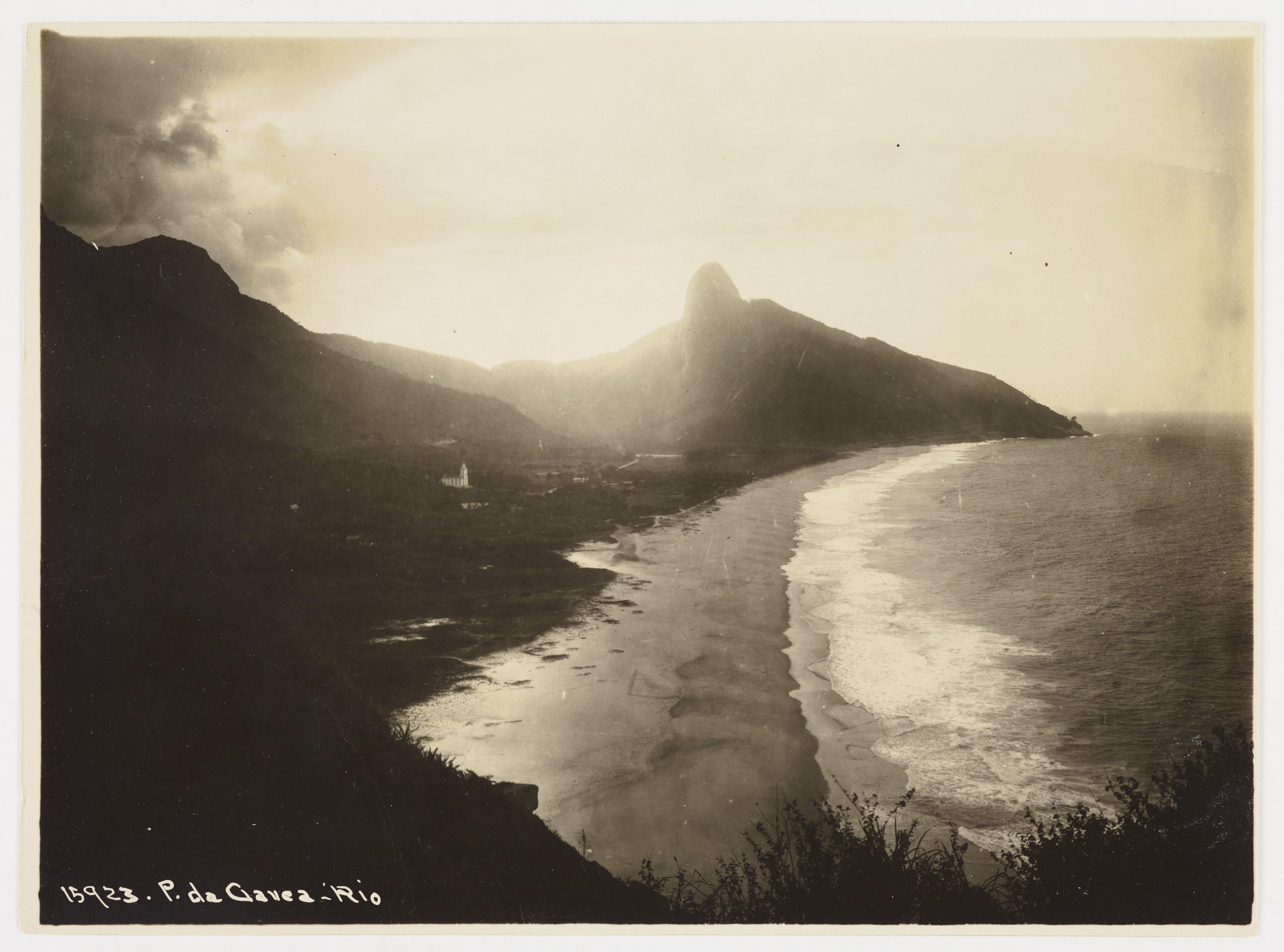
It helps to hold both in mind at once. The Pedra da Gávea is not Joá's private backdrop — it is a shared one, and from São Conrado you see a different face of it, squarer and more massive, rising straight up behind the valley. The light works the same way on both sides: the mountain holds the afternoon and hands the coast a long gold ending. But São Conrado gets the morning sun full on its sand, and that, as much as anything, is why the beach became what it became.
The drive between the two neighborhoods is short but memorable, and it is worth understanding, because it is the connective tissue of daily life on this coast. Coming from São Conrado toward Joá you leave the valley, pass the last of the beachfront towers, and enter a system of tunnels bored through the headland — the way most residents on this side move toward the rest of the Zona Sul. Above, the coast road lifts onto the elevated deck of the Elevado do Joá and runs out over the rock with the open Atlantic on one side and the cliffs on the other. In the space of a few minutes you pass from the busy amphitheatre of São Conrado, through the dark of the tunnels, and out onto one of the most dramatic stretches of road in the city. It is not a commute so much as a small transit between two worlds — the noise on one side of the mountain, the silence on the other.
Gliders on the wind
The thing most people know about São Conrado, whether or not they know its name, is the sky above it. On almost any clear afternoon with the right wind, the air over the beach is full of hang-gliders and paragliders drifting down in slow spirals toward the sand. They do not take off here. They land here. The launch is up on the mountain behind — the Rampa da Pedra Bonita, a wooden ramp set into the rock inside the Tijuca National Park, roughly five hundred metres above the sea. Pilots and their tandem passengers run off the end of it into open air and glide down over the forest, the Gávea and the Atlantic, aiming for the beach at São Conrado below. This is the city's voo livre — free-flight — scene, and it is one of the most established of its kind anywhere.
The choreography is worth describing, because it is the daily rhythm of the neighborhood. A van climbs the Estrada das Canoas up to the ramp with the gliders strapped to the roof. At the top, pilots read the wind and wait for a window. When it comes, they run — a few strides down the sloping ramp and off the lip — and the ground simply drops away beneath them into the Tijuca forest. From there it is a descent of, depending on conditions, something like ten to twenty minutes: out over the trees, past the flank of the Pedra da Gávea, and then a long turning glide down toward the beach, where the sand of São Conrado is one of the more forgiving landing zones on the coast — wide, flat, and open enough to bring a glider in on foot. The ramp has been in use for decades and is regarded as one of the safer free-flight sites in South America, which is a large part of why the tandem-flight business here is so steady.
The tandem business grew up around this geography and now runs on it. A first-time passenger flies harnessed to a licensed pilot, contributing nothing but the willingness to run off the ramp; everything else is the pilot's craft and the wind's cooperation. Flights only go when conditions allow, which is why the ramp on a marginal day is a scene of patient waiting, pilots watching the treetops and the sea for the wind to swing into the right quarter. When it does, the launches come in quick succession, and for an hour or two the sky over the beach fills with wings. It has become one of the fixed images of Rio — the gliders over São Conrado — in the same way the cable car over Sugarloaf or the statue on the Corcovado has, except that this one you can join.
It is a peculiarly local sight and a peculiarly São Conrado one. The gliders belong to São Conrado's sky the way the quiet belongs to Joá's — they are the thing you point at, the thing that tells you where you are. From certain terraces in Joá you can watch them across the valley, small and silent, wheeling down out of the mountain; but they are not landing on your side of the ridge. They are landing on the neighbor's beach, on the sand at the foot of the ramp, and that distinction — launch on the mountain, land on São Conrado — is the whole geography of the sport in one line.
The ramp on the mountain's shoulder.
Set into the rock inside the Tijuca National Park, roughly five hundred metres up, the Rampa da Pedra Bonita is where the flights begin. Pilots run off the lip into open air and glide down over the forest toward the sand at São Conrado — the launch, not the landing, of the city's free-flight scene.
The landing beach
The beach itself has two names, and both are in use. On the maps and the street signs it is the Praia de São Conrado; to almost everyone who uses it, and certainly to the pilots coming down out of the sky, it is the Praia do Pepino — Cucumber Beach, a name whose origin nobody bothers to explain because it has simply always been called that. It is a broad, straight crescent of sand facing due south into the open Atlantic, hemmed at one end by the rock toward Joá and at the other by the slope up toward Leblon and the Dois Irmãos. The water is more exposed than the sheltered coves of Joá, the surf heavier, and the sand wider — which is precisely what makes it a landing strip as well as a beach.
For a Joá resident this is the accessible ocean. Joá's own shoreline is a string of small, half-hidden beaches — Joatinga, Prainha da Barra, the coves below the cliffs — reachable by stairs and steep paths and often quietly possessive of their privacy. São Conrado's beach is the opposite: open, generous, walkable straight off the road, with kiosks and a promenade and the ordinary weekend crowd of a Rio beach. When you want sand without a scramble, this is where you go. The gliders come down onto the same stretch, folding their wings on the tideline among the sunbathers, and nobody finds the combination strange. It is one of the small pleasures of the place — a beach where the sky occasionally lands.
There is a working honesty to Pepino that the manicured coves further east lack. It is a real neighborhood beach, used by the people who live in the valley behind it and the hillside above it, and it carries the ordinary life of a Rio waterfront — football on the sand at dusk, the smell of grilled cheese from the kiosks, the vans unloading gliders at the far end. To arrive from the seclusion of Joá is to be reminded, pleasantly, that the city is still right there, a tunnel away.
Because it faces the open ocean rather than a sheltered bay, the sea here has a different temper from the calm coves nearer the house — it runs bigger and cleaner, and on the right day it draws surfers as well as swimmers. That exposure is part of the beach's character. It is a proper Atlantic frontage, wide and a little wild at the edges, with the mountains standing close behind it and the gliders coming down over the water. Few city beaches manage to be ordinary and spectacular at the same time; Pepino does, and the trick of it is the setting — a plain neighborhood beach that happens to sit at the foot of one of the great walls of rock on the Brazilian coast.
A cylinder on the sand
The single most recognisable building in São Conrado is the one you cannot miss from the beach: a tall, round tower standing alone on the seafront, its circular floors stacked like a column of coins. This is the Hotel Nacional, and it is one of Rio's most important pieces of modern architecture — designed by Oscar Niemeyer, built between 1968 and 1972, a hundred and eight metres and thirty-four storeys of reinforced concrete curved into a perfect cylinder. When it opened it was the grand hotel of the western Zona Sul, the anchor that was supposed to turn São Conrado into a resort district, and for a while it succeeded. Its lobby ran to thousands of square metres; its gardens were laid out by Roberto Burle Marx, the landscape architect who gave Rio its wave-patterned pavements; and a bronze mermaid by the sculptor Alfredo Ceschiatti stood on the grounds.
The Nacional's story then followed the arc of the whole neighborhood. It declined through the 1980s and closed in 1995, and for more than two decades it stood empty on the beach — a Niemeyer landmark going quietly to ruin in full view of everyone driving the coast road. It was finally restored and reopened in 2017, its concrete cylinder cleaned and its rooms rebuilt, and it works again as a hotel today. The building has long been recognised for its architectural significance, and to sit on the beach and look up at it is to see, in one object, both what São Conrado was meant to become and how uneven the becoming turned out to be. It is a masterpiece and a survivor, and the two facts are not separable. You can read the fuller arc of the man who designed it — and the other work of his that stands nearby — on our page devoted to Niemeyer's Rio.
The Nacional is not the only large hotel on this beach. A second tower, the former InterContinental, stands closer to the golf course under the Gávea and has passed through several names over the years — trading, at different times, under the Royal Tulip and Pullman brands as ownership changed. Between the two of them, São Conrado has more hotel capacity than anywhere near Joá, which is part of why the neighborhood, for all its ups and downs, has never quite stopped functioning as the visitor's gateway to this end of the coast. Joá has no hotels at all. If a guest wants a room within sight of the Gávea, São Conrado is where the room is.
“Joá goes to São Conrado for the things Joá refused to build.”
Niemeyer's own house, in the hills behind
The Nacional is not even Niemeyer's most personal building here. Up the hillside behind the beach, on the Estrada das Canoas — the same winding road that climbs toward the hang-gliding ramp — stands the Casa das Canoas, the house the architect designed and built for himself. He drew it in 1951 and completed it in 1953, and it is often held up as the purest small statement of his ideas: a low glass pavilion under a free-flowing white concrete roof that curves around an existing boulder, the living space opening straight onto the forest, the swimming pool shaped to the rock rather than the rock to the pool. It was his family home until the mid- 1960s, when the military dictatorship drove him into exile in Europe.
The house is now open to the public and kept by the Oscar Niemeyer Foundation, which uses it as a place to show his work. That it sits here, on the São Conrado side of the mountain, is a small piece of what makes this stretch of coast unusual: within a couple of kilometres you have the same architect's private house and his largest hotel, the intimate curve and the monumental cylinder, the thing he built for himself and the thing he built for the crowd. For anyone interested in how the modern city was imagined, São Conrado is a denser text than its ordinary-looking valley suggests. The Gávea presides over all of it — the mountain that turns up in every account of this coast, and the subject of its own longer study on this site.
The golf club and the mall
Behind the beach, filling much of the flat valley floor, is a stretch of fairway that would look at home in the English home counties: the Gávea Golf & Country Club, one of the oldest and most prestigious golf clubs in Brazil. Its roots go back to 1921, when it was founded — as the Rio de Janeiro Golf Club — by expatriate staff of the British tramway and power company that ran the city's utilities. The course itself was laid out here in the Gávea valley later in the decade, opening in 1926 and completing its full eighteen holes by 1929. It has been reworked by a succession of notable course architects over the years and has hosted the Brazil Open many times. It is, in every sense, the establishment club of this coast — private, old, and green in the middle of everything.
The golf course is one of the reasons São Conrado feels the way it does. It occupies a large share of the valley, which means the neighborhood is greener and lower-density at its centre than the apartment blocks around its edge would suggest, and it lends the whole place a slightly hushed, clubbable air at odds with the busy beach in front of it. Between the fairways and the sea, the Gávea and the sky full of gliders, São Conrado manages to hold a golf club, a national park, a hang-gliding scene and a working beach within a single small valley — which is a fair summary of how much this neighborhood tries to be at once.
It is telling that the club's origins are foreign and old. It began, like a surprising amount of early Rio infrastructure, with the British engineers and managers who ran the city's trams and electricity a century ago, and who wanted a golf course the way expatriates of that era always did. That the course they laid out in the 1920s is still here, still private and still playing host to the country's leading tournament across the decades, says something about how little this particular corner of the valley has changed even as everything around it — the towers, the mall, the highway, the hillside — was built up. The Gávea club is the old money of the neighborhood, green and quiet in the middle, and it has outlasted most of what was supposed to grow up beside it.
The other landmark of the valley is a shopping centre with a fashion designer's name: the São Conrado Fashion Mall, opened in 1982 as the city's first open-air mall and, for a long stretch, its most exclusive. For years it was where Rio's luxury brands kept their addresses, a low-slung, daylit building of designer boutiques and cinemas that served as the smart shopping of the western Zona Sul. Its fortunes have been more mixed in recent years, with changes of ownership and talk of redevelopment, and it is no longer unchallenged as the city's most refined mall. But for Joá it remains the practical point: the nearest concentration of shops, screens and services, a few minutes' drive over the elevado. When a Joá household needs something the forest cannot provide, the Fashion Mall is very often the answer.
The hillside above
There is no honest account of São Conrado that leaves out the hill. Rising steeply behind the golf course and the valley, between São Conrado and the neighborhood of Gávea, is Rocinha — by the 2022 census the most populous favela in Brazil, with a recorded population of around seventy- two thousand people packed onto roughly a square-and-a-half kilometre of steep hillside. It is one of the defining facts of the neighborhood: the wealth of the golf club and the beachfront towers sits directly below one of the largest informal communities in the country, and the two look straight at each other across a short distance every day.
Rocinha is a real place with a real history, not a backdrop for anyone else's view. It grew from the 1930s, when the hillside was first settled — the name itself, little farm, comes from the small holdings that once supplied produce to the market down in Gávea — and it expanded through the mid-century as migration from Brazil's drought-stricken northeast filled Rio's hillsides. It was recognised as a favela by the 1960s and has kept growing since. Today it is among the most developed of Rio's favelas: most of its houses are built of brick and concrete, many rising three and four storeys, and the great majority have running water and electricity. It has its own commerce, its own transport, its own institutions — a dense working neighborhood, not a camp.
The contrast with the beachfront below it is real and it is stark, and it would be dishonest to pretend otherwise. But the cliché — the postcard of inequality, the mansion and the shack in a single frame — flattens what is actually a complicated, functioning community of tens of thousands of people with jobs, homes and lives of their own, many of them working in the very neighborhoods around the hill. The right note is factual, not sentimental: Rocinha is the largest favela in the city, it sits on the São Conrado hillside, and it is part of what this neighborhood is. To describe São Conrado and skip it would be to describe only the half of the valley that photographs well.
The two sides of the hill are also more connected than the view suggests. Much of the labour that keeps the beachfront running — the hotels, the households, the club, the mall — comes down the hill every morning and goes back up it every night, and the commerce runs both ways: Rocinha is a market in its own right, with businesses and services that the surrounding neighborhoods use as well. The relationship between the formal city below and the informal city above is not a line on a map so much as a daily traffic of people and work. None of this dissolves the inequality, which is genuine and long-standing; it only means that São Conrado is best understood as one place with a very steep gradient, rather than two places that happen to share a postcode.
Joá's amenities neighbor
Put all of it together and São Conrado resolves into a single role, at least from the Joá side of the ridge: it is the neighbor with the amenities. Joá chose seclusion and paid for it in convenience — no shops, no cinema, no supermarket, no hotel, nothing but houses and forest and a handful of hidden beaches. São Conrado is where the missing pieces live. The mall for errands and the cinema. The wide beach for an easy swim. The hotels for visiting guests. The pharmacy and the bank and the ordinary machinery of a neighborhood, all a few minutes away through the tunnels. Joá keeps its quiet precisely because São Conrado holds the noise; the two neighborhoods together make one workable place, and neither would function quite so well without the other.
For anyone living on the Joá cliff, this is the practical geography of daily life — and it is one of the quiet advantages of an address like the house: the seclusion of the forest and the privacy of the coves, with the full life of a real neighborhood a short drive east. You get the silence without the isolation. When the day calls for nothing but the sound of the sea, you stay on the Joá side. When it calls for a cinema, a crowd, a beach with kiosks and a sky full of gliders, São Conrado is right there over the hill. That balance — the quiet neighbor and the lively one, sharing a mountain and a road — is a large part of what living on this coast actually means, a theme our notes on living in Joá return to more than once.
It is also, in the end, a lesson in reading a coastline. The Art de Vivre view has always been that a house is only as good as its surroundings understood — that the value of a place like Joá lies partly in what it is and partly in what sits a tunnel away. São Conrado is the answer to Joá's one real limitation, and a fine neighborhood in its own right: a Niemeyer cylinder on the sand, a golf course in a valley, a mall behind the beach, a favela on the hill, and a whole afternoon's worth of gliders coming down out of the mountain onto the Praia do Pepino. To know the western Zona Sul is to know both sides of the ridge. The Art de Vivre collection is built on exactly that kind of local reading, and the wider portfolio of homes on this coast rewards it.
Follow the coast road the other way — west past Joá, over the elevado — and the whole scale of the city changes again: Barra da Tijuca.