Stand at the western edge of Joá, past the Elevado, and the coast changes character completely. Behind you the road has been threading a cliff — sheer rock, hidden houses, a neighborhood that spends its energy staying out of sight. In front of you the land simply opens: a flat ribbon of sand running eighteen kilometres to the horizon, backed not by mountains but by towers, by avenues wide enough to lose a car in, by shopping malls the size of small towns. This is Barra da Tijuca — the bairro immediately west of Joá, and its near-total opposite. Where Joá is vertical, buried and old-money quiet, Barra is horizontal, visible and new. It is the coast Joá looks out over, the place its residents drive to for everything a hidden cliff cannot supply, and the clearest possible lesson in what Rio does when it stops building around the mountains and starts building in spite of them.
Joá Rio is published from ADV101, a five-suite villa in Joá offered at R$ 15,000,000, shown privately by appointment through Art de Vivre.
Ask about a viewing on WhatsApp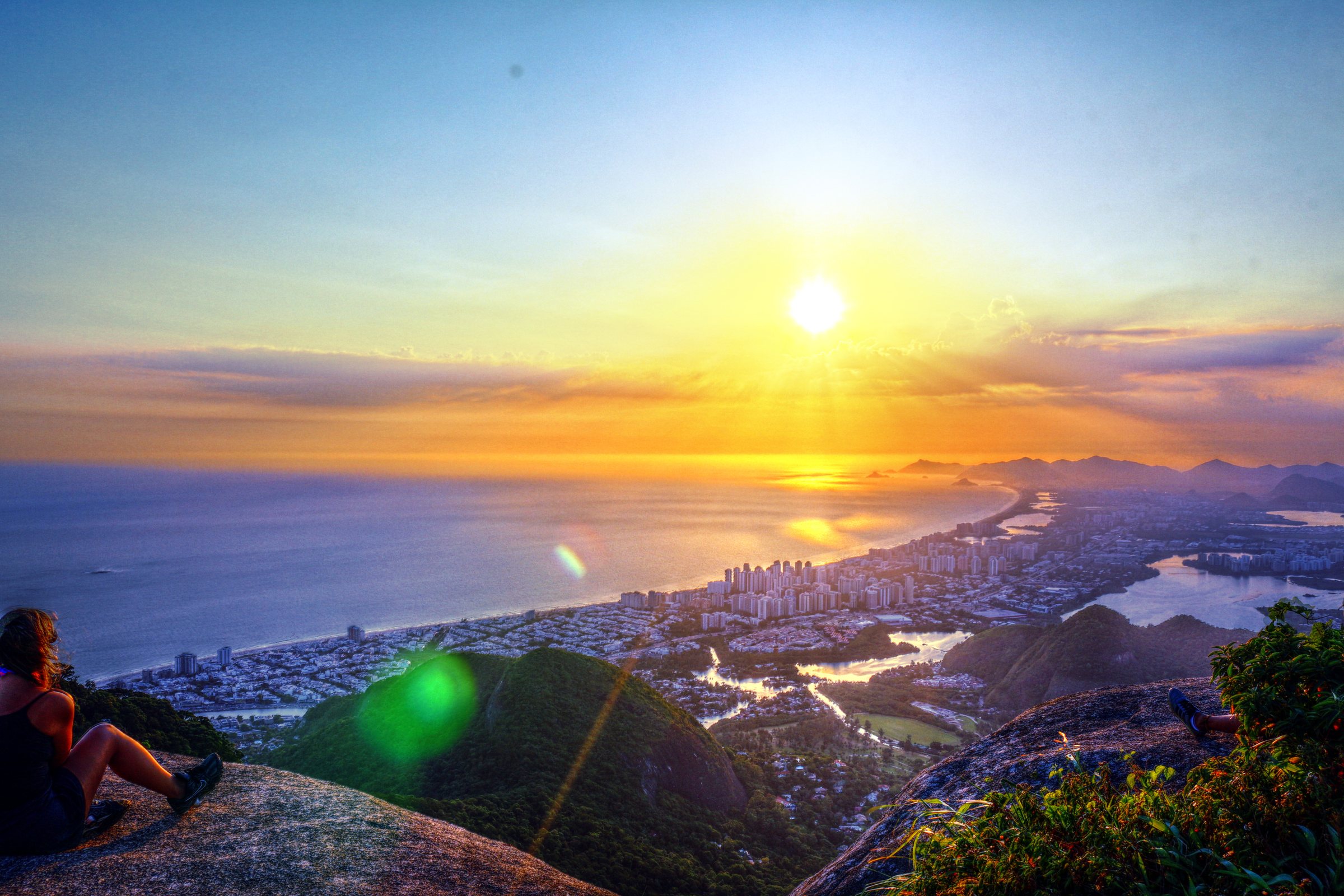
The plan that promised something else
Barra was drawn before it was built, and the drawing belonged to one of the most important architects Brazil ever produced. In 1969 the state invited Lúcio Costa — the man who had laid out Brasília a decade earlier — to prepare a master plan, a Plano Piloto, for the whole low-lying expanse between Barra da Tijuca, the Pontal de Sernambetiba and the Jacarepaguá basin. It was, at the time, mostly empty: sandbar, marsh, lagoon and restinga scrub, a coastal flatland the growing city had not yet reached. Costa saw a chance to do on a blank sheet what the old Zona Sul, cramped between hills and sea, had never allowed.
His plan carried the whole vocabulary of Brazilian modernism. There would be a great spine — an express highway running the length of the flatland, without signals or intersections, a road you were meant to move on rather than live beside. Off that spine, superblocks: large residential quadras of apartment slabs standing in open green, separated from the traffic, each a self-contained piece of city with its own commerce and schools and gardens. It was low-density where it counted and generous with open space everywhere, explicitly inspired by an American planning idea of wide boulevards and buildings set back in greenery. Costa imagined a diversified, breathing district — not a wall of towers, and emphatically not a fortress. The spine he drew became Avenida das Américas, the roughly twenty-one-kilometre arterial that still organises the whole of Barra: everything here is located by its relationship to that one enormous road.
It helps to understand what Costa was reacting against. He had spent his career watching Rio's older neighborhoods choke on their own success — Copacabana in particular, the dense vertical strip he regarded as a warning, where towers had been packed onto a narrow shelf of land between the hills and the sea until the light and the air ran out. Barra was to be the antidote: the same city given space to breathe, the density loosened, the buildings pulled apart and set in green so that no future Copacabana could congeal on the western flatland. The irony that history handed him is almost cruel. The very thing he designed Barra to prevent — a dense corridor of towers, sold by the unit, walling off the street — is close to what Barra became. He drew the escape route from Copacabana and the market used it to build a bigger, newer Copacabana on the sand. Where the old one at least gave onto a famous beach and a lived-in pavement, the new one gave onto a highway.
The comparison with Brasília is the one Costa's critics reach for, and it cuts both ways. Brasília was built by the state, all at once, to a plan the state enforced — which is why it looks, for better and worse, like the drawing. Barra was built by developers, plot by plot, over decades, each one optimising for what would sell — which is why it looks like a compromise between the drawing and the ledger. The superquadra idea survived in name and vanished in spirit: the blocks got taller, the green got thinner, the walls went up, and the open modernist city became a chain of private ones. Some scholars read this as the very moment Brazilian modernism ended — not in a manifesto, but in a flatland west of the mountains, quietly, as the plan was outvoted by the people building it.
It matters to Joá that this plan exists, because the same architect's thinking runs through both places at once. Costa's ideas about Rio — about roads, density, and where a modern city should be allowed to grow — are a thread we follow in more detail on their own page, Lúcio Costa's Rio. Barra is where those ideas were given the most room and, as it turned out, honoured the least.
What got built instead
Here is the honest part, and Costa himself said it first. Unlike Brasília, which he defended to the end of his life, the architect turned sharply against what happened to Barra da Tijuca. The plan that promised superblocks in parkland produced, over four decades, something close to the opposite: a dense sprawl of high-rise condominiums, most of them walled and gated, strung along an avenue built for speed and now permanently thick with traffic. The open green between the slabs became parking, service roads, and more slabs. The self-sufficient neighborhood units became gated communities that turn their backs to the street. The express spine that was never supposed to have a traffic light acquired dozens of them, and Barra's car culture — the plan assumed you would drive, and left little for anyone who wouldn't — hardened into the daily congestion the district is now known for.
The numbers tell the speed of it plainly. In 1991 fewer than a hundred thousand people lived in Barra da Tijuca. By 2010 the count had passed three hundred thousand, and by the 2022 census it stood above four hundred and twenty thousand — a neighborhood that grew from near-empty flatland to one of Rio's largest and wealthiest districts within a single working lifetime. Scholars who study the plan tend to reach the same rueful conclusion: that Barra is where Brazilian modernism ran into the market and lost, the master plan progressively undone by the developers who built the actual city. Life, as Costa's own commentators put it, turned out richer and wilder than the drawing.
None of which makes Barra a failure to the people who live in it. What the market built is, on its own terms, comfortable and coherent: broad avenues, reliable services, newness as a value in itself, and — a fact residents cite first and often — a reputation as the safest of Rio's affluent zones, a district notable for having almost no favelas inside it. If Joá sells itself on concealment, Barra sells itself on order. Both are answers to the same anxious question about how to live well in this city; they simply answer it in opposite directions.
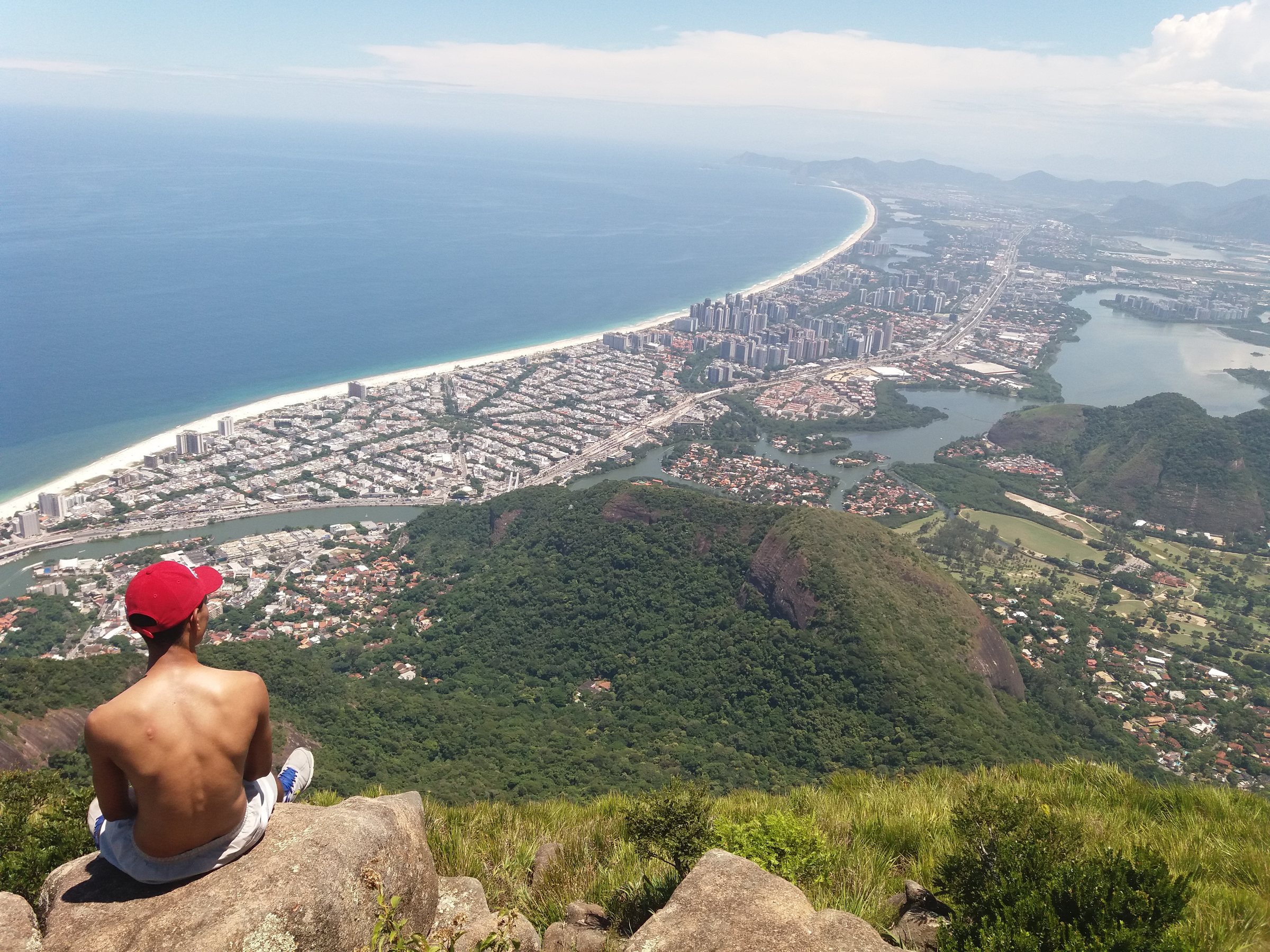
The rock, and the grid it looks down on.
From above Joá the contrast is a single view: the Pedra da Gávea and its protected forest on one side, the flat lit grid of Barra running west on the other. Old vertical secrecy meets new horizontal money across a few kilometres of coast — and the elevated road that joins them.
The most American beach in Brazil
People reach for the word "Miami" the moment they try to describe Barra, and the comparison is fair enough to be useful. The scale is American: the avenues, the setbacks, the reliance on the car, the preference for the enclosed and air-conditioned over the street. So is the texture of daily life — the drive-in errands, the chain restaurants, the sense that the good things are indoors and arrived at by parking. Costa reached for an American model on purpose in 1969, and the market, left to finish the job, delivered the American reality with a thoroughness he never intended. Barra is the part of Rio that looks least like the postcard and most like the suburb of a warm North American city, and its residents, on the whole, chose it for exactly that reason.
The beach itself, though, is entirely Rio, and it is magnificent. The Praia da Barra da Tijuca runs some eighteen kilometres, the longest beach in the city, a single unbroken arc of open sand and heavier surf than the sheltered Zona Sul coves. It is wide, bright, and — away from the few busy access points — often close to empty, because eighteen kilometres is more beach than even a district of this size can fill. Where Ipanema and Copacabana are social theatres, packed and performed, Barra's sand is somewhere you go to be left alone with the ocean. It is the same Atlantic that breaks under the cliffs of Joá, only here it has room to run.
Getting there, and getting around
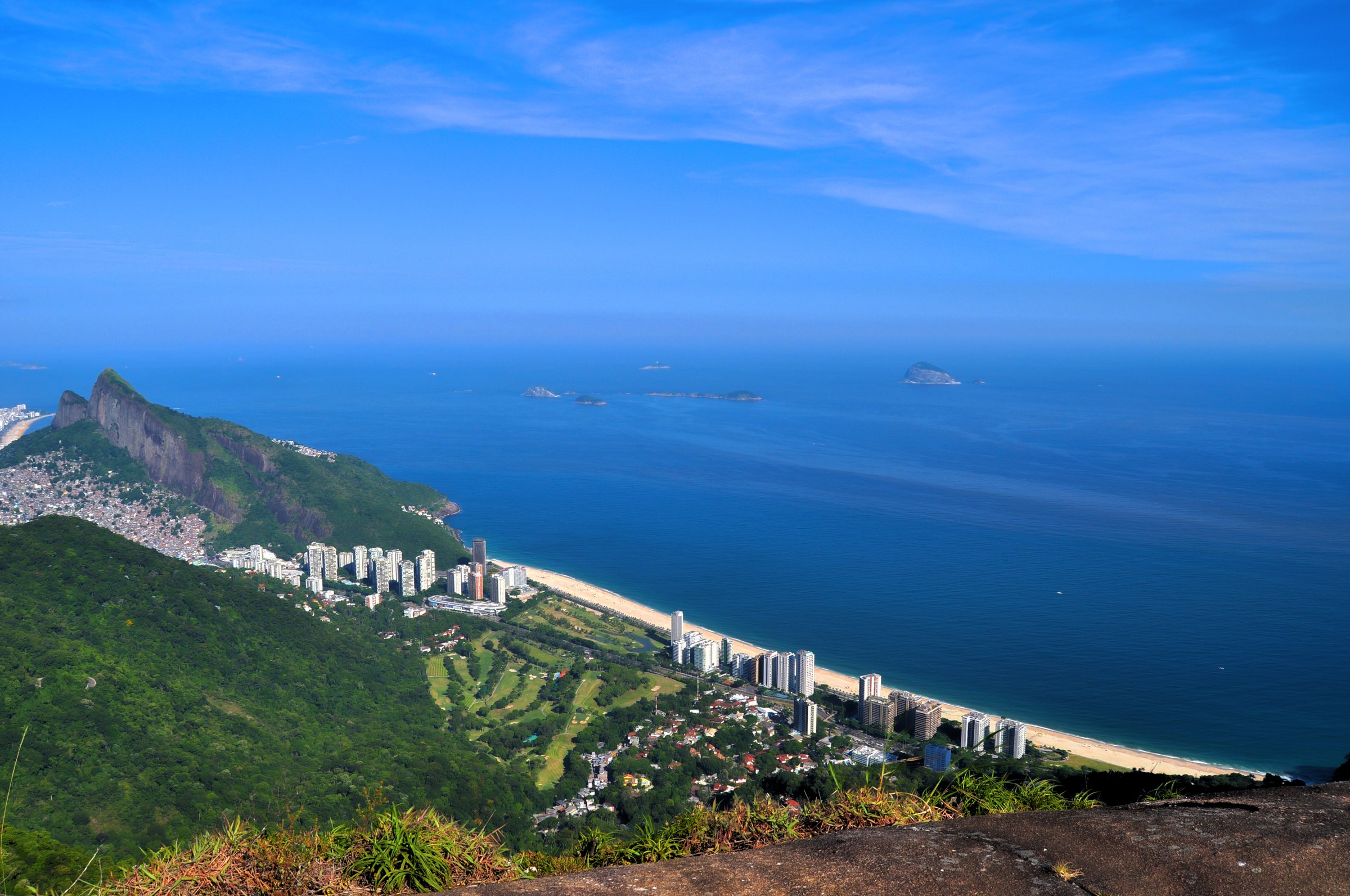
Barra's relationship to the rest of Rio has always been a problem of roads, because Costa's plan assumed the car and the city then had to keep building for it. For its first decades the district was reachable from the Zona Sul by two routes only: the coast road through Joá and São Conrado — the Elevado do Joá, threaded out over the rock, which is the whole reason this stretch of coast is connected at all — and the Lagoa–Barra highway punched through behind the hills in the 1970s. The Elevado is the seam that binds Joá to Barra; cross it westbound and you are in the flatland within minutes, which is exactly what makes Barra the natural everyday hub for anyone living on the Joá headland. That single elevated road does more to define the practical geography of this coast than any master plan ever did.
Later came more asphalt: the Yellow Line expressway in the 1990s, cutting north across the city to link Barra with the international airport; and, in the run-up to the Olympics, a network of dedicated bus rapid transit corridors — the TransOeste, TransOlímpica and TransCarioca lines — laid down to move people across the west without adding yet more private cars to Avenida das Américas. The BRT was the closest Barra ever came to admitting that a district built entirely around driving needed another way to move. It helped; it did not cure. Barra remains a place where distance is measured in traffic, where a trip that looks short on the map can dissolve into an hour on the avenue, and where the price of all that space and newness is paid, daily, in time spent behind a windshield. It is the standing rebuke to Costa's express-highway dream: the road that was never meant to have a red light now has little else.
Cathedrals of retail
If the avenue is Barra's spine, the shopping mall is its town square — the place the district actually gathers. The anchor is BarraShopping, opened in October 1981 as a bet on a neighborhood that barely existed yet, and grown since into one of the largest malls in Brazil and Latin America, a sprawling complex of some seven hundred stores that, joined to its adjacent New York City Center wing, functions as a covered downtown for the western coast. It is where Barra does the things older neighborhoods do on the street: strolls, meets, eats, is seen. That the social heart of a beachfront district is a shopping centre rather than a boardwalk tells you almost everything about how Barra chose to live.
At the luxury end sits Village Mall, a smaller, glossier centre built for the international brands — the flagship boutiques, the marquee names, the tenants who would be on a grand avenue in another city and are instead behind valet parking here. Between the two, Barra offers a density of first-rate retail, dining, cinema and medicine that no other part of Rio's west can match, and that Joá — which has, deliberately, no commerce of its own at all — cannot even attempt. For a Joá household, this is the practical case for Barra in one sentence: it is where the errands are. The hidden cliff supplies the view and the silence; the neighbor twelve minutes west supplies everything you actually need to buy.
There is a cultural reading in this too, and it is not entirely flattering. When the social centre of a beachfront district becomes a climate-controlled box with a parking deck, something has been decided about how people want to live — privately, comfortably, at a remove from the street and the weather and the unpredictable human traffic of a genuine public space. Barra did not stumble into the mall as its plaza; it chose it, the way it chose the gated condominium over the open block, the car over the pavement, the interior over the exterior. Critics call it a city with its back turned. Residents call it order, safety and ease, and point out — not wrongly — that a mall in the tropics is air conditioned, secure, and open when it rains. Both descriptions are true of the same building. What is not in dispute is the sheer usefulness of it: for the whole affluent west of Rio, Barra's retail is where the material business of a comfortable life gets done.
Life behind the gate
To live in Barra, for most of its residents, is to live inside a condomínio — a gated residential complex, often several towers sharing a walled compound with pools, gyms, function rooms, playgrounds, party spaces and a permanent staff of doormen and security. The best of them are small self-contained resorts; the plainest are simply towers behind a barrier. This is the form Costa's superquadra mutated into: the open block that was meant to flow into the city instead sealed itself off from it. The result is a district organised as an archipelago of private worlds, each one comfortable and complete inside its wall, with the public realm — the avenue, the strip mall frontage, the space between compounds — left as little more than the connective tissue you drive across to get from one enclave to the next.
It is worth being fair about why people choose this, because the appeal is real and it is the same appeal that draws people to Joá by a different route. Security is the first reason cited and the most honest: Barra's reputation as the calmest of Rio's wealthy zones, the district with almost no favelas woven into it, is a genuine draw in a city where safety is never taken for granted. Newness is the second — plumbing that works, lifts that are recent, buildings without the accumulated troubles of the old city. Amenity is the third: the pools and courts and party rooms that a vertical family life in the tropics runs on. Barra offers, in short, a frictionless version of the good life, bought by accepting that the good life happens indoors, behind a gate, and is reached by car. It is a bargain millions of people around the warm world have made, and Barra makes it more completely than almost anywhere in Brazil.
“Joá keeps its wealth out of sight; Barra puts its up in the air, in glass, along the avenue.”
The lagoons and the wilder west
For all the concrete, Barra is built on water as much as sand. Behind the beachfront lies a chain of coastal lagoons — Tijuca, Jacarepaguá, Marapendi and their smaller neighbours — the drowned lowland Costa's plan had to work around and never fully tamed. The Lagoa de Marapendi, a long saltwater lagoon running parallel to the beach, is the best surviving trace of what the whole flatland once was: a strip of restinga and mangrove, part of it now held as an environmental protection area, threaded through a district that mostly paved over its own origins. The Olympic Park, when it came, was built on a triangle of land pinched between two of these lagoons — the water was always the real shape of the place.
Keep driving west and Barra runs out into something wilder. Past the towers the coast loosens into Recreio dos Bandeirantes and, beyond it, the smaller far-western beaches — Prainha, Grumari — where the mountains come back down to the sea and the built city finally stops. These are the surf beaches, the empty ones, backed by protected hillside rather than condominiums, and they are where cariocas go precisely to escape the density Barra represents. It is a strange and telling geography: the same fifteen-kilometre stretch of coast holds Latin America's shopping malls at one end and near-untouched Atlantic Forest beach at the other, with the whole modern experiment laid out in between.
Recreio is the hinge between the two worlds — still gated towers, still Avenida das Américas, but thinning now, the density dropping off block by block as the land narrows toward the headlands. It is where families go when they want Barra's order but a little more sky, and it is as far as the master-planned city meaningfully reaches. Beyond it the road climbs into the coastal hills and the protected beaches begin, and the contrast becomes almost didactic: on one side of a single ridge, the most thoroughly engineered residential landscape in Rio; on the other, sand the city was never allowed to build on, held wild by the same environmental protections that keep the forest above Joá from ever being developed. The whole western coast, read end to end, is an argument about how much city is too much — and Barra sits in the exact middle of it, the most city of anywhere on the strip.
The Olympic decade
Barra's biggest single chapter arrived in 2016, when the district became the centre of gravity for the Summer Olympic Games. The city's four competition clusters were spread across Rio, but Barra held the most important of them: the Olympic Park, built on that triangle of reclaimed land between the lagoons, hosting roughly a dozen permanent and temporary venues and about half of all the athletes who competed. Barra had rehearsed the role once already — it had anchored the 2007 Pan American Games — and the Olympics finished the job the master plan had started, wiring the district into the rest of the city with new express bus corridors and cementing its status as the place Rio built its future when it needed somewhere flat and buildable to do it.
There was a logic to choosing Barra, and it was the same logic that built the place: it had land. The old Zona Sul, hemmed in by its hills, could never have found room for an Olympic Park and a village for eighteen thousand people; Barra, the flat frontier, could clear a triangle between two lagoons and start pouring concrete. The Games were, in this sense, the master plan's biggest single vindication and its harshest test at once — proof that Costa was right about where Rio's future had to physically go, and proof, in the messy aftermath, of how hard it is to turn a two-week spectacle into a lived neighborhood. The athletic venues have had the familiar afterlife of Olympic architecture: some repurposed, some converted into schools and sports centres, some left looking for a use. The Park is real and it is used; it is also, in places, too big for the ordinary life that has to fill it now that the world has gone home.
The clearest legacy, and the most complicated, is the athletes' village. Built in Barra to house everyone competing, it was the largest Olympic Village ever constructed — thirty-one residential towers, more than three and a half thousand apartments, a capacity near eighteen thousand people. It made headlines during the Games for the wrong reasons, with delegations arriving to find plumbing and wiring unfinished. And it made a slower kind of headline afterward. The plan was always to convert the towers into a new upscale neighborhood — christened Ilha Pura, "Pure Island" — and sell the apartments to the affluent. That conversion has been halting; years on, only a small fraction of the units had sold, and the district that was meant to be Barra's showcase became instead a monument to how hard it is to sell a city built for a two-week event back to the people who have to live in it. It is Barra's whole story in miniature: an ambitious plan, a market that does not quite cooperate, and a lot of very new towers waiting for the life they were drawn to hold.
Horizontal new money, vertical old
Set Barra beside Joá and you have the two extremes of how Rio's west decided to be wealthy. Joá spent its money going down and in — houses cut into a cliff, hidden in protected forest, no towers, no commerce, no through road, a neighborhood organised entirely around not being seen. Barra spent its money going up and out — towers along an endless avenue, malls as landmarks, everything new and legible and arrived at by car. One is the hidden vertical; the other is the horizontal on display. The Elevado that joins them is a border between value systems as much as a road: cross it going west and concealment gives way to visibility, mata gives way to glass, the twentieth century's discretion gives way to something newer and louder. This contrast is the real subject of The Views from Joá — because from the cliff, Barra is not somewhere you go so much as something you look at: the lit grid on the flatland, the coast running west, the neighbor you can watch from a window without ever quite joining.
And yet the two need each other, which is the part the contrast can obscure. Joá's near-total refusal of commerce only works because Barra exists twelve minutes away to absorb it. The malls, the hospitals, the international schools, the restaurants, the sheer buyable abundance of the western coast — all of it lives in Barra, and all of it is why a Joá household can enjoy a neighborhood with no shops of its own and never feel the lack. This is the quiet transactional logic of the whole western coast, and it is worth understanding before you understand what it is actually like to keep a home on the cliff — a subject we take up in Living in Joá. The hidden neighborhood outsources its daily life to the visible one, and both are the better for it.
Joá's window, Joá's warehouse
So what is Barra da Tijuca to a place like this house? Two things at once, and they do not contradict. It is the view: the long western prospect from Joá's ridge, the flat coast and the lagoons and the towers catching the last of the afternoon, a modern city laid out below the forest as a thing to be looked at from a distance. And it is the hub: the nearest concentration of everything a cliff cannot hold, close enough to be convenient and far enough to be optional, the practical engine that lets Joá stay impractical. You do not have to love Barra's traffic or its sprawl — few of its own residents love those either — to be glad it is there. It is the reason the most private address in Rio can also be one of the most comfortable.
That balance — the hidden house on the cliff, the open city at its feet — is a great deal of what makes Joá worth understanding, and worth living in. The Art de Vivre collection was built around exactly this kind of literacy about the coast: knowing not just what a house is, but what surrounds it, what it borrows from its neighbors, and what it deliberately keeps at arm's length. You can see how that reading of place runs through the wider portfolio at Art de Vivre, and how it shapes this particular house on the Joá headland at The House — the villa that turns its face west, toward Barra and the light, and its back to everything else. For the fuller sense of the coast this house sits within, the collection keeps an evolving portrait of the western shore at artdevivre.com.br, and Joá's other immediate neighbor — the beach on the far side of the Elevado — has its own account in São Conrado, the Neighbor.
Barra is the view and the errand; the cliff itself is the life. What it is actually like to keep a home on the Joá headland: Living in Joá.