The first thing anyone tells you about Joá is what it does not have. No supermarket. No pharmacy on the corner, because there are no corners in the ordinary sense. No bakery, no bank branch, no bus threading up the hill, no café with tables on the pavement — because there is, in the whole of the bairro, essentially nothing to buy. Joá is the smallest neighborhood in Rio de Janeiro and one of the very few that is almost purely residential: a square kilometre and a half of houses folded into forest above the sea, with a highway passing over the top and nothing commercial underneath it. To live here is to accept that daily life happens somewhere else, and to decide that the trade is worth making. Most people who make it never look back.
Joá Rio is published from ADV101, a five-suite villa in Joá offered at R$ 15,000,000, shown privately by appointment through Art de Vivre.
Ask about a viewing on WhatsApp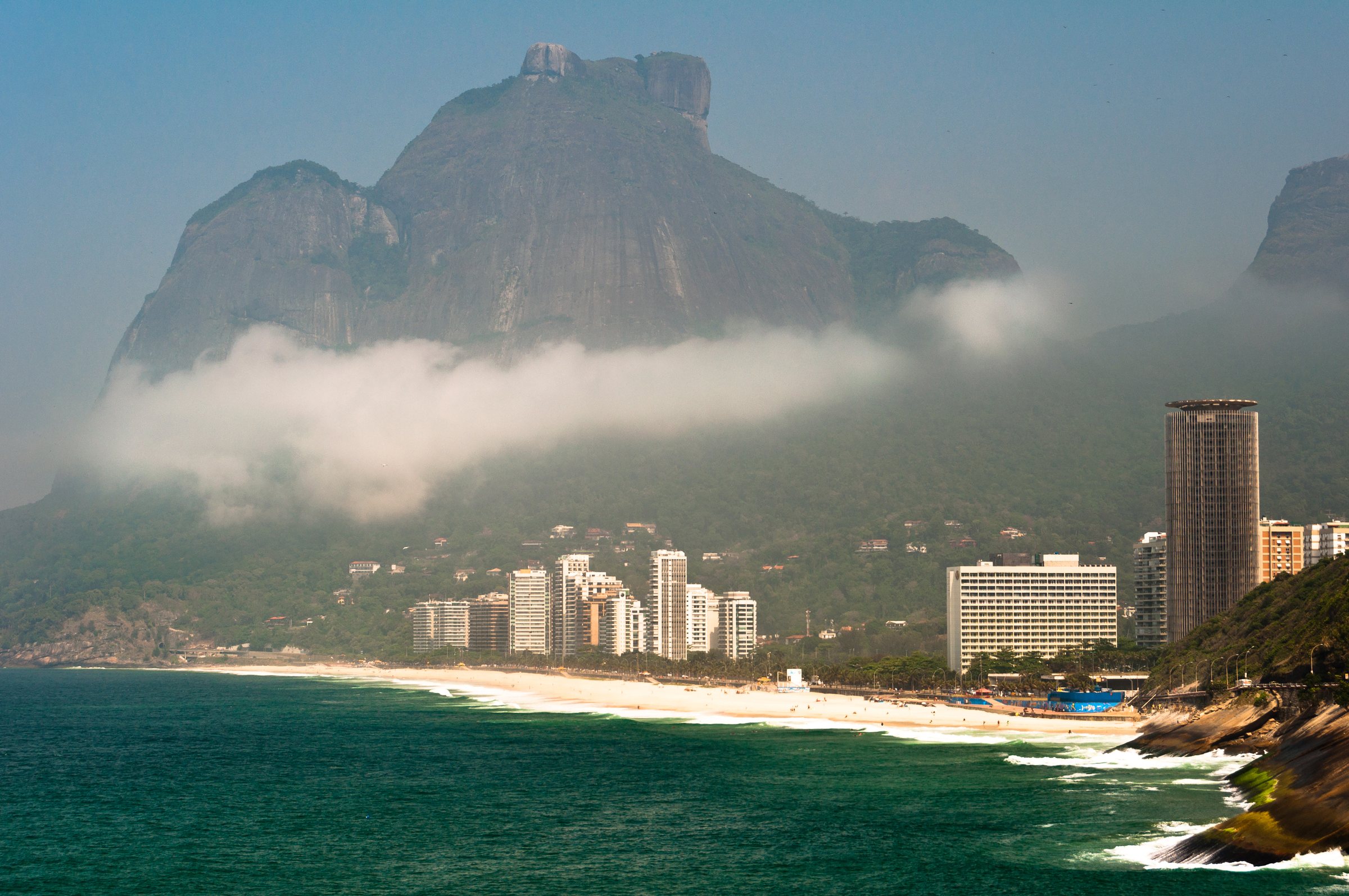
The bargain of a bairro with no shops
It is worth being precise about the absence, because it is the single fact from which everything else about living in Joá follows. The neighborhood occupies a little under a hundred and seventy hectares on the flank of the Morro da Joatinga, and across all of it there is no commercial strip, no shopping street, no internal public transport and no through-traffic to speak of. The one road that matters, the Estrada do Joá, exists mainly to deliver you to the houses and the gated condominiums set into the hillside; it is not a route to anywhere, and the elevated highway that is a route to somewhere runs above and past the bairro rather than through its heart. You cannot walk to buy bread. You cannot walk to catch a bus, because there is no bus to catch. If this sounds like a deprivation, that is only because most neighborhoods are built the other way around.
What the absence buys is the thing Joá is famous for: quiet, privacy, and the sense of living inside a landscape rather than a city. There are no towers with sightlines into the gardens, no delivery trucks idling at a loading dock, no foot traffic that did not come here on purpose. The trade-off is car-dependence, plainly and permanently. A resident of Joá organises life around the car in a way a resident of Leblon or Ipanema never has to. The reward is that when you come home and the gate closes behind you, the noise of the city does not follow you up the hill. For the right household this is not a compromise at all. For the wrong one it is a daily irritation that never quite goes away. The honest field guide begins by saying which you are likely to be.
Where residents actually shop and eat
The good news, and the reason the arrangement works, is that Joá is not remote. It is hemmed in by some of the best-served neighborhoods in the city, and every one of them is a short drive away. The nearest full-service address is the one next door: São Conrado, immediately to the east across the Zuzu Angel tunnel, where the São Conrado Fashion Mall sits on the Estrada da Gávea with a supermarket, a cinema, restaurants, pharmacies, a bank or two and the everyday services a house actually runs on. For most Joá households this is the default errand-run — close enough that it functions, more or less, as the neighborhood's missing high street. It is a polished mall rather than a corner shop, which tells you something true about the register of daily life out here: even the groceries come with valet parking. We say more about the neighbor in our guide to São Conrado.
East of that, toward the Zona Sul, the choices deepen. Gávea and Leblon are ten to fifteen minutes away through the tunnels in ordinary traffic, and this is where residents go when they want the city proper — the restaurants, the delicatessens, the doctors' consulting rooms, the bookshops. The Shopping da Gávea, small and old-fashioned and beloved, is as much a theatre district as a mall, with four playhouses inside it; Leblon has its own quiet, expensive shopping center and the best street-level retail in the city. A Joá family that keeps a foot in the Zona Sul tends to treat Leblon as its true neighborhood and Joá as the bedroom on the hill.
What no direction supplies is the thing a dense neighborhood supplies for free: the unplanned errand. In Leblon you notice you are out of coffee and you are back with a bag in ten minutes on foot. In Joá the same discovery means a car, a gate, the road, a parking garage and the whole apparatus of a proper trip, and so the rhythm of provisioning changes. Residents keep fuller pantries and larger fridges than a Zona Sul apartment ever needs; they consolidate errands into a single weekly run rather than a dozen small ones; they lean on standing deliveries for the staples. It is a more deliberate way of keeping a house, closer to the way a country property is run than a city flat. Once the habit is formed it is barely noticed — but the first month on the hill is usually the month a new resident learns to stop running out of things.
West, the other way over the elevado, is Barra da Tijuca — flat, planned, American in its scale, and built entirely around the car, which makes it the natural supply depot for a car-dependent hill. This is where the hypermarkets are, and the big-box everything, and the two malls that anchor the district: BarraShopping, one of the largest shopping centers in the country, and the luxury VillageMall attached to it. If São Conrado is the corner shop and Leblon is the high street, Barra is the warehouse: the place you go for the monthly stock-up, the appliance, the thing you need in a size the boutiques do not carry. Our Barra da Tijuca guide lays out what is there in detail. Between the three directions, a Joá resident is rarely more than fifteen minutes from anything a household could want — provided the household is willing to drive to it.

The flat city on the other side.
Over the elevado, Barra opens out — the malls, the hypermarkets, the international schools, the whole car-scaled district that supplies the hill with everything Joá deliberately refuses to hold itself. Five to ten minutes down the coast road, and a different Rio entirely.
The daily drive: the Elevado, the tunnels, and the times
Everything in Joá is measured in drive time, so it is worth learning the geography of the road. The bairro straddles the coastal highway that the city calls the Autoestrada Lagoa-Barra — officially the Autoestrada Engenheiro Fernando Mac Dowell — a dual-carriageway express route with its own motorcycle lane that runs, at roughly ten and a half kilometres, from Gávea in the Zona Sul out to Barra da Tijuca. The stretch that made Joá possible is the Elevado do Joá — the Elevado das Bandeiras — the elevated section carried out over the rock along the water, threading the Túnel do Joá through the headland. To the east, the tunnel system named for Zuzu Angel links the road down into São Conrado and on toward the beaches of the Zona Sul. We tell the full story of how the road was built, and of the names it carries, in the history of the Estrada do Joá.
In practice, the times a resident lives by look something like this. Barra is the closest destination — five to ten minutes west, essentially straight down the elevado — which is why the schools and the weekly shop tend to pull that way. Leblon and Ipanema are the other anchor: ten to fifteen minutes east through the tunnels when the road is clear, and this is the drive that defines the neighborhood's whole proposition. A resident can keep an office, a table at a favourite restaurant and a circle of friends in the Zona Sul and still sleep on a forested cliff above the sea, behind two gates and a wall of trees. That is the bargain of the hill in one sentence: central enough to work, hidden enough to disappear. Our comparison of Joá with Leblon and Ipanema weighs the two lives against each other for anyone deciding between them.
The honest caveat is the traffic, and it is a real one. "When the road is clear" is doing quiet work in those estimates, because the Lagoa-Barra is one of the busiest arteries in the city and it does not stay clear at the hours everyone needs it. At the morning and evening peaks — and on any Friday in summer, when the whole of Rio seems to be driving to or from Barra — the ten-minute run east can double or worse, and the tunnels can back up to a crawl. Rain makes it worse; a breakdown in the Túnel do Joá can make it much worse. Residents learn the rhythm of it the way sailors learn tides: you time the school run and the dinner reservation around the road, you keep a sense of which direction is moving, and you accept that a bad afternoon on the autoestrada is the price of the address. Nobody who has lived here for a season is surprised by the traffic. They have simply folded it into the shape of the day.
“Everything you need is fifteen minutes away — which is another way of saying nothing you need is here.”
Schools, and why families choose the hill
For all its reputation as a hideaway for the famous, Joá is quietly a family neighborhood, and the reason is partly the schools. The bairro itself has none — consistent with having no commerce of any kind — but it sits within easy reach of the densest cluster of international and bilingual schools in the city, spread across Barra da Tijuca and Gávea on either side of the hill. The Escola Americana do Rio de Janeiro, the city's long-established American school, runs campuses in both Gávea and Barra — an American and IB curriculum from early years through the high-school diploma — which means a Joá family can reach one of its two sites in either direction without ever leaving the coastal corridor. That geographic accident, a top school on each flank, is a large part of why families with school-age children tolerate the car-dependence: the daily run is short, and it is a run they were always going to make.
The rest of the cluster fills in around it. The SIS Swiss International School runs a bilingual, IB-continuum campus in Barra; the British School of Rio de Janeiro, one of the oldest foreign schools in the city, keeps a campus in Barra da Tijuca as well, and the district holds a long list of Brazilian private schools besides. Because Barra was planned late and built around the car, its schools were designed for exactly the kind of family that drives in from a quieter address — which is precisely what a Joá household is. The practical upshot is simple: if the reason you are considering the hill is children, the schooling is not an obstacle. It is one of the arguments in favour. What Joá cannot give a family is the walk-to-school life; what it gives instead is a five-to-fifteen minute drive to some of the best schools in Rio, from a house where the loudest sound in the garden is birdsong.
Healthcare, deliveries, and the logistics of a house on a cliff
The same principle governs healthcare and the hundred smaller logistics of running a household: nothing is on the hill, and everything is a short drive away. The private hospitals and clinics that a Rio family relies on are concentrated in Barra da Tijuca and in the Zona Sul, both within the usual ten-to-fifteen-minute band, and residents keep their doctors, dentists and laboratories in one or the other depending on which way their life already leans. For genuine emergencies, the calculus is worth thinking about honestly before you move: an ambulance, like everything else, arrives via the autoestrada and the tunnels, and at the wrong hour the same traffic that lengthens the school run lengthens the response. It is one of the quiet costs of a cliff address, and the households that manage it well are the ones that have thought about it in advance rather than the ones who assume the hill is closer to things than it is.
There is a household staff dimension to all of this that is easy to overlook and worth stating plainly, because it shapes how the neighborhood actually functions. A hill with no bus line and no commerce is a hill that everyone who works on it must reach by other means — by car, by ride-share, by the condominium's own arrangements — and the well-run houses think about that as carefully as they think about their own commute. The people who keep these properties running, the daily and live-in staff who make a large forested house possible, are part of the logistics of the address, and a household that has not planned for how they arrive and depart discovers the gap quickly. It is one more way the hill rewards forethought and punishes the assumption that a home this beautiful must also be simple to run.
Day to day, though, the modern city has softened the isolation considerably. What cannot be walked to is, increasingly, delivered — groceries, pharmacy orders, restaurant meals, the whole apparatus of app-based logistics — and the gated condominiums are set up to receive it, with gatehouses that log arrivals and hold parcels. Domestic staff, gardeners and pool services come to the house the way they come to any large Rio property, by car or by the same delivery economy. A Joá household runs, in other words, on a combination of the car it keeps and the drivers it invites: the resident goes out for the things worth going out for, and lets the rest come up the hill. It is a way of living that assumes a certain level of means — this is not a neighborhood for the household that must count every trip — but within that assumption it works smoothly, and it works because the surrounding districts are so well supplied that the hill can afford to hold nothing at all.
Climate, sea air, and the weather of the cliff
The setting does more than frame the view; it sets the weather of daily life. Joá faces the open Atlantic on a south-western coast, and the sea is close enough that you live inside its air. The breeze off the water is near-constant, which is a mercy in a Rio summer — the hill runs cooler and fresher than the flat, radiant heat of Barra or the enclosed streets of the Zona Sul — and the same wind carries salt, which is the small tax the sea collects in return. Sea air is hard on a house. Metal fittings corrode, electronics age faster, cars kept outdoors take a beating, and anything not chosen for the marine climate shows its age quickly. Owners here learn to specify marine-grade hardware and to maintain more often than an inland house would need. It is not a complaint so much as a condition of the address: the same sea that gives you the view and the breeze also asks to be budgeted for.
The winter, from roughly June to September, is the hill's quiet secret. Rio's cooler months are mild and dry rather than cold, and on the coast at Joá they arrive as clear air, low humidity and a sea that keeps its warmth long after the crowds have thinned. The relentless summer sun softens; the light lengthens; the garden stops fighting the heat. Many residents will tell you that the winter is when the neighborhood is at its best — the view its sharpest, the forest its most comfortable, the road its emptiest. It is a useful corrective to the postcard image of Rio as a place of permanent high summer. On this hill, the gentler season is arguably the finer one.
The rain is the other great fact of the climate, and the forest behind the houses explains it. Rio's summer, roughly November to March, is hot, humid and prone to sudden heavy downpours, and the wooded slopes of the Tijuca massif that rise directly behind Joá catch and hold the wet. The rewards are obvious — the green is extravagant, the light after a storm is the reason people photograph this coast — but the responsibilities are real too. A house built into a forested hillside above the sea has to think about drainage, about slope stability, about the way water moves in a cloudburst. The well-run condominiums manage this invisibly and the well-built houses were designed for it; it is simply part of what it means to live on a cliff in a rainforest, and part of what the caretaking of such a house involves. The climate here is not gentle so much as generous: it gives a great deal and asks for attention in return.
The quiet, and the forest at the back door
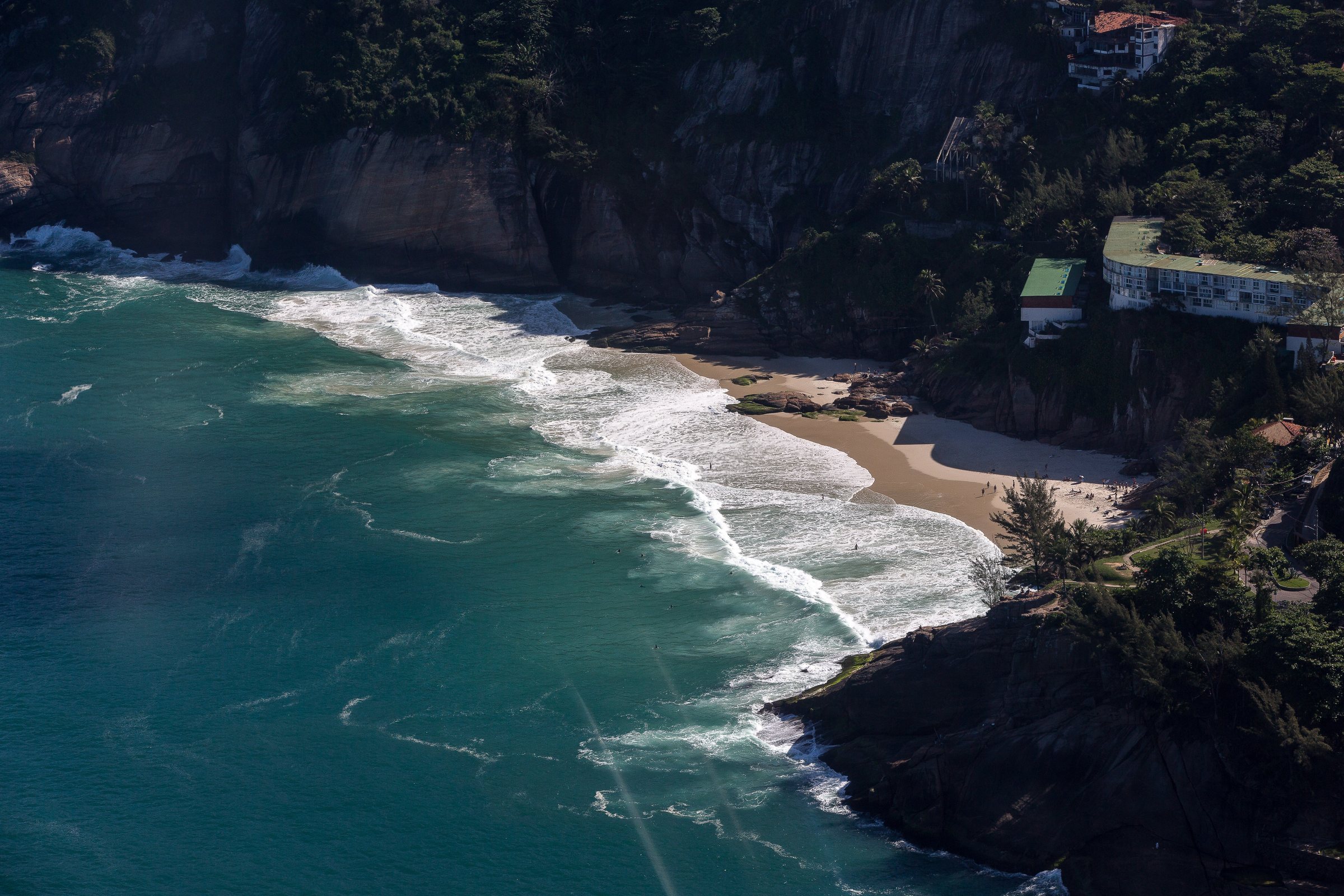
What you notice first, once you are inside the gates, is the silence — not a dead silence but a full one, the sound of a place with a forest at its back and no traffic at its heart. Joá borders the largest tract of urban Atlantic Forest in the world, the protected slopes of the Tijuca massif, and the mata does not stop politely at the property lines. It presses right up to the houses, which is why the wildlife is a daily presence rather than an occasion. Tufted-eared marmosets — the little saguis — move through the canopy and along the walls; toucans and tanagers work the fruiting trees; the dawn chorus is genuinely loud. The fauna of the Tijuca National Park runs to hundreds of species of birds and mammals, and a fair number of them treat the gardens of Joá as an extension of the park, because to the animals that is exactly what the gardens are.
Living with the forest is its own small education. The same green that gives the neighborhood its beauty brings mosquitoes in the wet season, the occasional snake that has wandered down from the mata, and marmosets bold enough to raid a fruit bowl left near an open window. None of it is dangerous and all of it is the point: you did not move to Joá for a manicured suburb, you moved for a house in a forest above the sea, and the forest is a living thing that behaves accordingly. Residents who thrive here are the ones who find this delightful — who like that a toucan is a normal morning sight and that the loudest neighbor is a troop of monkeys. Those who wanted a lawn and nothing on it are, quietly, in the wrong place. The wildlife is not a feature that can be switched off. It is what the address is made of.
The community, such as it is
A neighborhood with no shops and no public square has an unusual kind of community — one organised around gates rather than streets. Because most houses sit inside gated condominiums cut into the hillside, each with its own entrance, its own patrol and its own internal roads, the social life of Joá is a life of private thresholds. Neighbors know one another within a condominium and often barely beyond it; there is no café where the bairro gathers, because there is no café at all. What community exists is discreet by design, and that suits the residents, who came here in large part precisely to be left alone. The clubs and the private beaches supply what social geography the hill has — the Clube Costa Brava at the point, the sheltered cove of Praia da Joatinga reached on foot through a gate — but even these are guarded, low-key, and firmly for those who belong. Privacy here is not a service that was added; it is built into the topography and the way the bairro is organised.
The upside of this is obvious: a resident is never on display, never obliged to perform the small public rituals of a busier neighborhood, never watched. The downside is equally clear and worth naming, because it is the mirror image of the charm. Joá can be isolating for anyone who draws energy from the street — from running into people, from a walkable radius of familiar faces, from the low hum of a lived-in neighborhood. There is no such hum here. The hill is a collection of private worlds behind walls of forest and stone, connected by a road and very little else. For a household that values its own company and its own gates, this is exactly right. For a household that will be lonely without a neighborhood around it, no view compensates for the quiet. It is the most important question a prospective resident can ask, and the one the drone shots never answer.
Who it suits, and who it doesn't
So the field guide ends where an honest one should, with the plain summary. Joá suits the privacy-seeker before anyone else — the household, public-facing or simply private by temperament, that wants to close a gate on the city and not be found. It suits the family that will use the international schools on either flank and does not mind the drive to them, that wants children raised with a forest at the back door and the sea in front, in a house where the loudest thing is the dawn chorus. It suits people who already keep their real life in the Zona Sul or Barra and want a refuge from it rather than a substitute for it — who treat the fifteen-minute drive not as a burden but as a moat. And it suits anyone for whom the point of a home is the landscape it sits in: the light off the Pedra da Gávea, the coast opening west toward Barra, the green pressing up to the windows. For these residents Joá is not a compromise at all. It is the one place in Rio that gives them exactly what they came for.
It does not suit the person who wants to walk to a café. That is not a small exclusion; it is the defining one. If your idea of a good life includes stepping out the door for bread, a coffee, a newspaper, a face you recognise — if you want a neighborhood in the everyday, street-level sense of the word — Joá will feel like an exile no matter how beautiful the view. It does not suit anyone unwilling to build life around a car, or anyone who will resent the Lagoa-Barra traffic every time it turns against them. It does not suit the household that wants to be in the middle of things. Joá is, by design and by geography, the opposite of the middle of things. The whole of its value lies in that fact, and so does the whole of its cost. The people who love it here understood the bargain before they signed it — and, having made it, found that everything they gave up was everything they had wanted to leave behind.
It is against exactly this backdrop that a house like ours was conceived. The villa ADV101 sits where the field guide points — behind the gates, inside the forest, above the sea — and it is part of the wider Art de Vivre collection of homes assembled for people who have made precisely this trade. If the life described here is the one you are looking for, the Art de Vivre portfolio and the Joá field notes are the place to begin.
The gates, the patrols, and the topography that makes all this privacy possible are a subject of their own. We take them up in Privacy and Security in Joá.