Three neighborhoods in Rio de Janeiro answer to the word "most expensive," and they do not mean the same thing by it. Leblon and Ipanema are the beach — flat, walkable, glamorous, priced by the square metre at a rate no other apartment stock in Brazil can match. Joá is the cliff above and west of them — a thin band of hidden houses where the record is set not per metre but per house, in the number at the bottom of the contract. All three are true statements about wealth in the same city, and they describe three genuinely different ideas of the good life. This is an honest comparison of them — on price, on privacy, on beach culture, on who lives there and on what you actually give up to choose one over the other two.
Joá Rio is published from ADV101, a five-suite villa in Joá offered at R$ 15,000,000, shown privately by appointment through Art de Vivre.
Ask about a viewing on WhatsApp
One question, three right answers
Ask a broker in Rio which is the most expensive neighborhood and you should be suspicious of a quick answer, because the honest one has three parts. If you mean the highest price for a single home, the answer is Joá. If you mean the highest price per square metre of apartment, the answer is Leblon, with Ipanema a close and rising second. And if you mean the neighborhood most people picture when they say "rich Rio," the answer is probably still Leblon or Ipanema, because those are the names on the postcards. Each answer is correct on its own terms, and the confusion between them is the single most common mistake in writing about this coast.
The clearest recent snapshot comes from a 2025 study by the property firm Loft, which analysed tens of thousands of active listings across Rio and, among homes above 125 square metres, put Joá first in the city by average price — roughly R$9.7 million, on an average house size near seven hundred square metres. Behind it came the beach names in the order you would expect: Leblon around R$6.2 million, Ipanema around R$5.5 million, then Jardim Botânico and Barra da Tijuca (Portas / Loft, 2025). Read plainly: the typical house on the market in Joá costs more than the typical house in Leblon, and considerably more than the typical one in Ipanema. That is the sourced, defensible claim, and it is the one this site stands behind.
But note what that same table quietly says about size. The average Joá house in the study ran near seven hundred square metres; the Leblon and Ipanema homes averaged closer to two hundred. Joá wins on total price partly because it is selling something structurally larger — a house on a plot, not a floor in a tower. Which is exactly why the second answer exists, and why it points the other way.
The two numbers, and why they don't fight
The number that makes Leblon and Ipanema famous is price per square metre, and on that measure they lead not just Rio but the country. At the close of 2025 and into early 2026, the FipeZAP index put Leblon around R$25,700 per square metre and Ipanema just behind, both ahead of every neighborhood in São Paulo, including Itaim Bibi (InfoMoney / FipeZAP). Leblon has held that top spot in Brazil for years; the news of the last two years is how close Ipanema has drawn, with the sharper twelve-month rise of the two (Tempo Real).
Joá does not really appear in that ranking at all, for a simple reason: it has almost no apartments. It is a neighborhood of large houses on large plots, and the price-per-metre league is an apartment league. So the two records sit side by side without contradiction. Leblon and Ipanema own the most expensive square metre; Joá owns the most expensive house. Anyone who tells you Joá has "the priciest square metre in Rio" is quoting a figure the apartment market flatly contradicts — the same caution we set out at length in Buying in Joá. The two claims measure two different things, and keeping them apart is the first discipline of reading this market.
- Joá — #1 in Rio by average house price, ~R$9.7M; average house ~700 m² (Loft, 2025).
- Leblon — #1 in Brazil by apartment price per m², ~R$25,700; avg listed home ~R$6.2M.
- Ipanema — close 2nd on price per m², ~R$25,300, with the faster recent rise; avg home ~R$5.5M.
- The pattern: beach neighborhoods lead per metre; the cliff leads per house.
What the money actually buys in space
The gap between the two records becomes concrete the moment you translate it into floor space. Take the Loft averages at face value. An average Ipanema home in the study ran near two hundred and ten square metres; an average Joá house, near seven hundred. At Ipanema's roughly R$25,000 a metre, that two-hundred-metre apartment lands close to the R$5.5 million average the same study reports — the numbers agree with each other. Now run Joá the other way: its R$9.7 million average across seven hundred square metres of house works out to something in the region of R$14,000 a metre of built house, before you even count the land it sits on. The cliff's metre is cheaper than the beach's; the cliff's house is dearer, because there is so much more of it.
That is the whole trade in one line of arithmetic. On the beach you pay a world-record price for each metre and buy relatively few of them. On the cliff you pay a gentler price per metre and buy a great many — plus the plot, the garden, the pool and the forest boundary that an apartment cannot include at any price. Neither is a better deal; they are deals in different currencies. A buyer comparing a R$6 million Leblon apartment against a R$9.7 million Joá house is not comparing like with like at all, and the sooner that is admitted, the clearer the choice becomes.
Leblon — the last beach, the tightest metre
Leblon is the western end of the line. Beyond it the Zona Sul beaches run out against the Dois Irmãos massif, and the only way further west is up and over toward São Conrado and Joá. That geography — a small, finite neighborhood pressed between the sea, the lagoon and the mountain — is a large part of why its square metre is the most expensive in the country. There is very little of Leblon, and no more of it can be made.
In character it is the quieter, more residential of the two beach names. Leblon is where Rio's establishment keeps its address: a neighborhood of low-key affluence, good schools, dogs on the calçadão, and a dining street — Rua Dias Ferreira, in the pocket locals call the Baixo Leblon — that is as close as the city has to a single strip of high gastronomy. The register is discreet money rather than display; families and professionals rather than the fashion crowd. If Ipanema sets the trends, Leblon tends to be where people move once they no longer feel the need to be at the centre of them. The neighborhood wears its money quietly: the wealth is in the address and the square metre rather than in anything on display, and that understatement is precisely what its residents are paying to keep. It is a short, expensive, deeply settled few blocks, and it behaves like one.
What you buy in Leblon is proximity in its purest form: the beach at the end of the block, everything you need within a ten-minute walk, and the reassurance of the country's most defended real-estate value under your floor. What you give up is space and quiet in the literal sense. This is apartment living, with a neighbor above and below, a doorman downstairs, and the ordinary friction of a dense, desirable few blocks where parking is a sport and the beach on a hot Sunday belongs to the whole city.
Ipanema — glamour, noise, and the girl who named it
Ipanema sits just east of Leblon, the two divided by the narrow Jardim de Alah canal, and for most of the world it is the more famous name — carried there by a bossa nova song. "Garota de Ipanema," written in 1962 by Tom Jobim and Vinicius de Moraes and reportedly inspired by a young woman the pair watched walk to the beach past a corner bar, became one of the most recorded songs in history and fixed Ipanema in the global imagination as the essence of carioca cool (Wikipedia). The bar is still there, renamed for the song; the beach still trades on it.
On the ground Ipanema is the more energetic, more cosmopolitan of the pair — the bohemian, trend-setting beach. Its nightlife is denser and louder, concentrated around the Farme de Amoedo and Garcia D'Ávila corners; its Sunday hippie fair, its galleries and its bars give it a cultural churn Leblon does not try to match. Ipanema Beach itself is socially mapped almost metre by metre, each stretch — marked by the lifeguard posts, the postos — claimed by a different tribe of the city. It is glamour that participates rather than withdraws.
The two beach neighborhoods share the same essential offer, which is why they trade the price-per-metre crown back and forth rather than one running away from the other. Choosing between them is less a question of budget than of temperament: Leblon for the quieter, more familial version of the beach life, Ipanema for the version that is out in the street. Both are, unmistakably, the beach. Which is exactly what Joá is not.

Flat beach one side, hidden cliff the other.
Leblon and Ipanema live on the flat, at sea level, in front of the water. Joá lives above it — on the headland where the coast turns to rock, west of São Conrado and east of the long sweep of Barra da Tijuca. The two ideas of Rio wealth are barely a few kilometres and a whole world apart.
Joá — the fortune you can't see from the road
Drive the Elevado do Joá — the elevated coast road that threads the cliffs between São Conrado and Barra — and you will pass directly through the most expensive neighborhood in Rio without seeing a single one of its houses. That is the point of the place. Where Leblon and Ipanema face the city and are faced back, Joá turns away: its mansions are set into the hillside and the Atlantic Forest, behind gates and greenery, on winding private roads that go nowhere a stranger needs to be. It is a bairro of fewer than a thousand residents on a square kilometre and a half of cliff, and it is built, deliberately, to disappear.
A point of accuracy that matters, and that we hold to across this site: Joá is an ordinary, open public neighborhood — a bairro like any other on the city map, not a single closed compound. What creates the privacy is that most of its houses sit inside gated condominiums within the bairro — the best known being the Condomínio da Joatinga — each with its own gate, guardhouse and internal roads. The neighborhood is public; the clusters of houses inside it are private. Getting that distinction right is the difference between describing Joá honestly and repeating a cliché, and it is drawn out more fully in Living in Joá.
What you buy on the cliff is the inverse of what you buy on the beach. Not a floor in a tower but a whole house on its own ground; not the sea at the end of the block but the sea seen from above, framed by the Pedra da Gávea and the protected forest that will never be built on behind you. Space, silence, a gate, a view that arrives already composed. What you give up is the walkable street life — Joá has no commerce, no cafés, no beach you can stroll to barefoot, and no nightlife at all. You trade the calçadão for the car, and the crowd for the quiet. For the people who choose it, that trade is the entire appeal.
“Leblon and Ipanema are seen; Joá is the address you choose so you won't be.”
The trajectory — who is rising, who is holding
A comparison frozen at one moment misses the movement, and the movement is part of the story. Of the two beach neighborhoods, Leblon has behaved like the blue chip it is: a steadier, more modest climb, in the order of six to seven per cent over the twelve months to early 2026, on top of a base that was already the highest in the country. Ipanema has been the mover, rising at closer to double that pace over the same window and closing much of the gap to Leblon's square metre (InfoMoney / FipeZAP). The short-term rental boom is part of the reason Ipanema has run hotter — the fame that the song lent it now translates directly into nightly demand, and that demand shows up in the sale price.
Joá does not fit on that chart, and its absence is itself informative. A market of a few hundred houses and a handful of buyers does not produce a clean monthly index; it produces occasional, headline-making transactions and long stretches of quiet. You cannot read Joá the way you read Ipanema, month over month, because the sample is too small and too lumpy. What holds the cliff's value is not a rising tide of demand but a fixed and shrinking supply — a neighborhood that cannot expand, hemmed by the sea and the protected forest, where the city in 2024 even demolished mansions built illegally over the line. Scarcity does the work that momentum does on the beach.
For a buyer thinking about the future rather than the view, the three offer three different bets. Leblon is the defensive hold — least likely to surprise you in either direction. Ipanema is the growth story, with the volatility that comes attached to anything running above the market. Joá is the scarcity play — a wager not on Rio's demand curve but on the simple fact that no one will ever build another Joá. None of that is investment advice, and none of it should be taken as a forecast; it is only a fair reading of how three very different markets have actually behaved.
Getting there, and getting around
Daily logistics divide the three as sharply as anything else. Leblon and Ipanema are built for the pedestrian: flat, gridded, dense, with the metro reaching Ipanema's General Osório station and Leblon a short hop beyond, and with almost everything a household needs — market, pharmacy, school, restaurant, beach — inside a short walk. You can, genuinely, live in either without a car, which in a city like Rio is a luxury of its own. The cost of that convenience is the density that produces it: traffic, scarce parking, and streets that belong to everyone.
Joá is the opposite arrangement. There is no metro, no commerce, no internal bus line worth the name, and nothing within walking distance except other houses and the forest. Life on the cliff assumes a car — often more than one — and every errand begins with the drive down and out along the Elevado do Joá toward São Conrado and the Zona Sul, or west toward Barra. That road, and the tunnels that feed it, are the neighborhood's single thread to the rest of the city; the history of how they were built is told in the Joá guide. In exchange for the inconvenience you get the seclusion the beach neighborhoods structurally cannot offer. It is, once more, the same trade in a different guise: the beach hands you the city on foot, the cliff hands you distance from it.
Privacy, and what each address actually buys
Privacy is where the three neighborhoods separate most sharply, because it is the one thing money buys differently in each. In Leblon and Ipanema, privacy is vertical and relative: it comes with height, with a high floor and a good building, with the anonymity of a dense neighborhood where no one tracks who comes and goes. It is real, but it is the privacy of a crowd — you are unseen because there are so many of you. Step out of the lobby and you are on a public beach shared with the whole of Rio.
In Joá, privacy is horizontal and near-absolute. It comes from the gate, the guardhouse, the distance between houses, the forest at your back and the cliff below. No through-traffic passes your door because the roads lead only to other residents. This is why the neighborhood attracts the people it does — figures who need to not be watched, and can pay for the guarantee. Who those people are, and why the roster reads the way it does, is its own subject, taken up in Who Lives in Joá. The short version is that the cliff sells a kind of invisibility that a beachfront penthouse, however expensive, structurally cannot.
It is worth being clear-eyed that neither kind of privacy is total. Beachfront glamour is a public performance by design. And the cliff's seclusion has its own costs: dependence on the car, distance from the city's daily life, and a neighborhood so quiet that its silence is, for some people, the thing they can't live with. The right question is not which is "more private" in the abstract but which kind of privacy you actually want — the anonymity of the crowd, or the seclusion of the gate.
Beach culture — three ways to meet the Atlantic
All three neighborhoods touch the same ocean, and each meets it completely differently. In Ipanema the beach is the town square — a long, flat, socially mapped stretch where the city comes to see and be seen, posto by posto, from dawn swimmers to sunset applause at Arpoador. In Leblon it is the same sand a little calmer and more residential, the beach of families and morning runs and the western end where the Dois Irmãos hills close the view. In both cases the beach is a public, democratic space that happens to sit in front of the most expensive apartments in Brazil. You share it, and the sharing is the point.
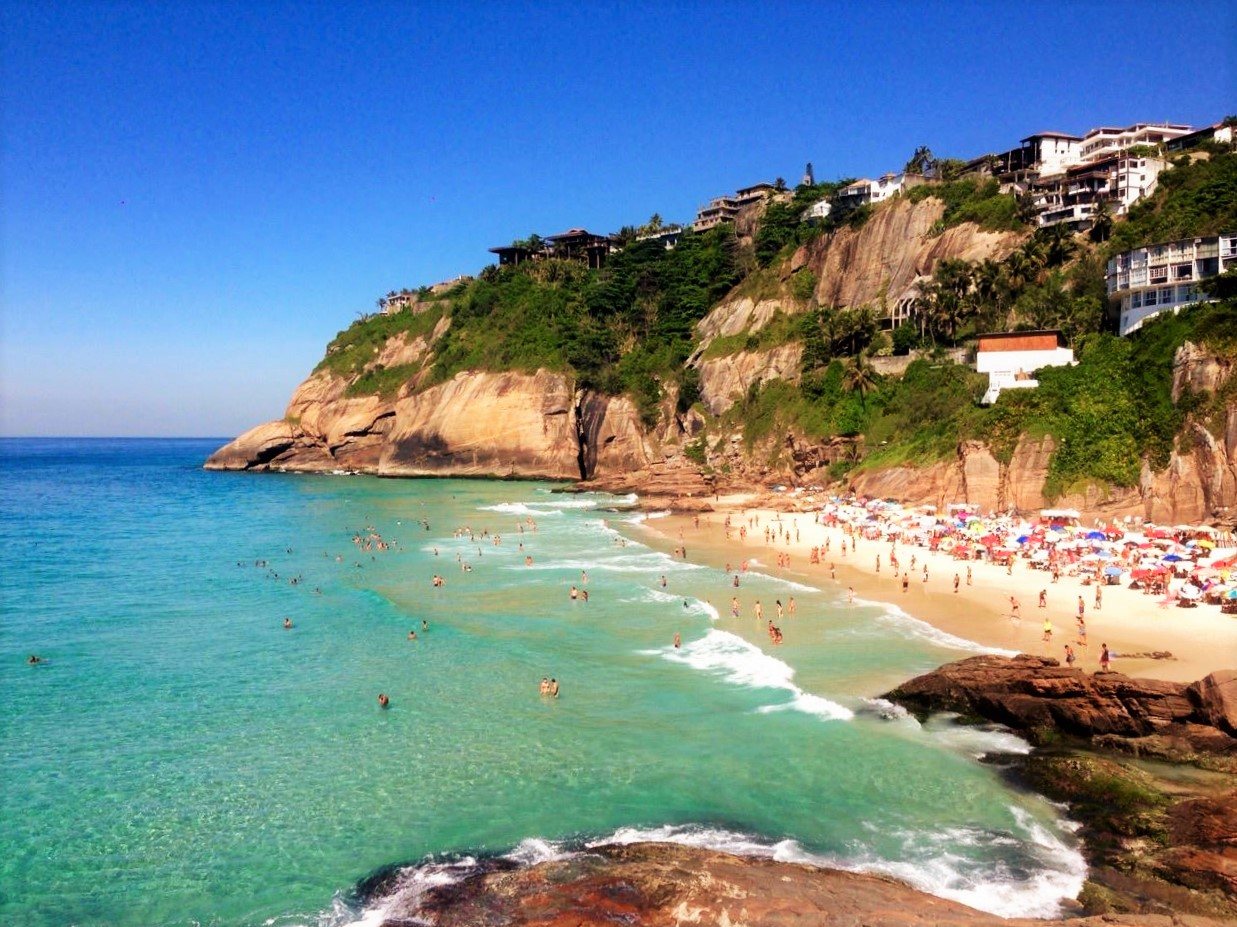
Joá's beach is the opposite proposition. Praia da Joatinga is small, wild and hard to reach — a pocket of sand at the foot of the cliffs, entered on foot through the Condomínio da Joatinga and largely swallowed by the sea at high tide. It has no kiosks, no boardwalk, no room for the multitudes; on the wrong tide it barely exists. It is not a lesser version of Ipanema so much as a different thing entirely — a beach that is difficult and half-hidden, which is precisely why the people who use it prize it. The cliff's relationship to the water is looking down on it from a terrace, not walking onto it from the street.
So the beach question sorts the three neighborhoods as cleanly as the price question. If your idea of coastal living is putting on flip-flops and being on the sand in ninety seconds, amid the whole city, that is Ipanema and Leblon. If it is a pool cut into a cliff edge with the Atlantic a hundred metres below and almost no one else in the frame, that is Joá. The views that come with the second are their own long story, told in The Views from Joá.
Who lives where
The three addresses draw somewhat different people, and the differences are instructive. Leblon is the neighborhood of Rio's settled establishment — old-money families, senior professionals, the discreetly wealthy who value a quiet, walkable, well-schooled few blocks over any kind of spectacle. Ipanema skews younger and more outward — the fashion and culture crowd, artists and media people, the socially visible, alongside a heavy layer of the short-stay and second-home market that the song and the fame keep feeding.
Joá is the smallest and most particular population of the three, and by the last census one of the least-populated neighborhoods in the entire city, at the highest per-capita income in Rio. It concentrates the people for whom invisibility is worth more than proximity: entertainers, executives, and others who can work from behind a gate and would rather not run into the city on the way to the beach. It is telling that the two beach neighborhoods are places you move to be part of Rio, and the cliff is a place you move to step back from it. The full picture of that roster, hedged where the public record is thin, is set out in Who Lives in Joá.
The trade-offs, laid out plainly
Strip away the glamour and the choice between the three comes down to a small set of honest trade-offs. The first is house versus apartment. Leblon and Ipanema are, with rare exceptions, apartment neighborhoods — you buy a floor, not a plot, and you accept neighbors, shared walls and a building's rules in exchange for being at the centre of everything. Joá is nothing but houses — you buy land and a whole structure and total control of it, in exchange for distance and dependence on the car. There is no version of Joá that is a walk-to-the-café life, and no version of Leblon that is a private cliff.
The second trade-off is liquidity, and it favors the beach. Leblon and Ipanema are deep, active markets: apartments trade often, prices are well-observed, and a good unit finds a buyer. Joá is a market of a few hundred irreplaceable houses and a very small pool of buyers, where a single sale can take a long time and where — as we cautioned in Buying in Joá — an asking price and a sale price can be very different numbers. The famous R$250-million Joá listing is an announcement, not a transaction. On the beach, the gap between asked and paid is usually smaller and the exit usually faster.
The third trade-off is simply what you want your daily life to feel like. The beach neighborhoods offer a life lived outward — on the street, on the sand, in the restaurants and the crowd, with the sea at the end of the block and the city all around you. The cliff offers a life lived inward — behind a gate, above the water, in the quiet, with the view doing the work the street does elsewhere. Neither is better; they are answers to different questions about how you want to live in the same extraordinary city.
Reading it all honestly
The tidy way to hold the whole comparison is this. Leblon is the safest, most-defended value and the most walkable establishment address — the record per square metre, and the quieter of the two beaches. Ipanema is the famous one, the more energetic and outward beach, running hard at Leblon's per-metre crown and winning on cultural gravity if not quite on price. Joá is the hidden fortune — the record per house, the most private, the most spacious, and the least like the rest of Rio — bought by people who want the ocean without the crowd and are willing to trade the street for the gate to get it. Three right answers to one question, and no single winner, because they are not really competing for the same buyer.
This is also, in the end, why a collection like Art de Vivre keeps houses across these registers rather than betting on one. A beach apartment and a cliffside house are not two prices for the same thing; they are two different lives, and the right one depends on which trade-offs you would rather make. The considered, house-by-house version of that judgment — matching a specific property to a specific idea of how you want to live in Rio — is the work of the Art de Vivre collection, and it starts from exactly the distinctions drawn on this page.
If your answer to the question is the cliff — the whole house, the gate, the ocean seen from above and the quiet that comes with it — then the rest of this hub is written for you. The Art de Vivre house on the crest of Joá, presented in full at The House, is one very particular answer: five suites, an infinity pool cut into the edge, and the Atlantic from every room. Start instead from the Joá guide if you want the neighborhood before the property.
Once you've chosen the cliff, the next question is how its market actually works: Buying in Joá.