Buy a house anywhere else in Rio and you are buying the house. Buy a house in Joá and you are buying the air in front of it. The walls, the pool, the square metres under roof — these matter, and they are priced, but they are not the asset. The asset is the view: the particular arc of ocean, mountain and coastline that a given plot happens to command, held permanently in place by a wall of protected forest that will never be built out. Two houses of identical size a hundred metres apart on the same hillside can be worth wildly different sums, and the whole of the difference is in where they look and how the light falls on what they see. In Joá, orientation is not a detail of the deed. It is the deed.
Joá Rio is published from ADV101, a five-suite villa in Joá offered at R$ 15,000,000, shown privately by appointment through Art de Vivre.
Ask about a viewing on WhatsApp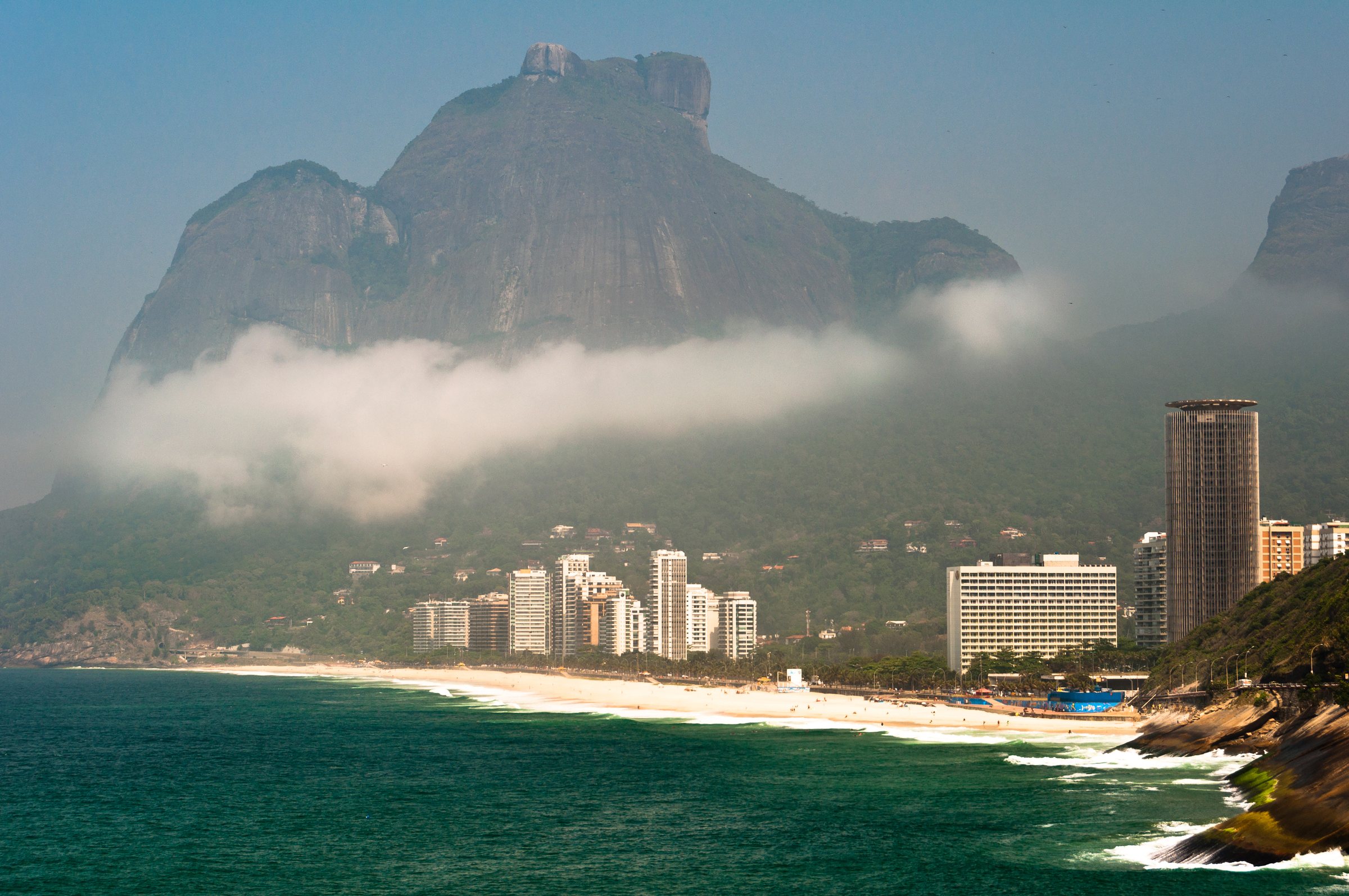
Why the compass is the price tag
It helps to understand what kind of place you are standing in. Joá is a small neighborhood draped over the Morro da Joatinga, wedged between two much larger ones — São Conrado to the east and Barra da Tijuca to the west — with the open Atlantic below to the south and the mountains of the Tijuca massif rising immediately behind to the north. That single fact of geography — sea in front, protected rock behind, a headland reaching out into the water between two bays — is what gives every plot its personality. A hillside like this is not a flat grid of interchangeable lots. It is a curved wall of stone facing several directions at once, and the house you build catches whatever the slope beneath it happens to be pointed at.
That is why, in Joá, the first question a serious buyer asks is not how many bedrooms but which way the living room faces. A north-facing plot lives under the mountain and keeps the afternoon sun late into the day; a south or east-facing plot lives over the open sea and takes the light head-on at dawn; a west-facing plot watches the sun set into the ocean off Barra and pays for the privilege. None of these is objectively best. Each is a different life, and each carries a different number. The people who buy well here are the ones who understand that they are choosing between orientations, not just properties — that the compass, not the floor plan, is the thing that sets the price. Our own ADV101 was designed around exactly this logic: every principal room turned to the water, so that the asset the house is really selling is the one thing Joá cannot manufacture more of.
North: the wall of rock and forest
Turn inland and you meet the reason Joá exists at all. Behind the houses, filling the whole northern sky, stands the Pedra da Gávea — a single block of granite and gneiss rising to eight hundred and forty-two metres, its flat crown and sheer seaward face visible from half the western coast of the city. It is not a distant feature; from the upper plots of Joá it is close enough to read the texture of the stone, close enough that the mountain is genuinely part of the room. Around and below it the slopes are dense with the Mata Atlântica, the Atlantic Forest, held under the protection of the national park. This is the view most people underrate before they see it and never forget after: not the ocean, but the green-black wall of jungle rising straight off the back of the house.
A north-facing house in Joá trades the horizon for intimacy. You lose the endless flat line of the sea and gain something closer and stranger — cliff faces, canopy, the calls of the birds that live in the mata, mist that gathers in the folds of the mountain and burns off by mid-morning. There is weather in this view. The Gávea makes its own clouds; the forest breathes visibly after rain. Where an ocean plot offers a serene, unchanging expanse, a mountain plot offers a living thing that is never the same hour to hour. For some buyers that is the entire appeal, and they will pay for it. For our purposes the more important point is defensive: that green wall is the single greatest guarantor of every other view in the neighborhood, because it is the reason nothing can ever be built behind you. More on that below, since it is the quiet engine of value here.
The mountain is in the room.
From the higher plots the Pedra da Gávea is not scenery but architecture — a granite face close enough to read, backed by protected forest that will never be cleared. It is the view that guarantees all the others.
South and east: the open Atlantic and the beach far below
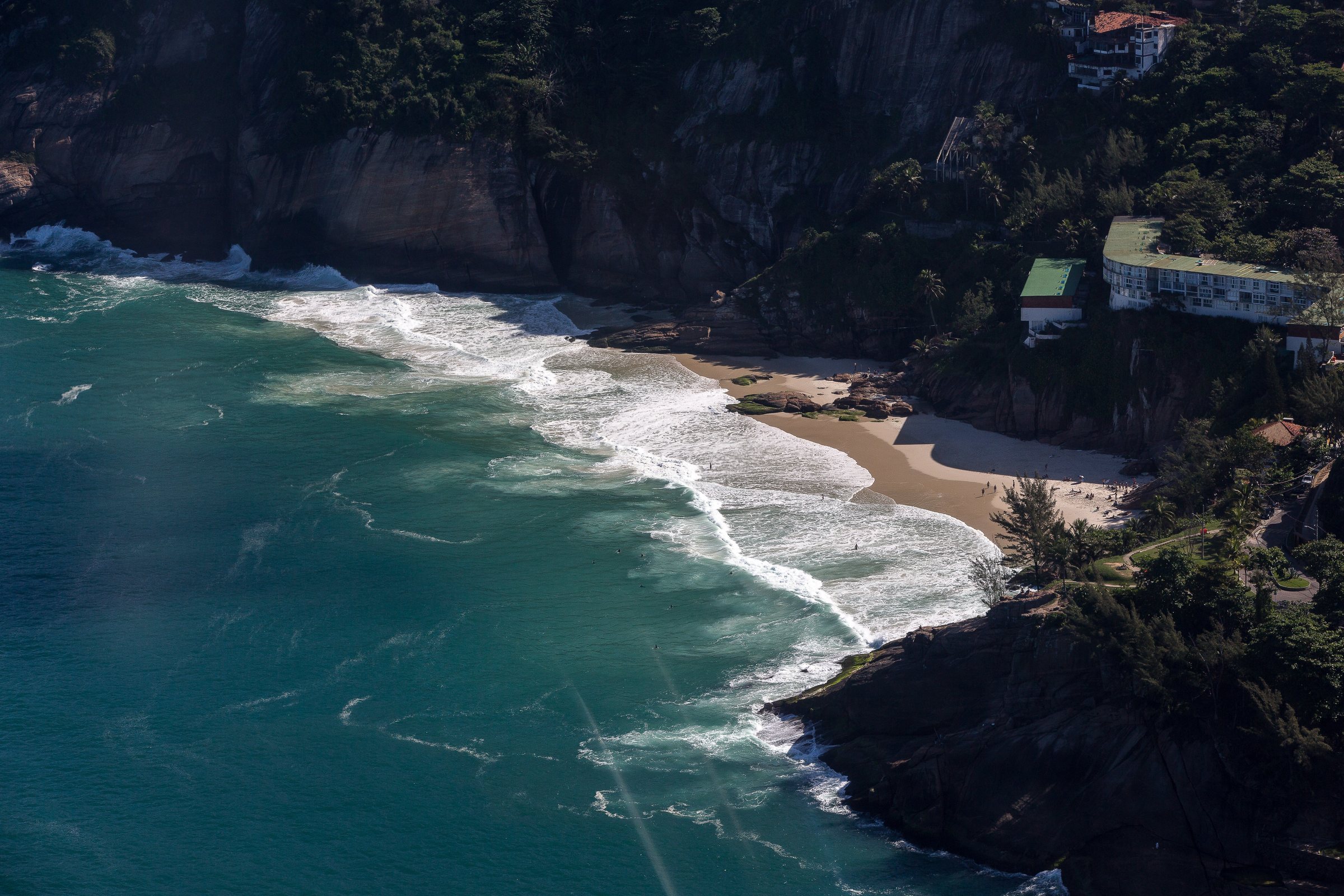
Turn back to face the water and the character of Joá changes completely. To the south and east the land falls away in a long tumble of rock and vegetation to the Atlantic, and set into that fall, directly beneath the neighborhood, is its most secret asset: the Praia da Joatinga. It is a crescent of sand less than three hundred metres long, hemmed by cliffs and reached only through a private condominium and a steep trail — and, crucially, only at the right state of the tide. At high water the sea comes up to the rock and the beach effectively disappears; at low water it opens into one of the most beautiful and least crowded stretches of sand in the city. From the houses above, the beach reads as a bright sickle far below, appearing and vanishing with the tide like a slow tidal clock you can set your day by.
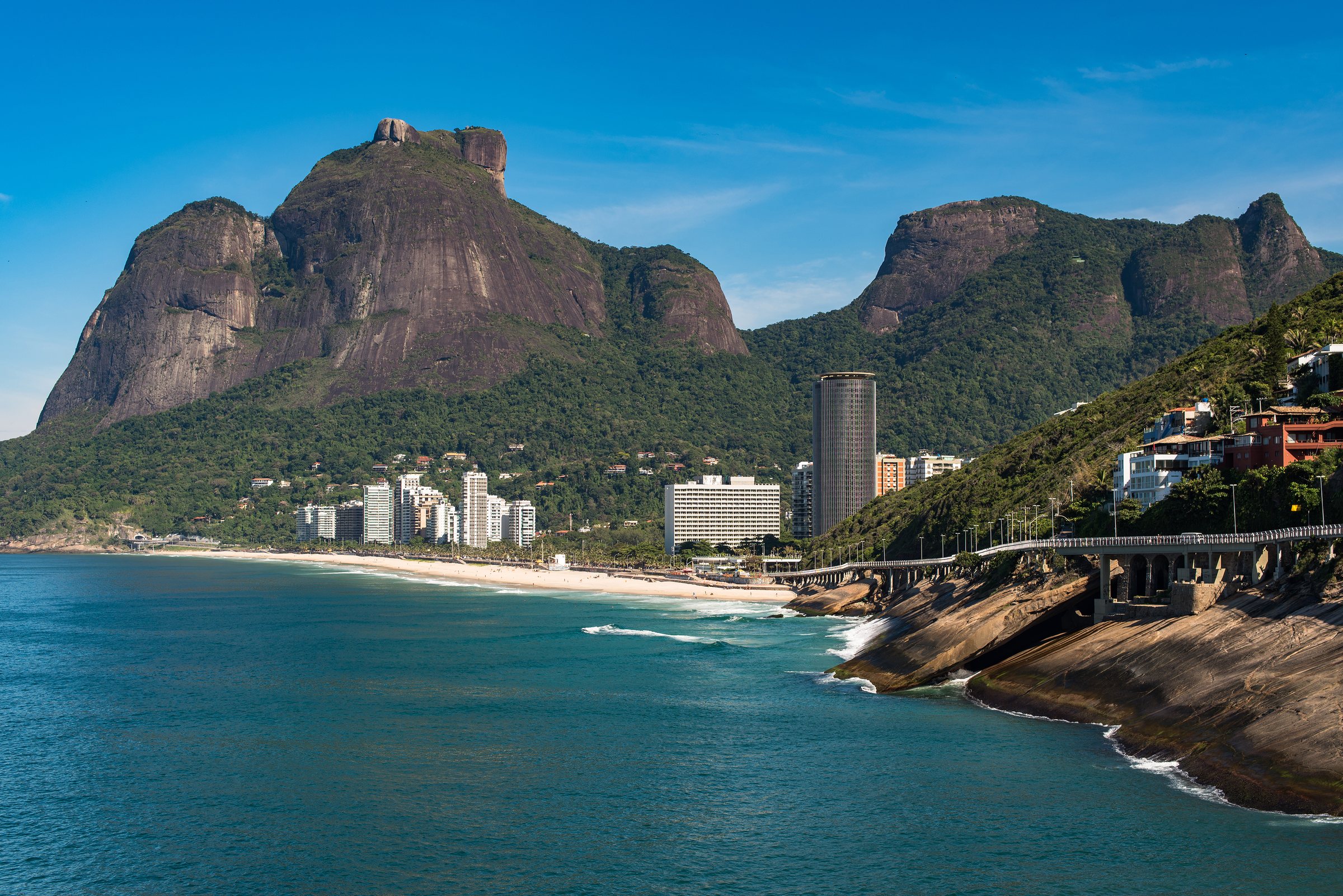
A south or east-facing plot gives you this — the open ocean straight ahead, the horizon uninterrupted, and the little beach tucked in at the bottom of the view. It is the most classically "carioca" of the orientations: sea light, the sound of surf carried up the cliff, boats standing off the headland, the whole Atlantic doing what it does. The east-facing rooms take the sunrise directly — the ocean goes from grey to silver to blue in the first hour of the day — and they hold cooler, cleaner light through the morning before the sun swings around and behind the house. This is the orientation for people who wake early, who want the day to arrive over the water, and who are content to trade the theatrical sunset for the quieter drama of dawn on an empty sea.
West: the long coast of Barra and the far skyline
Face west and the view stretches out rather than down. Beyond the headland the land relaxes into the long, flat sweep of Barra da Tijuca — kilometres of straight beach and the towers built behind it, running away to the west until the coast dissolves into haze. Where the mountain view is close and the ocean view is deep, the Barra view is wide: a broad panorama of curving shoreline and distant skyline that at night becomes a long string of lights along the water. It is the most cosmopolitan of Joá's outlooks, the one that reminds you that this hidden neighborhood sits at the seam between the old Zona Sul and the modern west of the city.
But the west-facing plot's real currency is the sunset. This is the orientation that takes the sun down into the ocean off Barra, night after night, through the full theatre of a tropical evening — the sky going gold, then rose, then a deep bruised violet over the water, the far towers lighting up against it. In a city where the sun sets over the sea from only a handful of privileged angles, a west-facing house in Joá owns one of them outright. That is why, all else being equal, sunset-facing plots tend to command a premium: the buyer is paying not just for a view but for a recurring event, a nightly performance delivered to the terrace whether or not anyone is watching. The trade is comfort. West light is hot light; the afternoon sun comes in low and strong, and the houses that face it are designed with deep eaves, shade and glass to civilise it. The reward arrives at the end of the day and is worth the engineering.
East again: São Conrado and the gliders coming down
There is a fourth outlook, and it is the one that surprises visitors most. Look east past the near headland and the coast opens into the wide bay of São Conrado, its long beach backed by the green flank of the Tijuca forest and, above it, the blunt profile of the Pedra Bonita ramp. From that ramp, most days, come the hang-gliders. São Conrado is one of the great launch sites of the sport; pilots run off the rock high in the forest and spiral down over the bay for eight or ten minutes before landing on the sand. From an east-facing terrace in Joá you watch them the way you might watch birds — a slow scatter of bright wings turning in the thermals off the mountain, drifting down toward the beach in the afternoon light.
It is a small thing and an unrepeatable one. No other luxury neighborhood in Rio hands you, as a standing feature of the view, a sky with people gliding through it. It gives the eastern outlook a sense of animation the others lack — the ocean is still, the mountain is still, but the gliders move, and they give scale and life to the enormous space between the ramp and the water. Buyers rarely put it on a wish list, because they do not know to. Then they stand on the terrace at four in the afternoon, watch the first wing come off Pedra Bonita and turn out over São Conrado, and understand that they are looking at something no floor plan could have promised them.
“You are not buying the house. You are buying the air in front of it — and the certainty that nothing will ever fill it.”
The quality of the light
A view is only ever as good as the light on it, and Joá's light is unusual, for a reason that is geographic rather than poetic. Because the neighborhood sits on the south face of the massif with the Pedra da Gávea rising behind it to the north and west, the mountain shapes the sun's passage across the houses. In the middle of the day the light is direct and hard, the sea a flat glare. But as the afternoon goes on and the sun swings west, the great bulk of the Gávea does not block it so much as hold it — the last hours of daylight rake in low and long across the water and the forest, and the whole neighborhood turns the colour of honey. The rock glows; the mata goes from green to gold; the ocean picks up the warm light and throws it back. Cariocas have a word for this hour, and Joá gets more of it than almost anywhere in the city.
Then there is the sea haze. On humid days — and there are many — a fine salt mist hangs over the water and softens everything past the near cliffs, so that the Barra skyline and the far coast float in a pale blue distance and the ocean has no hard horizon at all. It can make the view feel enormous, like looking off the edge of the world. On the clearest days, usually after a front has come through, the haze burns off and the whole coast snaps into hard focus — you can count the towers of Barra, pick out the surf on São Conrado, see the summit of the Gávea cut sharp against the sky. Part of living with a Joá view is learning its moods: the soft days and the sharp days, the mornings the mountain makes its own cloud and the evenings it hands the neighborhood its long gold ending. The view is never the same twice, and that, rather than any single perfect vista, is what people are really paying for.
Morning light, evening light, and the life a plot gives you
Orientation does not only decide what you look at; it decides when your house is alive. An east-facing house is a morning house. It takes the sunrise over the ocean, fills with clean early light, and is at its best with coffee on the terrace before the heat arrives; by late afternoon the sun has swung behind it and the rooms fall into a cool, blue shade that many people love for exactly that reason. A west-facing house is an evening house. It can run warm and bright in the afternoon — sometimes uncomfortably so without good shading — but it comes into its own at the end of the day, when the sunset arrives at the terrace like a guest and the whole house glows for an hour. A north-facing house, under the mountain, gets the most even daylight of all and the longest hold on the afternoon sun, at the cost of the open horizon.
None of this is abstract when you are choosing a house, because it decides how you will actually use the rooms. Where is the main living space, and does it face the light you want at the time of day you are home? Is the primary suite oriented for the sunrise or against it — do you want to wake with the sea coming up in the window, or do you want a cool, dim room to sleep late in? Does the pool terrace catch the sun in the afternoon when you would use it, or does the house shade it by two o'clock? On a hillside as sculpted as Joá's, two neighbours can have entirely different days simply because their slopes point a few degrees apart. The buyers who are happiest here are the ones who visited the house at more than one hour, who stood in the living room at the time of day they actually live in it, and who chose a plot whose light matched the life they intended to lead in it.
There is a seasonal dimension to this as well, and it is easy to overlook when you visit once. Rio sits below the equator, so the sun tracks through the northern sky and swings noticeably between summer and winter — higher and more direct in the long, hot months around the new year, lower and softer in the mild middle of the year. A terrace that is bathed in sun on an August afternoon may sit in the shadow of the mountain by June; a room that is comfortable in winter may want its shading drawn in the fierce clarity of January. Local builders have always designed around this, orienting the deep verandas and overhangs that give the older Joá houses their shade, and it is one more reason the neighborhood's architecture leans into the landscape rather than fighting it. For a buyer, the practical takeaway is modest but real: understand that the view and its light shift with the calendar, and, if you can, learn a plot in more than one season before you decide it is the one.
The framed view: a house set in the forest
There is one more quality particular to Joá that has nothing to do with compass direction and everything to do with the forest, and it is the hardest to put a number on. Because the neighborhood is stitched into the Atlantic Forest and the houses are set into the hillside among the trees rather than lined up on an open strip, the best of them do not merely have a view — they have a framed view. The ocean and the mountain arrive through and around the greenery: a window of sea held between two shoulders of rock, a terrace that looks out over a foreground of canopy to the water beyond, a pool that seems to spill into jungle before the horizon opens behind it. The forest is not something in the way of the view. The forest is the frame, and it makes the view feel found rather than bought.
This is a large part of why Joá does not look or feel like a conventional luxury enclave, and why photographs of it are so often misleading in both directions — they either miss the drama or exaggerate it. A house here is a room cut into a mountainside, with the vegetation left standing on either side, so that the eye is led out through green to blue. The mansions, as the old accounts of the neighborhood like to say, hide in the mata and let the landscape do the work. A plot that has this — real forest in the foreground, real ocean beyond — is worth more than a plot with the same square footage and the same horizon but no green between the terrace and the sea. It is the difference between a view you look at and a view you are inside of.
Permanence: the view that cannot be built out
Everything above is aesthetic. This is the part that is financial, and it is the single most important thing a buyer needs to understand about a Joá view: it is permanent. In most of the world, buying a view is a gamble against the future. The empty lot next door gets a tower; the low building across the water is replaced by a tall one; the sightline you paid a premium for is gone in a decade, and there is nothing you can do about it. That risk, which shadows every view-priced property in every growing city, barely exists here — and the reason is the wall of green behind the houses.
Joá is hemmed on its inland side by the protected forest of the Tijuca massif, administered as national park. That land is not zoned for low density; it is not zoned at all in the developable sense. It cannot be cleared and it cannot be built on, which means the mountain view is fixed forever and, just as important, that nothing can rise behind a house to loom over it or block its light. The neighborhood itself has no towers, no commercial strip and no through-road, and the same scarcity that makes it valuable is defended, when necessary, by the authorities: in a recent and widely reported case the city demolished several luxury homes that had been built illegally onto the protected land. The lesson for a buyer is reassuring in the round even as it is a warning in the particular — the line between the neighborhood and the forest is real, it is enforced, and it is the guarantee that the view you buy is the view your grandchildren will inherit.
So when you evaluate a Joá view, evaluate its permanence as carefully as its beauty. Look at what lies between the terrace and the horizon and ask what could ever change. On the ocean side, nothing can: it is open water and protected headland. On the mountain side, nothing can: it is national park. The only real variable is the near ground — a neighbouring plot within the neighborhood whose future building envelope might rise into your sightline — and that is exactly the kind of thing a good local advisor checks before you commit. Get that right and you have bought something rarer than a beautiful view. You have bought a beautiful view that is not going anywhere, which is the only kind worth paying a premium for. Our own read on how to weigh all of this — light, orientation, permanence and price together — is set out in our guide to buying on the hill.
Reading a view before you buy it
If orientation is the deed, then evaluating a view properly is the most important work a buyer does in Joá — more consequential than the survey of the building and harder to undo. A house can be renovated; a bad orientation cannot. So it is worth being methodical about it, and the method is simpler than it sounds. Go to the house at three different hours: early morning, mid-afternoon and the hour before sunset. Almost everyone views a property once, in the middle of the day, at the worst possible time — when the light is flat and hard and every plot looks much like every other. The house that is merely good at noon can be extraordinary at five, and the house that dazzles at noon can turn hot and glaring by three. Only the clock will tell you which you are standing in.
At each hour, ask the same set of plain questions. Where is the sun, and where will it be when you are actually home to enjoy the terrace? Which rooms have the view, and are they the rooms you will live in, or has the plan spent its one great outlook on a guest suite? What is in the foreground — is there forest between you and the water, giving the framed view that Joá does better than anywhere, or does the terrace look straight out over a neighbour's roof? Where does the wind come from; a south-easterly off the open Atlantic is a very different thing on an exposed plot than on a sheltered one, and it decides whether the terrace is usable in the afternoon. And, quietly but decisively: what could ever be built in the near ground to rise into the sightline? The ocean and the mountain are fixed. The empty slope two plots over may not be.
Notice, too, what the view gives you that a photograph cannot. Sound — the surf carrying up the cliff on a south-facing plot, the birdsong off the mata on a northern one. Movement — the tide filling and emptying the Praia da Joatinga far below, the hang-gliders turning down over São Conrado in the afternoon, the boats standing off the headland. Air — the salt haze that softens a humid morning, the clean hard light after a front. These are the things that make a Joá view a place to live rather than a picture to own, and they are precisely the things that never survive translation to a listing photograph. You have to stand in the view to know it, which is the whole argument for seeing a house in person, at more than one hour, before you decide what it is worth to you.
It is also worth being honest about the trade-offs, because every orientation has one and the buyers who are happy here are the ones who chose their trade with open eyes. The mountain view surrenders the horizon for intimacy and weather. The open ocean view surrenders the sunset for the sunrise and the sound of the sea. The west-facing sunset plot surrenders afternoon comfort for the nightly performance over Barra, and must be engineered — with deep eaves, shade and glass — to make the reward outrun the heat. There is no orientation that wins on every count, and a plot that promises to is usually being oversold. The right question is never which view is best in the abstract. It is which trade suits the life you actually intend to live in the house.
ADV101: the water from every room
All of which is why ADV101 was conceived the way it was. The plot faces the ocean, and the house was designed to spend that orientation completely — not one hero room with the view and the rest turned inward, but the sea carried through the whole plan, so that every principal room in the house looks out over the water. You wake to it, you cook to it, you swim toward it; the Atlantic is the fourth wall of every space that matters. Behind and above, the protected forest and the Pedra da Gávea hold the line that keeps that outlook permanent, and the light does the rest — the clean morning over the sea, the long gold afternoon the mountain hands down, the haze softening the far coast into blue.
A house like this is, in the end, an instrument for one thing: to take Joá's real asset and give it to you undiluted, in the best light, from wherever you happen to be standing. That is what the Art de Vivre collection looks for in a property before it takes it on, and it is what ADV101 was built to deliver. If you want to understand a view before you own it, the only reliable method is to stand inside it at more than one hour of the day — which is precisely what a private viewing is for.
How a house is engineered to hold all this — cantilevered over the rock, turned to the water, rooted in the forest — is the next question: Building on the Rock.