He never earned a diploma, never sat an examination in structures, never learned to draw a working plan the way a school would teach it. And yet by the end of his long life José Zanine Caldas was called, without irony, the most Brazilian of Brazil's architects — a verdict pronounced by the very men who had the credentials he lacked. He was born in a cacao town on the Bahian coast and died an old man on the same coast a country away, and in between he built miniature versions of other people's masterpieces, ran a furniture factory, walked away from it, and taught himself to raise houses out of salvaged timber on the cliffs of Rio de Janeiro. Somewhere in that arc the country gave him a title that stuck: o Mestre da Madeira, the Master of Wood. This is the story of how a self-taught man from Belmonte came to leave his mark on the hillside above the sea — and on the way we now think about the forests his houses were made from.
Joá Rio is published from ADV101, a five-suite villa in Joá offered at R$ 15,000,000, shown privately by appointment through Art de Vivre.
Ask about a viewing on WhatsApp
The master with no diploma
It is worth stating the paradox plainly, because it is the key to everything else. Zanine Caldas was an architect who never studied architecture, a furniture designer who never trained as one, a sculptor who came to the chisel late and by instinct. He belonged to no school and founded none. What he had instead was a lifelong, almost physical intimacy with wood — how it splits, how it holds a load, how a single trunk can be persuaded into a bench or a beam — and a conviction, unusual for his generation, that the material had a moral weight and not only a structural one. To use a Brazilian hardwood was, for him, to answer for the tree it came from.
He is easy to misread, and the misreadings are worth clearing away at the start. He is sometimes lumped in with the great modernists of mid-century Brazil — Oscar Niemeyer, Lúcio Costa, the concrete visionaries of Brasília — because he worked alongside them for years. But Zanine was not one of them and did not want to be. He built the small-scale models of their buildings, not the buildings; and when he turned at last to architecture of his own, he turned deliberately away from their poured concrete and their abstraction, toward timber, craft, the vernacular and the hand. His was a counter-current within Brazilian modernism, not a tributary of it. Keeping that distinction clear is the difference between understanding him and flattering him with the wrong company.
A boyhood in Belmonte
He was born on the 25th of April 1919 in Belmonte, a small port on the far south coast of Bahia where the Jequitinhonha river meets the Atlantic — cacao country, timber country, a place where sawmills and boat-builders were part of the ordinary furniture of a childhood. By his own account he was drawn to construction almost as soon as he could hold a tool. The story most often told of his boyhood is that at about thirteen he began making presépios, little nativity scenes, cut from the cardboard of the syringe boxes his father brought home — the first models of a life that would be full of them. Whether or not the detail is polished by fondness, it points at something true: he learned to build by building small, and he learned it with his hands before anyone thought to teach him with a book.
At around eighteen he left Bahia for São Paulo, the industrial engine of the country, and took work as a draftsman at the firm of Severo & Villares. It was the ordinary apprenticeship of a boy with more talent than schooling: he watched, he copied, he learned the conventions of the drawing board without the certificate that was supposed to come with them. Then, near the start of the 1940s, he moved on again — this time to Rio de Janeiro, then the capital and the crucible of the new Brazilian architecture — and there he found the work that would make his name for the first time. He would make models. Not toys, and not, at that stage, buildings of his own, but exact miniatures of the boldest structures the country's architects could imagine.
The maquetes: the modernists in miniature
In Rio, around 1940, Zanine opened a workshop for architectural scale models — the Maquete Studio — and for more than a decade it was one of the busiest of its kind in Brazil. The numbers that survive are striking: by the reckoning of the institute that now guards his legacy, he and his workshop produced on the order of five hundred models for the leading architects of the day, Oscar Niemeyer and Lúcio Costa among them. When those men needed to see a building before it existed — to test a curve, to convince a client, to understand in three dimensions what a drawing could only promise — it was frequently Zanine's hands that gave the idea its first physical form.
This is the period that most tempts the careless writer, and it is worth being exact about it. Zanine did not design Brasília, or Pampulha, or any of the monuments whose models passed through his shop. He translated other men's designs into miniature, and in doing so he acquired something no design school could have given him: an intimate, working understanding of how ambitious buildings actually stand up. He learned structure the way a luthier learns music — by making the instrument, over and over, until its logic is in the fingers. When he later built houses without ever having been licensed to, this was the education he drew on. He had spent ten years inside the geometry of the country's greatest buildings, at one-fiftieth scale.
The model-making also carried him briefly into the university world he would otherwise never have entered. In the early 1960s he was invited to run the scale-model workshop of the new architecture faculty at the University of Brasília, teaching the making of maquetes to students who did have diplomas ahead of them. The post did not last: he lost it in 1964, in the upheaval that followed the military coup, when the young university was purged and reshaped. He would return to Brasília as a teacher only much later, in the late 1980s, and by then he was teaching something entirely his own — the structural use of wood.
It matters to understand what a model actually demanded of him, because the discipline of it shaped the builder he became. A maquete is not a sketch; it is a small building. To make a faithful one, Zanine had to grasp how the real thing would resolve its loads, where its weight would fall, how a cantilever or a shell would behave — and he had to render all of it at a scale where an error of judgement showed. He worked in wood and card and whatever would hold the form, cutting and joining by hand, day after day, for the most demanding clients in the country. A man who spends a decade doing that acquires an engineer's intuition without an engineer's training: a feel for structure lodged in the eye and the fingers rather than in a set of equations. This is the paradox of his authority resolved. He never learned architecture from a book because he had learned something adjacent and, for his purposes, better — the physical behaviour of buildings, rehearsed five hundred times in miniature.
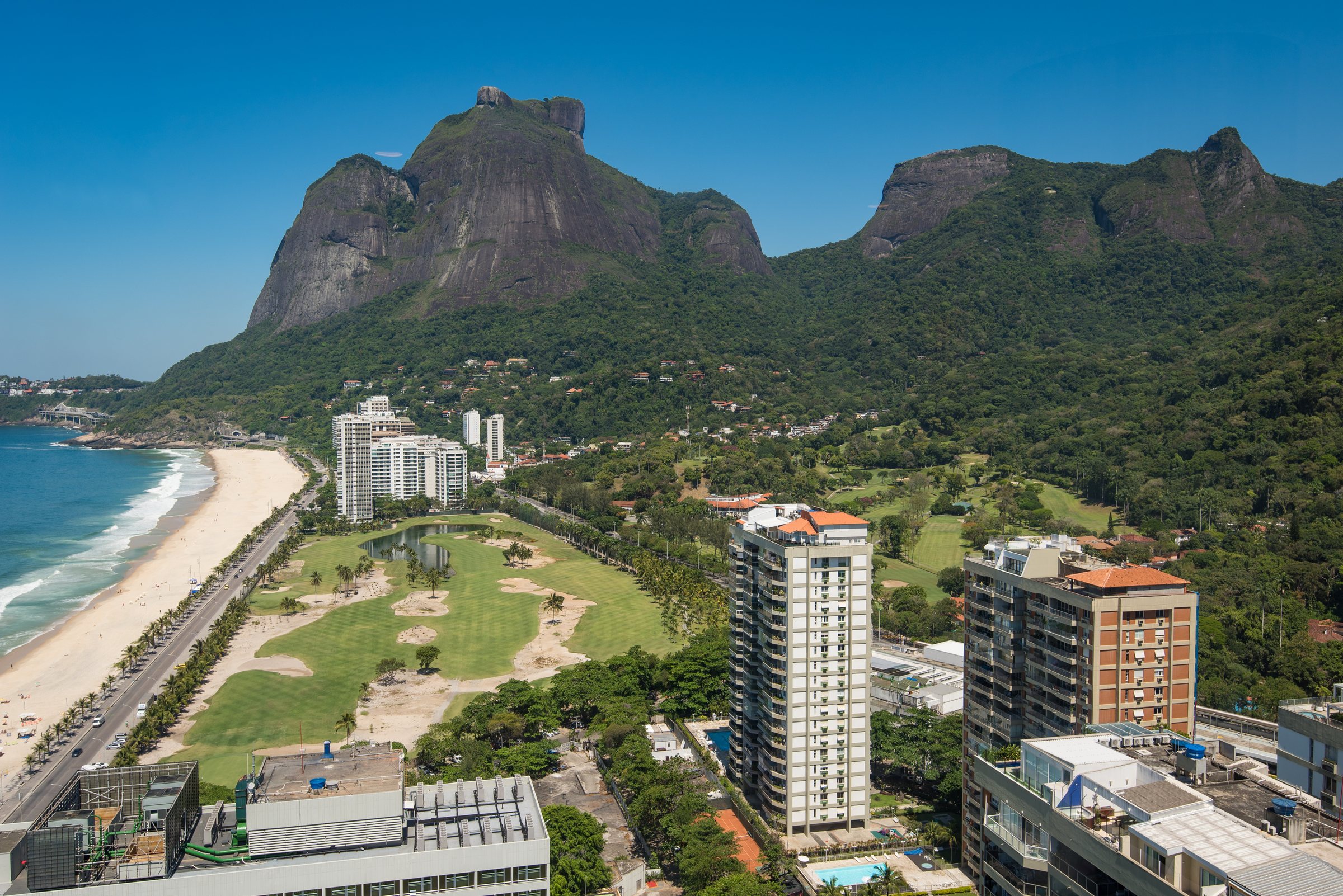
A country made of hardwood.
The Atlantic Forest that once ran the length of this coast held some of the densest, most beautiful timber on earth — peroba, vinhático, pequi, jacarandá. Zanine built with these woods, and mourned their felling. The forest above Joá is a surviving fragment of that vanished expanse; the picture shows the land, not a house of his.
Móveis Artísticos Z: design for the many
In 1948 Zanine turned from making models of buildings to making objects for them. With two partners he founded a furniture company — Móveis Artísticos Z — in the interior of São Paulo state, and set out to do something that in Brazil was close to radical: to manufacture well-designed modern furniture cheaply enough that ordinary people could buy it. The pieces were made of moulded and cut plywood, light and organically shaped, sinuous where the heavy colonial furniture of Brazilian homes had been massive and dark. They were, in the fullest sense, democratic objects — modern design offered at a popular price, produced in something near to series.
For a few years the company thrived on exactly that proposition. Then Zanine walked away from it. The reasons that come down to us are partly commercial and partly temperamental: he is said to have grown weary of the industrial, profit-first logic the business demanded, of making the same shape a thousand times for a market that cared about the price and not the tree. Whatever the precise mix of motives, by the early 1950s he had left the venture behind. It is a telling exit. The plywood chairs of Móveis Artísticos Z are now prized by collectors as landmarks of Brazilian modern design — but their maker had already decided that the future he wanted was not in the factory. It was in the single trunk, worked by hand.
The plywood pieces themselves deserve to be remembered on their own terms, and not only as the thing he left behind. In a country whose middle-class homes were still furnished, for the most part, in dark and heavy styles, the Móveis Artísticos Z chairs were a small revolution of lightness. Their forms curved where tradition was square; their material was thin and modern where tradition was massive; and their ambition was frankly popular, aimed at a broad market rather than a narrow one. They belong, in the history of Brazilian design, to the brief and hopeful moment when modernism believed it could be democratic — could be for everyone, not merely for the clients of Niemeyer. That Zanine could conceive such objects, manufacture them, and then judge the whole enterprise a compromise not worth keeping tells you how exacting his sense of purpose already was, years before he found the material and the cause that would define him.
The turn to the tree: Nova Viçosa and the móveis-denúncia
The great pivot of Zanine's life came when he went home to the Bahian coast. In the late 1960s he settled for a time in Nova Viçosa, a fishing town not far from his native Belmonte, and opened an atelier that would run there into the 1980s. On that coast he watched the local craftsmen — the men who carved boats and rough furniture out of fallen trees — and he recognised in their work an honesty his factory years had lacked. He began to carve too: large, heavy, sculptural pieces, benches and tables and seats hewn from single blocks of hardwood, worked with the chisel and the adze rather than assembled from cut parts. The furniture stopped being a product and became something closer to sculpture.
And it acquired a purpose beyond use. Zanine came to call one body of this work his móveis-denúncia — furniture of denunciation, protest furniture — and the name was literal. Each massive piece, carved from the trunk of a Brazilian hardwood, was meant to stand as an accusation: a witness to the forest that was being cleared, burned and drowned across the country in those years, in the name of cattle, roads and hydroelectric dams. He made the point with the material itself. Rather than cut living trees, he used timber that was already dead or doomed — wood salvaged from trees that had fallen naturally, or rescued from land about to be flooded behind a dam, or hauled out of the path of a clearance. A table from this series is not merely furniture. It is a fragment of a forest that no longer exists, kept and shown so that its loss cannot be ignored.
In Nova Viçosa the ethos found a partner. There Zanine fell in with the artist Frans Krajcberg, the great sculptor of charred and rescued wood, and the two — kindred spirits, both of them working from the burnt and fallen remains of the forest — dreamed of an ecological reserve on that coast, a place where art and the living forest might be held together. Zanine designed a studio for Krajcberg in 1971. What the two men were doing on the Bahian coast in the early 1970s — insisting that the destruction of the forest was a subject for art, and that the timber trade carried a debt — was a good decade or more ahead of the vocabulary the world would later reach for. They were environmentalists before the word was in common Brazilian use.
“He would not cut a living tree for a table. The wood had to be already fallen, already condemned — rescued, not taken.”
The houses in the forest: Joá, Joatinga and the carioca hillside
It was in these same years that Zanine finally became, in fact if never in title, an architect. From the late 1960s he was back in Rio de Janeiro, and he began to build — not models now, but houses, and he built a great many of them on one particular stretch of the city's coast. He settled on the headland of Joatinga, the wooded ridge that runs alongside Joá at the western edge of the Zona Sul, and over the following years he raised, by various accounts, dozens of houses on that hillside and its surroundings. His own house there was among the first of the series. The Rio residences of this period — roughly 1968 to 1976 — have since become the subject of serious academic study, precisely because they show a self-taught man inventing a whole architecture out of timber on some of the most difficult ground in the city.
A word of care is owed here, because Joá and Joatinga are open, ordinary neighbourhoods and not private estates, and the houses Zanine built on that ridge belong to the families who own them. It would be wrong to point at any particular gate and attach his name to it without knowing. What can be said with confidence is the character of the work and the terrain it answered. This is a coast of near-vertical rock, dense surviving Atlantic Forest and long sea views — the same landscape that makes the whole district what it is, described in our account of the forest that guards Joá. Into that steep, green, humid ground Zanine set houses of wood: raised on posts where the slope fell away, roofed broad against the rain, opened to the breeze and the view, built to sit inside the forest rather than to clear it.
The method was as unorthodox as the man. He built by a principle close to self-construction — working on the site, deciding as he went, trusting the eye and the material over the finished drawing. He used salvaged and recycled timber wherever he could, and he was known to fold in reclaimed pieces of old buildings: doors, windows, shutters and railings rescued from demolitions and antique dealers, colonial fragments set into modern frames. The result was an architecture that felt at once old and new — rooted in the Brazilian colonial vernacular of the veranda and the deep eave, yet unmistakably of its own century in its boldness and its openness. It is the deliberate opposite of the glass-and-concrete villa, and it belongs to a different lineage within the neighbourhood's story than the one we trace in carioca modernism — a warmer, more handmade, more explicitly ecological answer to the same cliffs.
There is a further reason his Rio houses reward attention, and it is a structural one. Building in wood on a near-vertical, forested, tropical slope is genuinely hard: the ground gives you little, the rain gives you a great deal, and timber in that climate must be detailed with real understanding or it will not last. Zanine had that understanding, earned in the model shop and refined over the carving years, and he spent it freely here — lifting floors clear of the wet ground, throwing broad roofs well past the walls to shed the rain and shade the glass, and letting the frame itself become the architecture rather than hiding it behind plaster. The houses read as handmade because they were, and that is not a weakness but the whole point. They are the record of a man thinking through a problem on the site, in the material, with the forest standing over his shoulder — which is exactly why the best study of them treats the wood not as a finish but as the argument.
An ecology before the word was fashionable
What holds the whole of Zanine's mature work together — the denunciation furniture, the salvaged-timber houses, the reserve at Nova Viçosa — is a single conviction, and it was a lonely one to hold when he held it. He believed that Brazil was destroying something irreplaceable, and that a maker who used the country's hardwoods had a duty to answer for that destruction rather than profit quietly from it. The Atlantic Forest that had once run almost unbroken down this coast — the biome of which the forest above Joá is a surviving scrap — was being felled and burned at a pace that horrified him. So was the Amazon, where the great hydroelectric projects of the 1970s and 1980s drowned whole stands of hardwood behind their dams.
His response was consistent to the point of stubbornness. He would not take a living tree. He worked from timber already dead, already fallen, or already condemned to the flood — and, by more than one account, he tried to answer each tree he did use by planting another. It is easy, at a distance of decades, to make this sound like a marketing posture; it was nothing of the kind. It cost him. It ruled out the easy, abundant supply of freshly cut wood that any furniture-maker of his stature could have commanded, and it bound his art to the slow, uncertain business of rescue and salvage. He accepted the cost because for him the alternative was incoherent: you could not, he thought, make beautiful objects out of a forest and pretend not to know where the forest had gone.
This is the thread that ties Zanine to the deepest logic of the neighbourhood he built in. Joá endures as it does because a wall of protected Atlantic Forest stands behind its houses and will never be built on — the same forest, the same restraint. A house that sits lightly inside that green, made of timber that was rescued rather than taken, is not a contradiction of the setting but its truest expression. The best of the wooden houses on this coast argue, in their material, exactly what the mountain behind them argues: that the forest is the point, and the building is a guest in it. It is an idea our own house was conceived around, and one we return to in the contemporary carioca villa.
Paris, and the architect of the forest
Recognition, when it came in full, came from abroad — as it so often has for Brazilian artists. In the winter of 1989 the Musée des Arts Décoratifs in Paris, in the Louvre's own galleries, gave Zanine a solo exhibition as part of the celebrated Festival d'Automne. Its title said everything about how he was by then understood: Zanine — l'architecte et la forêt, Zanine, the architect and the forest. The show ran from November 1989 into January 1990, and by the account of those who guard his memory it drew crowds that rivalled and even exceeded a Picasso exhibition running in the city at the same time — an extraordinary reception for a self-taught woodworker from the Bahian coast, standing in the most credentialled art city on earth. Two years later the Académie d'Architecture in Paris awarded him its silver medal.
There is a quiet justice in the Paris title. The men whose buildings Zanine had modelled in miniature half a century earlier were architects of concrete and abstraction, of the city as a designed idea. Zanine, when the world finally looked at him whole, was named the architect of the forest — a maker whose subject was not the city that replaces the trees but the trees themselves, and the debt owed to them. The boy who cut nativity scenes from cardboard, the model-maker who translated other men's dreams, the factory owner who walked away, the carver of accusing tables: at the end they were all one figure, and Paris gave that figure its name.
He returned to Brazil and to Brasília, teaching the structural use of wood at the university that had dismissed him a quarter-century before. He died on the 20th of December 2001, on the Espírito Santo coast, an old man of eighty-two. The country he had spent his life warning about the loss of its forests was, and remains, still losing them. But he had changed how a generation of makers thought about the material, and he had left, on the cliffs of Rio among other places, a body of buildings that argued his case in timber.
The collector's market, and what endures
In the years since his death, the market has done what markets do with a singular talent: it has discovered him, and priced him accordingly. Galleries that specialise in Brazilian modern design — among the international houses that now handle his work, alongside the São Paulo and New York dealers who have championed it — treat Zanine's pieces as blue-chip. The sinuous plywood chairs of the Móveis Artísticos Z years and, above all, the heavy hand-carved tables and benches of the denunciation series in peroba, vinhático and pequi now change hands for sums their maker, who set out to furnish ordinary homes cheaply, would have found astonishing. A scholarly monograph and a run of museum and gallery exhibitions have carried his name well beyond Brazil.
There is an irony in it that Zanine himself would surely have noted. The furniture he made as protest — objects meant to shame a country into seeing what it was losing — has become an object of luxury and desire. But the meaning is not therefore cancelled. Every one of those tables is still, physically, a rescued fragment of a vanished forest; to own one is to hold a piece of the argument he spent his life making, whether or not the owner chooses to hear it. The material remembers even when the market forgets.
For a house on this particular coast, Zanine is more than a name for the auction catalogue. He is the figure who best expresses what it can mean to build here honestly: lightly, out of the place itself, in debt to the forest and not in denial of it. That sensibility — the wood, the craft, the deep eave and the open view, the refusal to pretend the mountain isn't the point — is the tradition our own villa draws from, and it is why we tell his story at all. It runs, as a thread of thought, straight through the way we have imagined the house, and through the wider account of the neighbourhood gathered under the Joá field notes. To see how that inheritance is carried forward in the collection this house belongs to, one can look to the wider portfolio of Art de Vivre, and to the way each of its carioca residences is set, like Zanine's houses were, to belong to its ground rather than to conquer it.
How that inheritance takes built form on the cliff — the wood, the light and the forest gathered into a single house: The Contemporary Carioca Villa.