Before Roberto Burle Marx, a garden in Brazil was mostly an act of homesickness. The wealthy laid out their grounds in the manner of Europe — clipped hedges, gravel allées, imported roses that sulked in the heat — and turned their backs on the forest at the edge of the lawn as if it were something to be kept at bay. Burle Marx did the opposite. He walked into the forest, learned its names, carried it home, and made it into art. Over sixty years he designed more than three thousand gardens, parks and promenades, and in the process he changed how an entire country looked at its own ground. The lush, near-wild garden that frames a great carioca house today — the kind that closes a hillside villa off from the road and opens it to the sea — is, more than anyone else's, his invention. To understand the garden of a house in Joá, you have to start with him.
Joá Rio is published from ADV101, a five-suite villa in Joá offered at R$ 15,000,000, shown privately by appointment through Art de Vivre.
Ask about a viewing on WhatsAppThe painter who became a gardener
He was born in São Paulo on the 4th of August 1909 and raised in Rio de Janeiro, and for the first part of his life he meant to be a painter. In 1928 the family travelled to Germany, and it was there — of all places — that Brazil first arrived to him. Visiting the botanical garden at Dahlem, in Berlin, the young Burle Marx found whole glasshouses devoted to the tropical plants of his own country: philodendrons, bromeliads, palms and aroids that no one at home thought worth cultivating because they grew wild by the roadside. He saw them the way a foreigner sees them — as astonishing — and the shock never left him. He would spend the rest of his life treating the ordinary flora of Brazil as material for a modern art, according to the biographical record kept by Wikipedia and the entry at Britannica.
Back in Rio in 1930, he enrolled at the National School of Fine Arts, still intending to paint, and there fell into the orbit of the architect Lúcio Costa — the man who would later plan Brasília, and who is the presiding figure over the whole modern movement this cluster keeps returning to. Costa saw that the student's experiments with native plantings in his own yard were something more than a hobby. In 1932 he handed Burle Marx his first commission: the garden of the Schwartz house, a project shared with Costa and the pioneering modernist Gregori Warchavchik. Burle Marx was twenty-three, and he had found his medium. He never really stopped being a painter — he simply changed the pigment. His plans read like abstract canvases, great sweeping fields of colour and form, and the plants were how he filled them in. The story of how that modernism arrived in Rio, and who carried it, is told across this hub in Carioca Modernism.
There is a temptation, looking back from a century's distance, to make his path sound inevitable — the young genius who found his calling and marched toward greatness. It was nothing so tidy. He came to gardens sideways, from painting, and he treated the two as the same trade to the end of his life; when he showed his landscape plans as works on paper, hung on a wall, they held up as abstraction. What set him apart from the architects he worked with was that he had trained his eye on colour and composition first and learned the plants afterward, rather than the reverse. Most designers of gardens begin as horticulturists and reach, if they are gifted, for art. Burle Marx began as an artist and reached for the plants — and because he did, he never mistook a garden for a collection of specimens. It was always, first, a composition; the botany served the picture, not the other way round.
A garden could be a modern painting
What made Burle Marx modern was not a plant list. It was a way of composing. The gardens he inherited from the nineteenth century were built on symmetry — the axis, the mirror, the parterre laid out so that the left matched the right. He threw all of it away. His signatures, as the design histories summarise them, were the free-flowing curve instead of the straight line, the biomorphic pool with no square edge, the flat sweep of a single species read as a block of colour, and the pavement itself treated as a canvas. He grouped plants not by botanical family but by what they did to the eye — the silver of one leaf against the wine-red of another, a hundred of the same thing massed until it became a gesture. It is the logic of a painter who happened to work in living material, on a scale measured in hectares.
The work that carried his name out of Brazil came at the end of the 1930s, when he designed the roof gardens and terraces of the Ministry of Education and Health in Rio — the building now called the Palácio Gustavo Capanema, the first great monument of Brazilian modernism, built by a team that included Lúcio Costa, a young Oscar Niemeyer and Affonso Reidy, with Le Corbusier consulting from Paris. Set among that architecture, Burle Marx's abstract, curving beds announced that a garden could belong to the modern movement as fully as a concrete pilotis or a brise-soleil. From then on the architects came to him. The garden had become part of the building — not the thing you planted around it once the work was done, but a designed surface in its own right. That principle is the quiet inheritance behind every serious carioca house, and it runs through the story of the house this journal is written from.
More than a gardener
It is easy to file Burle Marx under "landscape architect" and stop there, but the people who knew him described someone harder to bound. He was, across his life, a painter and a printmaker, a naturalist and a self-taught botanist, a singer with a trained voice, a designer of textiles and stage sets and jewellery — a man who treated every surface as an occasion for form. The breadth was not dilettantism; it was the same eye applied to different material. The abstraction he worked out on canvas is the abstraction he laid into pavement and planted into ground, and the plants he sang about at dinner were the plants he had hauled out of the forest that morning. To understand why his gardens feel composed rather than merely grown, it helps to remember that the person making them thought of himself, first and last, as an artist.
The sítio at Barra de Guaratiba became the stage for all of it. He kept the place as a working estate and a kind of permanent salon, cooking enormous meals — he was a serious and theatrical cook — for the architects, botanists, writers and diplomats who made the pilgrimage out to the far west of the city to see the garden and its maker. The gatherings were part of the work. Ideas about what Brazil was, and what its art and its ground could be, were argued out over those tables as much as in any studio. The man and the garden were, by the end, inseparable — which is part of why the estate reads, to anyone who visits, less like a museum than like a self-portrait.
The wave that was already there
Ask anyone in the world to name a Burle Marx design and, if they can name one at all, it will be the black-and-white wave that runs the length of Copacabana beach. It is the most photographed pavement on earth, and the story usually told about it is not quite right, so it is worth getting straight — the honest version is the more interesting one. The wave did not begin with Burle Marx. It is a piece of Portuguese pavement, the hand-set black basalt and white limestone technique called calçada portuguesa. The undulating design goes back to Lisbon: in the mid-nineteenth century the Rossio square was paved with a pattern of waves in homage to the sea the Portuguese sailors had crossed. When Copacabana's seafront avenue was first urbanised in the early twentieth century, the city brought Portuguese calceteiros and their materials across the Atlantic and laid the wave along the new promenade, perpendicular to the beach.
What Burle Marx did, when he redesigned the Copacabana seafront in a scheme completed around 1970, was to take that inherited wave and make it modern. He turned it: the undulations that had run across the sidewalk now ran the length of it, parallel to the sea, so that walking the promenade you move with the wave instead of across it. He widened the curves and opened the spaces between the black and the white, giving the whole four-kilometre sweep the loose, abstract rhythm that reads as his. Along it he set groupings of native, salt-tolerant trees and palms. The account of that intervention — origin in Lisbon, arrival in Rio, and Burle Marx's reworking — is laid out carefully by ArchDaily. It is a lesson in how he worked: not the invention of something from nothing, but the transformation of what was already on the ground into something that looked forward. It is also, incidentally, a lesson in humility about attribution — the wave that half the world credits to him entirely was in fact a design he adapted rather than authored, and he never pretended otherwise. The honest account of an artist's work is usually more layered than the legend, and Burle Marx's is no exception; the greatness is in the editing, not in a myth of pure origination.
Reclaiming the bay
If Copacabana is the famous small gesture, the largest was Flamengo Park — the Aterro do Flamengo, opened on the 17th of October 1965 on more than a million square metres of land reclaimed from Guanabara Bay. It remains, by the usual reckoning, the largest urban seaside park in the world, and it was never a solo work. The idea belonged to Lota de Macedo Soares — Carlota, a landscape enthusiast and force of will, close to the state governor Carlos Lacerda — who assembled the team and drove the project through. The architecture, including the roads, the pavilions and the setting for the Museum of Modern Art, was the work of Affonso Eduardo Reidy, the same Reidy who had helped build the Capanema ministry. And the planting — the vast, species-rich landscape that turned an expanse of raw fill into a forest by the sea — was Burle Marx. The park's history and its authorship are recorded at Wikipedia and in Rio's cultural encyclopaedias.
Flamengo is where you can see the whole of his method at civic scale. He did not fill the reclaimed ground with a botanical zoo of exotics; he planted Brazil — great drifts of native and tropical trees, chosen for how they would age, how they would shade, how their masses would read from a moving car on the express lanes he had to plant around. A garden of that size is really a work of patience: it was designed to be understood decades after the men who made it were gone. Half a century on, the park is a mature forest that most cariocas assume was always there. That is the highest compliment a garden of his kind can be paid — that it has stopped looking designed at all.
“He did not decorate Brazil with foreign flowers. He taught it to look at what already grew at the edge of the lawn.”
The plant hunter
None of the public work would have been possible without the private obsession that fed it. Burle Marx was, in the most literal sense, a collector. From the 1930s onward he mounted expeditions into the Brazilian interior — the Atlantic forest, the cerrado, the Amazon — often in the company of botanists, notably Henrique Lahmeyer de Mello Barreto, studying plants where they grew and hauling specimens back to Rio. He was one of the first landscape designers anywhere to build his art out of native tropical flora rather than the imported European palette, and the biological record of that work is extraordinary: more than fifty plants carry his name, among them the Philodendron burle-marxii, and his expeditions turned up dozens of species new to science, as the biographical sources and the UNESCO file both note. He amassed, at one point, some five hundred kinds of philodendron alone.
The collecting was not acquisitiveness for its own sake; it was research. He wanted to know which plants would thrive where, how they behaved in mass, what they did beside one another — the practical knowledge no European manual could give him because the plants in question had never been cultivated. Much of what is now ordinary in tropical horticulture, the everyday palette of the carioca garden, was worked out by him and the botanists he travelled with, plant by plant, in the field and then at the sítio. When he specified a hillside of a single species, or the particular aroid that would hold a shaded slope, he was drawing on a lifetime of having watched that plant grow wild. The gardens look effortless for the same reason the parks look as if they had always been there: the effort had gone in years earlier, on the expeditions.
This mattered beyond horticulture, and Burle Marx knew it. He became, decades before it was fashionable, one of Brazil's earliest and loudest opponents of deforestation, arguing against the clearing of the forests for timber and farmland at a time when clearing was simply called progress. His gardens were, in a sense, an argument made in living material: proof that the vegetation being bulldozed in the interior was not worthless scrub but the raw stuff of beauty — that a country could be at once modern and itself. It is a conviction that has aged well, and it is the reason his name still carries moral weight in Rio and not merely aesthetic prestige.
The forest was the material.
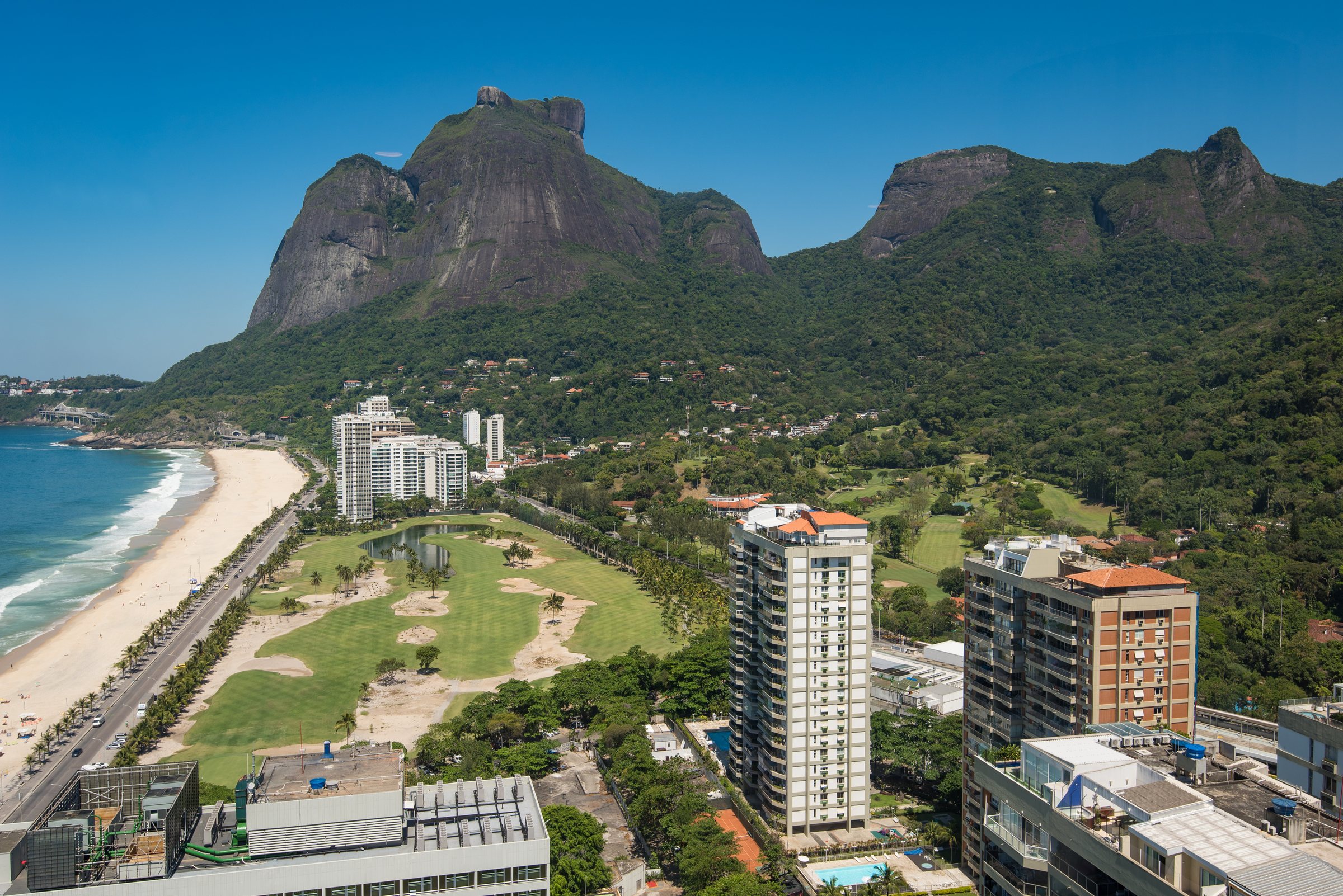
The protected Atlantic forest that climbs toward the Pedra da Gávea is the living catalogue Burle Marx spent his life reading — the aroids, bromeliads and palms he pulled into cultivation. The photograph shows the wild hillside above Joá, not a planted garden; but it is exactly the register his gardens were trying to reach.
The sítio
All of it came home to one place. In 1949 Burle Marx acquired an old estate at Barra de Guaratiba, in the far western reaches of Rio, and over the next four decades he turned its roughly three hundred and sixty-five thousand square metres into the single greatest work of his life — part garden, part laboratory, part living museum. The Sítio Roberto Burle Marx became the place where he tested every idea, grew out the plants his expeditions brought back, and assembled what became, by the late 1960s, the most representative collection of Brazilian flora in the country: today more than three and a half thousand species of tropical and subtropical plants. He donated it to the nation in 1985 and continued to work there until his death.
What the sítio proves, more clearly than any single commission, is that his gardens were never finished objects but processes — things that were meant to grow into themselves over decades, and that he tended and re-tended as they did. He could plant for an effect that would only arrive after he was dead, which is a kind of confidence most designers never earn. The estate holds the whole vocabulary in one place: the sweeping single-species beds, the water gardens, the stone he salvaged and reassembled, the shaded ravines packed with the aroids and bromeliads he loved. It is the Rosetta stone of his art, the key that makes every public promenade and private hillside legible, because here you can see the ideas at full strength and without a client to please. He was pleasing only the plants, and himself.
He died in Rio de Janeiro on the 4th of June 1994, at eighty-four. Twenty-seven years later, on the 27th of August 2021, at the 44th session of its World Heritage Committee, UNESCO inscribed the Sítio on the World Heritage List — the first modern tropical garden ever to receive that recognition, entered in the cultural-landscape category as a "landscape laboratory" where native plants were used to make, in the committee's phrase, living works of art. The decision, reported at the time by Agência Brasil, placed a garden — a thing made of plants and patience — alongside cathedrals and ancient cities on the world's short list of what must be kept. It was the formal confirmation of what Rio had understood for a generation: that the man had raised landscape to the status of art.
Gardens for the new architecture
Because he had made the garden part of the building, Burle Marx became the landscape architect of Brazilian modernism itself — the man the great architects called when the walls were up. His longest partnership was with Oscar Niemeyer. It began at Pampulha, the resort complex Niemeyer designed outside Belo Horizonte in the early 1940s, where Burle Marx laid the gardens around the curving church and casino, and it ran on through the building of Brasília, where he planted the settings for a whole capital of Niemeyer's white concrete — the ministries, the gardens of the Itamaraty Palace, the mineral-hard plaza the army building looks onto. The pairing was almost inevitable: Niemeyer's free-flowing curve in concrete and Burle Marx's free-flowing curve in planting were the same instinct, worked in two materials.
What that collaboration established, and what filtered down from the ministries to the private house, was a grammar. The modern carioca building — flat-roofed, glass-walled, open to the air — needed a landscape that would meet it as an equal rather than hide it behind topiary. Burle Marx supplied it: the sculptural massing, the water read as abstract shape, the native canopy that gave shade and privacy without a single straight line. Every architect building on Rio's hillsides after him inherited that language whether they had met him or not. It is the reason a modernist house and a wild-seeming tropical garden look, to the carioca eye, like two halves of one idea — the theme this journal follows into the present in The Contemporary Carioca Villa.
His reach did not stop at Rio, or at Brazil. Over a career that ran past sixty years he worked on commissions across the Americas and into Europe, and his studio produced gardens and public spaces by the thousand — the figure most often given is more than three thousand across his lifetime, according to the landscape historians at The Cultural Landscape Foundation. But the centre of gravity was always the tropical coast he came from. He understood, better than the foreign modernists who admired him, that a garden is a local argument: it is made of a particular place's plants, answering a particular place's light and rain and slope. A Burle Marx garden in Rio is not a style you could airfreight; it is Rio, composed. That is exactly why his influence took root so completely on the carioca hillsides, and why it reads as native there in a way it never quite could anywhere else.
The private gardens of the great houses
The public promenades and parks are what put Burle Marx in the encyclopaedias, but his deepest mark on a place like Joá is more intimate. He and the office that carried his name also designed private gardens — for the modernist houses going up on Rio's western hillsides, where a client with the means could commission the master of the tropical garden to plant the ground around a new villa. Those private commissions are, by their nature, harder to document than a public park; they sit behind gates, and the record of them lives partly in the memory of the families who own them and partly in the property press when a house changes hands.
Joá, which is an open bairro of the city rather than a closed compound, is precisely the kind of hillside where this happened. The clearest example to reach the public record is the Joá mansion long associated with the presenter Márcio Garcia: in the coverage of its sale, the landscaping is reported — on the owner's account — to have followed a plan originally laid out by Burle Marx, with palms, mango, coconut and almond trees arranged to his design and a kitchen garden folded into the scheme, as described by outlets including CNN Brasil. It is worth marking the caveat plainly: this is a reported attribution, the kind of claim that circulates with a valuable property and is difficult to verify from the outside. It should be read as press reporting, not as a catalogued work.
It is not the only such house on the hill. A separate 1980s villa in Joá, put up for sale more recently, has been marketed on the strength of a garden said to have been designed by Burle Marx — a listing covered by the Rio press, among them Diário do Rio. Whether or not any single one of these attributions would survive a scholar's scrutiny, the pattern itself is the point: on the great hillsides of the western Zona Sul, a Burle Marx garden is the landscape equivalent of a Niemeyer roof — the name a house reaches for to say that its ground, too, was taken seriously. That the claim carries a premium is itself the measure of his standing. The roster of who lives on that hillside now, and what their houses are worth, is its own subject in Who Lives in Joá.
What the villa inherits
You do not need a documented Burle Marx plan to live inside his idea. His real legacy in Joá is not a signature on a handful of gardens; it is the assumption, now so settled that no one questions it, that the right setting for a great carioca house is not a lawn but a piece of forest — that the garden should feel less designed than uncovered, as though the house had been set gently into vegetation that was already there. The heavy native canopy that gives shade and privacy at once; the planting massed for the eye rather than clipped into shape; the ground read as part of the architecture — all of it descends from the man who walked into the Dahlem glasshouse in Berlin and recognised his own country on the other side of the glass.
This is the inheritance a hillside villa in Joá lives on. The tropical garden that wraps such a house — screening it from the road, opening it to the Atlantic, holding the line between the built and the wild exactly the way the whole neighbourhood does — is Burle Marx's argument made small and private. It is the reason a house here can feel at once modern and rooted, sheltered by forest and aimed at the sea. For the wider collection that keeps this way of building alive, see Art de Vivre; and for how one house on the Joatinga headland gathers the theme into a single address, the Art de Vivre journal is where the thread continues. Everything above the garden wall is view. Everything inside it is the quiet, deliberate wildness that a painter taught a country to plant.
Where the modernist house and the tropical garden meet in the present, in the villa built for it: The Contemporary Carioca Villa.