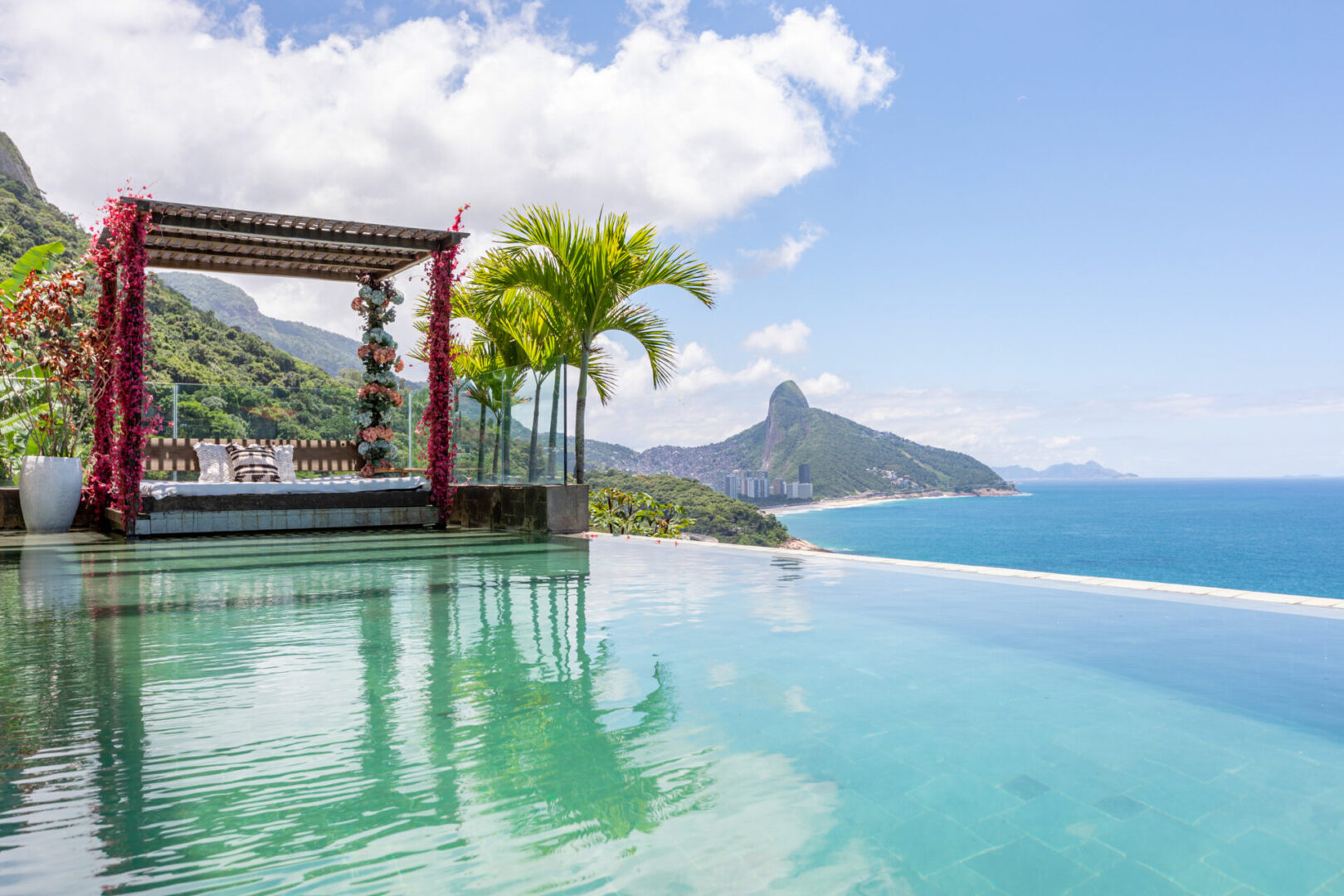
The first thing people say about an infinity pool is that the water looks like it stops. It does not stop. It goes over the edge, all day, on purpose, and everything interesting about the detail is what happens to it after that. A vanishing edge is not a finish. It is a piece of hydraulic engineering wearing a very good suit, and on a cliff it is the part of the house that is doing the most work at any given moment.
Joá Rio is published from ADV101, a five-suite villa in Joá offered at R$ 15,000,000, shown privately by appointment through Art de Vivre.
Ask about a viewing on WhatsAppThis is worth understanding before you buy a house with one, because the edge is expensive to build, expensive to run, and the three ways it goes wrong are all invisible in a photograph.
The mechanism, in one paragraph
A conventional pool holds its water level a little below the coping and skims the surface through a few skimmer boxes cut into the wall. An infinity pool does the opposite. One wall — the one you look over — is built fractionally lower than the other three and finished dead level. The water is pumped to sit slightly above that lip, so it spills over the whole length of it in a sheet perhaps a millimetre thick. Behind and below the wall, hidden from the deck, is a second tank: the catch basin, or balance tank. The spilled water lands there. A second pump lifts it back into the pool. That loop never stops while the effect is running.
So an infinity pool is two bodies of water, not one, and two pump circuits, not one. The illusion is entirely a function of the lower wall being perfectly level and the return pump keeping up with the spill.
Why the level matters more than anything else
The weir has to be flat to within a couple of millimetres across its whole run. If one end sits low, the entire sheet finds that end and you get a waterfall in one corner and a dry lip everywhere else. There is no way to correct this later with equipment; the fix is structural. This is the reason a vanishing edge costs what it costs — it is a demand on the concrete work and the tiling, not on the plant room.
It is also why the detail is more common on rock than on soil. A pool anchored into competent rock will hold its geometry. A pool on fill will settle, and a weir that settles a few millimetres has lost the effect it was built for.
“The edge has to be flat to within a couple of millimetres over its whole length. That is a concrete problem, not a plumbing one.”
The catch basin is the part nobody looks at
Sizing the balance tank is the other half of the design. It has to hold the volume that is in transit over the edge at any moment, plus the surge when four people get into the pool at once, plus enough reserve that the return pump never runs dry. Undersize it and the pump cavitates and the tank overflows when the pool is used. Oversize it and you have paid for a concrete box and a larger volume of water to treat.
The basin also becomes the first place problems show. It is where debris collects, where the auto-fill valve lives, and where you find out that the edge is losing more water than it should.

Three failures, in order of how often we see them
Wind loss. An exposed edge on a cliff throws spray. On a breezy afternoon a vanishing edge can lose noticeably more water than a conventional pool of the same size. This is normal, it is not a leak, and the auto-fill handles it — but it shows up on the water bill.
Scale on the weir. Hard water leaves a white line exactly where you look. It has to be taken off by hand, on a schedule.
The return pump. It runs whenever the effect runs. It is the shortest-lived component in the plant room and the one to ask about the age of.
What it costs to run
Two pumps instead of one, and the second is on for as long as you want the edge to be doing its thing. Most owners of oceanfront houses run the effect on a timer rather than continuously — morning through evening, off overnight — which cuts the electricity meaningfully and costs you nothing, because nobody is looking at the pool at three in the morning.
Salt air adds its own line. On the Atlantic, the plant room, the fixings and the lighting all need to be specified as marine-grade or they will not see out five years. That is a decision made once, at build, and it is worth asking whether it was made.
What to ask on a viewing
Ask to see the plant room. It tells you more about how a house has been kept than any room upstairs. Ask where the balance tank is and whether it has ever overflowed. Ask when the return pump was last replaced. Ask whether the edge is tiled or finished in stone, and who takes the scale off, and how often.
And then stand at the far end of the pool and sight along the weir. If the sheet is even from one end to the other, the concrete was done properly, and that is the expensive thing you cannot buy later.